



Weapon Retention on the Ground
If you unexpectedly end up on the ground, you will be forced to make aggressive efforts to retain your firearm. Unfortunately, many law enforcement trainers focus on standing weapon retention techniques, which creates a training gap that leaves officers vulnerable when they find themselves in a ground fight.


Working in law enforcement, you may at any moment have to defend yourself from a gun takeaway and literally fight for your life. According to FBI statistics, 46 officers were killed with their own firearms in the decade between 1998 and 2007. Every assault on an officer is a potential gunfight.
If you unexpectedly end up on the ground, you will be forced to make aggressive efforts to retain your firearm. Unfortunately, many law enforcement trainers focus on standing weapon retention techniques, which creates a training gap that leaves officers vulnerable when they find themselves in a ground fight.
To make matters worse, there has been a surge of interest and involvement in the sport of mixed martial arts in recent years. It seems you can't channel surf without seeing a TV commercial for the next MMA cage fight. This mass appeal has led to a rise in the number of criminals who have studied mixed martial arts. This trend concerns law enforcement because one of the key elements of MMA is the ability to take your opponent to the ground and control or beat him through the use of brutal tactics and techniques.
Now more than ever, you are at risk from suspects who are trained in ways to take you down and might try to take your firearm. The following principles, techniques, and training methods will help you retain your gun when the fight hits the ground.
Principle 1
If you are taken to the ground, first make every effort to maneuver to your back. It is more difficult to defend a gun takeaway if you are face down on the ground.
Once on your back, create a good amount of space between your head and the suspect's head. Push the suspect's head away with one arm and continue to push it alongside your body or toward your feet. You can also use your feet to help push the suspect away and move most of the suspect's weight off of you. This will give you the space you need to move your firearm away from the suspect's reach and get into a balanced seated position. Then push yourself onto your feet and into a solid fighting stance. At that point, reassess what needs to happen next.
There are several reasons why this option works. Most of your weapons systems are carried on your duty belt. Most training is conducted from a standing position, not seated or prone, so most officers feel comfortable using hands-on skills from their feet. When the fight hits the ground unexpectedly, your primary goal should be to create space, get back to your feet, and reassess the situation.
Principle 2
If the suspect places most of his weight on your upper torso, you may be unable to create enough space to stand up, disengage, and reassess. In this case, use your arms and hips to push the suspect away.
Drive your hips vertically into the air to explosively create a "bridge." At the top of the bridge, turn onto your gun side shoulder and use both arms to push the suspect's weight alongside of you. Finish the technique by moving your hips away from the suspect, sitting up, and then standing up to reassess. This series of movements is a little more complicated than those in Principle 1. However, it is a good backup technique if a suspect gets a good amount of weight on top of your hips and or upper torso.
Principle 3
If you end up on the ground and have a hard time executing Principle 1 or 2, lying on your gun is the simplest way to retain your firearm on the ground. Then look for "pain inflicting" options to make the suspect reconsider his attempt to take your firearm.
Consider the following techniques:
Draw a secondary weapon.
Gouge or poke an eye.
Bite a sensitive area on the body.
Elbow the eye socket, temple, or neck.
Dislocate the pinky finger.
Grab, squeeze, or strike the groin.
While we do not consider these "primary methods" of ground defense, they can be an effective set of tools to employ when the suspect demonstrates his intent to disarm you. After you have effectively employed these techniques and forced the suspect to let go of your weapon, return to the same goals as Principles 1 and 2: Create space, stand up, and reassess the situation.
Training Methods
To help you develop these principles and techniques into muscle memory, consider the following training methods.
Training Method 1
Learn and practice these basic techniques with your eyes open. Spend 15 to 20 minutes practicing the techniques to get an overall feel for the technique. As with any new physical endeavor, there will be a short period of familiarization as you overcome the awkward and uncomfortable feelings that are normally associated with learning new techniques. Use this process to develop the technique to a level where you don't have to think about using it.
Training Method 2
Practice these basic techniques with your eyes closed. The goal of this exercise is to develop the technique to the point where you feel the correct arm positioning. This is important because feeling is faster than thought. In other words, if you have to think about it, it is already too late. If you feel something, you won't have to think about it. You can just act.
Training Method 3
Consider a new training regimen. Instead of waiting for quarterly defensive tactics training, why not conduct defensive tactics training every shift? This is not to say that every shift should include intense training where injuries can occur or where officers will perspire. Rather, view a 60-second video or conduct a short hands-on training session. Just one minute per day can add up to more than four hours of training each year, in addition to quarterly training. Also consider sharpening your defensive tactics training with a good martial arts instructor who will tailor techniques to the specific needs of your current assignment.
These concepts will give you the tools to not only survive a violent suspect encounter, but to win it decisively. A series of short videos demonstrating these and other techniques can be found at http://www.harrisacademy.tv/le/20pm09.html.
Roy Harris is a fourth degree black belt in Brazilian Jiu-Jitsu and a member of the Martial Arts Hall of Fame.
Mike "Ziggy" Siegfried is a detective with the San Bernardino County Sheriff's Department and a subject matter expert in defensive tactics.
More Patrol

Team Wendy Introduces the EXFIL Endurance Ballistic Helmet, Engineered to Reduce the Burden of Extended Wear
Team Wendy has launched its EXFIL Endurance, a new lightweight ballistic helmet engineered to deliver protection, comfort, and fit during demanding, extended operations.
Read More →
The First Responders Children’s Foundation National First Responders Day Roll Call of Heroes Ceremony Returns to Times Square, NYC
First Responders Children’s Foundation (FRCF), in collaboration with T-Mobile, will host the Roll Call of Heroes ceremony in Times Square to commemorate National First Responders Day on Wednesday, Oct. 28. During the event, FRCF will present 18 Hero Awards.
Read More →
Streamlight to Showcase Newest Lighting Products for Law Enforcement Professionals at IACP 2026
Streamlight will showcase its newest lights for law enforcement at the International Association of Chiefs of Police Annual Conference & Expo. Featured lights will include the TLR-3 X, the PolyTac 1X, and more.
Read More →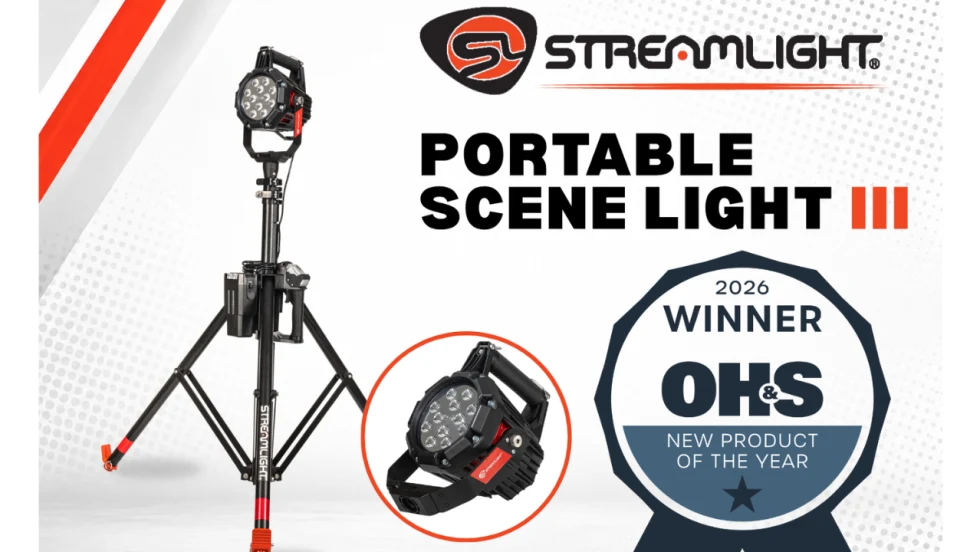
Streamlight Portable Scene Light III Wins 2026 OH&S New Product of the Year Award
Streamlight’s Portable Scene Light III has won the 2026 Occupational Health & Safety (OH&S) New Product of the Year Award in the Lighting category.
Read More →
Adept Armor Introduces Two New Rifle Plates
Adept Armor has launched two new Level IV ballistic plates, the Emperor and the Archon Mark 2, which brings Adept Armor’s new Quatroid ceramic to the high-threat, performance-value center of the range at 5.2 pounds.
Read More →
POLICE Product Test: Benchmade Bailout
The Benchmade Bailout is a slim, lightweight carry knife with a deep-ride pocket clip and comes in a variety of blade steels and scales. Here is a detailed review of the Taiga Green Bailout, released earlier this year.
Read More →
NLEOMF Announces July 2026 Officer of the Month
NLEOMF honored a Michigan deputy sheriff as the July 2026 Officer of the Month for rescuing a trapped driver from a burning vehicle following a Fourth of July crash.
Read More →
Streamlight to Showcase Newest Lighting Products at National Safety Council’s Safety Congress & Expo 2026
Streamlight will showcase its latest lights, including the Portable Scene Light III and the LiteBox 1Million, at the 2026 National Safety Council (NSC) Safety Congress & Expo.
Read More →
The 2027 World Police & Fire Games Set for Perth, Australia
The 2027 World Police & Fire Games (WPFG) will take place in Perth, Western Australia, from Friday, March 12 through Sunday, March 21, 2027.
Read More →
5.11 Partners with National Fallen Firefighters Foundation to Support #ForThe343
5.11 has joined the nationwide movement honoring the 343 New York City Fire Department firefighters lost on Sept. 11, 2001.
Read More →