



Tales of the Occupation
The Occupy protestors have been willing to forego "nine-to-five" picketing in favor of setting up camps on public land. And that has presented two major problems for law enforcement: crime within the camps and civil disobedience once the protesters are legally ordered to disperse.

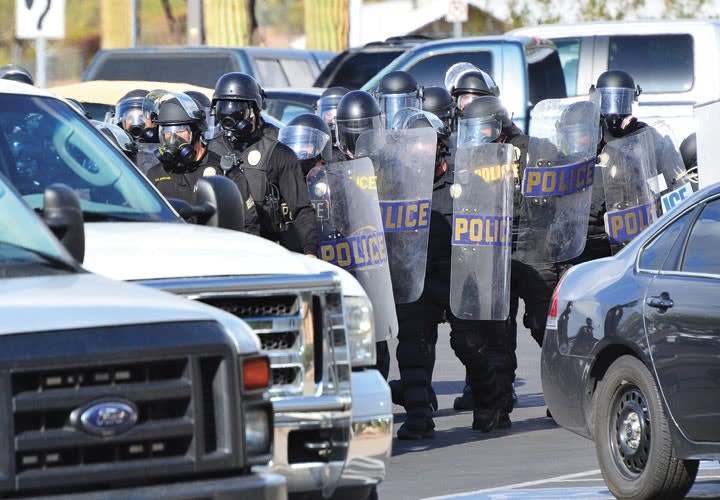
Photo: Mark W. Clark
The Occupy Movement protests—the 99% vs. the 1% in Occupy terms—commenced last September in the Wall Street financial district and soon spread across the nation. Targeting Wall Street, banks, CEOs, and the federal reserve system, its signature tactic has been a willingness to forego "nine-to-five" picketing in favor of setting up camps on public land. And that has presented two major problems for law enforcement: crime within the camps and civil disobedience once the protesters are legally ordered to disperse.
Protestors have been victims of sexual assaults and batteries, often by fellow protestors. Within the shadows of one camp a man was murdered; others have been found dead in their tents, one as a result of carbon-monoxide poisoning. In Houston, a police officer shot and wounded a gunman who threatened Occupy Houston protesters.
Occupiers have also been hurting the very working people whose causes they are ostensibly trumpeting. Pedestrians on their way to work have been swept up in protesting crowds and arrested. Protests at ports have negatively impacted other innocent citizens, causing dock workers and truckers to miss work and pay. Refuse left in the wake of occupy camps, including trash and human waste, put constraints on public works and discouraged families from frequenting favorite parks and restaurants.
And once cities and citizens have had enough of the Occupy Movement, they have demanded that their local governments clear the camps. So there have been numerous clashes between Occupy protesters and law enforcement.
A Tale of Two Dozen Cities
Rich Roberts, public information officer for the International Union for Police Associations (IUPA), contends that there should be no basis for conflicts between police and the Occupy Movement. "Where demonstrations are orderly, police don't have to interfere," Roberts notes. "It's only when protestors become disorderly and disrupt the lives of other citizens that the police have a sworn duty to respond according to the general orders of their department."
Unfortunately, not all forms of protest have been in compliance with the law. The manner of dissent being exercised deviates substantially from the kinds of civil protest and acts of civil disobedience advocated by the likes of Gandhi, Thoreau, or Martin Luther King. The ensuing skirmishes between cops and protestors have resulted in injuries to each, as well as third parties, and mutual finger-pointing in their aftermath does little to enhance either's standing in the PR war.
What many cops say has complicated law enforcement's ability to keep the peace is the positions of their local governments, which seem to change with the political wind. Mayoral vacillations have seen protestors granted permission to set up camps, only to find it rescinded, then reinstated still later.
"You have these gutless, pandering politicians and gutless police administrators who are, in effect, politicians," asserts retired California Highway Patrol officer Dave Hollenbeck. "Rule number one for them is, 'Never offend anyone who can have an effect on your career.' To them, the next promotion is more important than any subordinate's or citizen's safety."
The Oakland Experience
Whatever the impetus for their actions or inactions, SWAT consultant and retired Cleveland SWAT sergeant Bob O'Brien says evidence of municipal meddling is never in short supply.
"Look at Oakland," O'Brien says. "They were extremely successful in dismantling the camp the first night. But the very next day the mayor allowed the protesters back in, and that same night all hell broke loose."[PAGEBREAK]
Oakland's experience is hardly unique-similar missteps have occurred in Los Angeles and elsewhere. But Oakland perhaps best illustrates how disparate issues are complicating law enforcement's ability to deal with the Occupy phenomenon and perhaps future protests.
In the decade before the Occupy Movement, Oakland was the scene of several high-profile incidents, including the murder of four officers by Lovelle Mixon and the shooting of an unarmed black man by Bay Area Rapid Transit police officer Johannes Mehserle. Millions of dollars paid out behind a variety of force-related lawsuits only further compromised the city's budget. The results have been devastating to the Oakland Police Department.
The Oakland PD is 600 officers down, saddled with increasingly limiting force policies, and subject to a dissatisfied federal oversight committee. This decimated force has repeatedly been forced to call upon mutual aid resources that, as de facto agents of the Oakland Police Department, become active participants in problems that are at once uniquely Oakland's and already rife with potential lawsuits. These confrontations have resulted in injuries to two war veterans among the protesters and more disastrous public relations for the Oakland PD.
A Leaderless Movement
Even those who might side with the Occupy movement are questioning its tactics.
Jim Huffman, dean emeritus of Lewis and Clark Law School, is an advocate of civil disobedience as a political strategy. But writing for Dailycaller.com, Huffman notes that it is the movement's self-defining tactic of occupying venues for protracted periods of time that has found initially sympathetic mayors such as Michael Bloomberg in New York City and Sam Adams in Portland, Ore., re-evaluating their postures and rolling up the welcome mats. "In foregoing parade permits and marches in favor of establishing tent cities in violation of city ordinances the OM is violating laws that by any objective standard could hardly be called unreasonable," observes Huffman.
The movement's doctrine that "We really are all equal, no one above, and no one below" has also proven problematic for law enforcement. There are no designated leaders. Therefore there is no one in authority and no one for law enforcement officials or city government to negotiate with.
Worse, people claiming to be in charge could just be deluded. Valerie Krull, who participated in Occupy Olympia (Wash.), wrote: "We do not throw people away because they are addicts, or have mental health issues, or have any other aspect that makes them challenging to work with."
Violence and Anarchy
A few deluded homeless guys claiming to be in charge is one thing. But there's a darker side to the "come one, come all" philosophy reported by Krull. It welcomes people with many different agendas, including anarchists.
The movement's darker side has found creative expression ranging from 48-page police-brutality coloring books, to YouTube videos warning NYPD officers of forthcoming reprisals, to flyers advocating an occasional need to kill cops. The discovery of a weapons cache in Zuccotti Park following the dispersal of Wall Street protesters suggests there are those who consider acting on that perceived obligation.
Threats aside, IUPA's Roberts finds the Occupy Movement already culpable in hurting law enforcement in three key areas.
First, it is exhausting critical resources that are already very limited. "In every city where this has taken place, you've seen increased amounts of overtime-this at a time when police departments all over the country are facing cutbacks. They are damaging the departments financially right off the top," Roberts says. The damages stem from more than the expenditure of overtime. In Los Angeles, a city already more than $70 million in debt, Occupy-related costs in police operations and clean-up efforts were already well over $2 million by early December.
Second, not only do the demonstrations put their participants at a higher risk, but the public is increasingly endangered as many police officers are pulled away from their regular public safety duties.
Finally, it puts officers at risk because that kind of overtime in those kinds of intense situations leads to significant fatigue. "Fatigue is very dangerous to the police officer because it has a diminishing effect on their thinking processes," asserts Roberts. "This is particularly dangerous any time they're obligated to make a split-second decision."[PAGEBREAK]
Strategic and Tactical Responses
That law enforcement's response to the Occupy Movement has been seemingly schizoid at times is, to some degree, understandable. Certainly, appraisals of its responses have been similarly dichotomous, with some characterizing police arrests as precipitous, or their reticence to engage as too soft and lenient.
One West Coast police officer sums it up thusly: "We as the police will be damned if we do and damned if we don't. If we're too hands-off and permissive, it gives the impression that we're ineffective and it emboldens those people in the crowd who might have an interest in exploiting that perceived weakness. On the other hand, if we're too heavy handed, then actions that we take will be misconstrued, mischaracterized, videotaped, and broadcast or cybercast out of context, and we'll take a beating in the press and in the court of public opinion."
The less than homogenous response within the law enforcement community is also predictable, given the varying geo-political environments impacted and the lead-time law enforcement agencies have in confronting OM-generated problems.
Brian Muller, of the Los Angeles County Sheriff's Department, notes that the Occupy Movement's proclivity for spontaneous action is a huge concern.
"There is a difference between an 'event' and an 'incident,'" explains Muller. "An event is pre-planned. There is time to gather intel, exploit open source information sources such Facebook and Twitter, and decide what personnel and gear you want in place ahead of time. Within LA County, when we have an OJ verdict coming or a Rose Parade protest, the affected stations coordinate with our Emergency Operations Bureau ahead of time. We know what's coming. But an incident is something that is spontaneous. You don't have as much lead time to get your resources in place. And unfortunately, much of law enforcement's responses to the Occupy Movement protests have been the results of an incident type of behavior."
Tactical Response
One law enforcement tactic that has elicited howls of protest from Occupy proponents has been infiltration of the movement's ranks by undercover officers.
Rich Rosenthal, chief of the Wellfleet (Mass.) Police Department, doesn't feel their pain. "Not to have used officers in an undercover capacity would have been irresponsible," notes Rosenthal. "There was a threat-indeed, the likelihood-of criminal activity. To place uniform officers directly into that environment would have been neither prudent nor useful in the prevention of civilian injuries."
Ultimately the very nature of its oxymoronic title has found all activists associated with the Occupy Movement being asked, then ordered, to vacate venues en masse. Where push has come to shove, a variety of tools have been called into play. One device finding increasing subsidy within law enforcement circles: Sonic blasters.
Previously deployed at G-20 protest rallies and elsewhere, Long-Range Acoustic Devices are enjoying a jump in sales. Emitting beams of sound with laser-like intensity, a "low end" model is capable of generating 137 decibels. Higher end models such as the LRAD's 500X model can reach 149 decibels. Company spokesperson Robert Putnam told the Associated Press that the sound at close range causes most people to experience discomfort, cover their ears, and move away.[PAGEBREAK]
Raymond DeMichiei, deputy director of the Pittsburgh Office of Emergency Management and Homeland Security, says his agency supplied the LRADs to Pittsburgh police for the G-20 summit, and he's never seen a better device for communicating with an unruly crowd.
While there have been criticisms of law enforcement's responses, not all the news has been bad; some observers have even been complimentary of police tactics.
James Lafferty, executive director of a human rights bar association facilitating public demonstrations, is on record as saying, "I think it's a credit to the Los Angeles mayor and city council to get ahead of this whole movement by discussing at a time what it was about and what they wanted to achieve."
Police and Movement members haven't always found themselves on opposite sides of the fence. Cops sympathetic to the cause are represented by occupypolice.org, and Occupy Atlanta went to bat for a DeKalb County police officer in mobilizing a protest on his behalf when his house became subject to foreclosure.
Nor has every impasse between protesters and civic government resulted in confrontations. Declined an extension to their permit to protest on government property, Occupy Des Moines in Iowa simply moved its message elsewhere.
Future Implications
The hard truth is that many in law enforcement wish the Occupy Movement would just go away. Bob O'Brien notes that most of the occupy movements in colder climates have slowed down considerably, if not phased out of existence. But while such weather can have a literal chilling effect on fair-weather activists, one cannot count on inclement conditions as a fail-safe in dealing with the movement's protesters.
O'Brien sees the Bay Area protest as the epicenter of the movement's hijacking by anarchists. Whatever legitimacy the movement may have had initially has been compromised by large numbers of homeless people and a long-standing entrenchment of radical activists and anarchists endemic to the area.
"One lesson to be taken out of the Bay Area situation is that if you take action, you can effectively be on your own," O'Brien says.
No matter where their individual sympathies might lie, law enforcement officers are caught in the middle. Law enforcement vis-a-vis their employing municipalities need to recognize that there are factions involved that will remain unappeasable. In an ideal world, one would be able to drive a permanent wedge between sincere members of the Occupy Movement and those who have insinuated themselves among its ranks; notably, hackers and anarchists. Unfortunately, ideological commonalities and the talents that such groups bring to the tables make them tempting allies for one another. When problems occur, Occupy Movement members can insulate themselves by distancing themselves from the crimes committed, and those cloaked in cyber anonymity and face-shielding hoodies are content to assume a collective blame while not being held individually responsible.
Given their sometimes questionable means of making their grievances known, one tactic would be to wait for the Occupy Movement to effectively self-destruct. This could prove a costly patience. For one, there is no guarantee that the movement will not correct its missteps; for another, there is no promise that someone will not still step forward to fill the "leaderless void." Already there are grumblings from many of its members that the movement's mission is too diffused and ungoverned to generate any long-term success and will ultimately only foster resentment toward it and its various off-shoots.
A USA Today poll determined that one out of five Americans supports the Occupy Movement. That 20% may well diminish should the Occupy Movement continue its scattershot approach to things. Even the Occupy Movement itself must eventually reconcile the fact that its protests continue to fiscally erode an infrastructure from which it often seeks financial redress in the forms of lower tuitions and public assistance.
Perhaps the greatest significance of the Occupy Movement lies not in its successes or failures but in its heralding of a new era, an era where protestors can be galvanized, organized, and deployed in short order.
Some departments see the writing on the wall and are gearing up accordingly.
Fearing a rehash of the disastrous Chicago Democratic National Convention of '68, Charlotte, N.C., officials are taking steps to insulate the city when it hosts the DNC this summer. Measures include passing an ordinance that would make occupying downtown spaces with tents a "public nuisance." Padlocks, camping equipment, and "noxious substances" would likewise be banned. Nearly 1,700 officers in the Charlotte-Mecklenburg area are participating in riot training and familiarizing themselves with tools that have already been deployed at other OM venues: TASERs, capsicum-based weaponry, long-range acoustic devices, water cannons, armored fighting vehicles, police dogs, and mounted police on horses.
Whether or not tents are to be found this summer in Charlotte, Occupy Movement members anticipate that thousands of like-minded citizens will make their presence known. "Charlotte has a target on it," asserts one.
As of this writing, many OM camps are skeletally represented in the form of a largely homeless demographic that hasn't the recourse of more fair-weather
constituents.
But as winter gives way, police administrators may find themselves wondering if clocks aren't the only things to have fallen back and sprung forward.
More Patrol

Adept Armor Introduces Two New Rifle Plates
Adept Armor has launched two new Level IV ballistic plates, the Emperor and the Archon Mark 2, which brings Adept Armor’s new Quatroid ceramic to the high-threat, performance-value center of the range at 5.2 pounds.
Read More →
POLICE Product Test: Benchmade Bailout
The Benchmade Bailout is a slim, lightweight carry knife with a deep-ride pocket clip and comes in a variety of blade steels and scales. Here is a detailed review of the Taiga Green Bailout, released earlier this year.
Read More →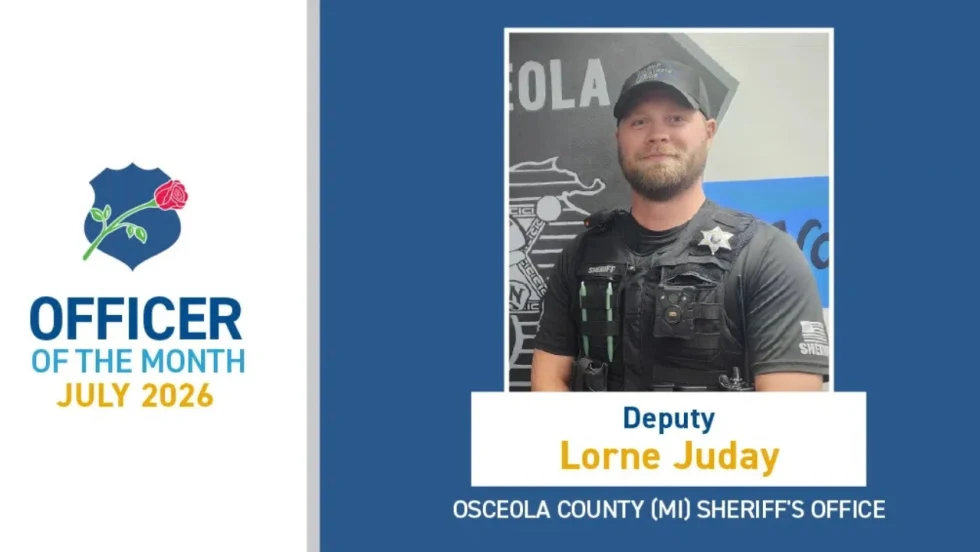
NLEOMF Announces July 2026 Officer of the Month
NLEOMF honored a Michigan deputy sheriff as the July 2026 Officer of the Month for rescuing a trapped driver from a burning vehicle following a Fourth of July crash.
Read More →
Streamlight to Showcase Newest Lighting Products at National Safety Council’s Safety Congress & Expo 2026
Streamlight will showcase its latest lights, including the Portable Scene Light III and the LiteBox 1Million, at the 2026 National Safety Council (NSC) Safety Congress & Expo.
Read More →
The 2027 World Police & Fire Games Set for Perth, Australia
The 2027 World Police & Fire Games (WPFG) will take place in Perth, Western Australia, from Friday, March 12 through Sunday, March 21, 2027.
Read More →
5.11 Partners with National Fallen Firefighters Foundation to Support #ForThe343
5.11 has joined the nationwide movement honoring the 343 New York City Fire Department firefighters lost on Sept. 11, 2001.
Read More →
Team Wendy Announces Title Sponsorship of the Jorge Pastore Foundation
Team Wendy’s 3-year partnership with the Jorge Pastore Foundation expands access to programs that strengthen those who serve.
Read More →
National Law Enforcement Memorial and Museum Hosting 9/11 25th-Year Commemoration Ceremony
The National Law Enforcement Memorial and Museum is hosting a 9/11 25th Year Commemoration Ceremony on Sept. 11 at 4 p.m.
Read More →
National Law Enforcement Officers Memorial Fund Announces June 2026 Officers of the Month
The National Law Enforcement Officers Memorial Fund (NLEOMF) named 15 officers of the Chico Police Department (California) as the Officers of the Month for June 2026 for their roles in responding to an active-shooter incident at a public library.
Read More →
Team Wendy App Creates New Digital Hub for Helmet Owners
The Team Wendy Community App provides one location for warranty registration, size-fit tools, product updates, and community connection. For helmet owners, the new app creates a simpler path to the information and tools that matter most.
Read More →