



Staying Safe on Your Second Job
If you decide you want to work an extra security job at a local business to make some extra money or just because it sounds fun, be aware of what you're taking on. And do everything you can to stay safe while working this type of job.

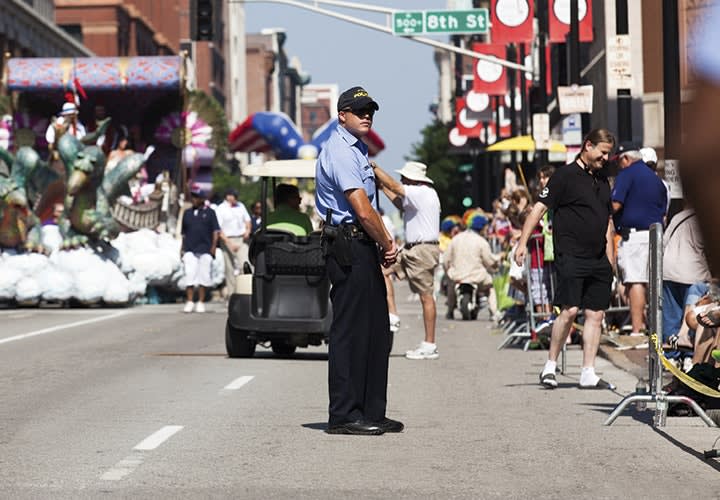
Photo: istockphoto.com
A belligerent gambler stabbed a Miami police officer in the face. A man attacked an Indiana campus police officer with a razor. A Texas police chief was shot in the head and died several days later. All of these incidents occurred in the past six months to officers who were working security jobs and technically off duty.
If you decide you want to work an extra security job at a local business to make some extra money or just because it sounds fun, be aware of what you're taking on. And do everything you can to stay safe while working this type of job.
Standing Out in a Crowd
"When officers are working a secondary job, in some situations they're even more vulnerable," warns Lt. Tom Sweeney, who oversees the Austin (TX) Police Department Special Events Unit. Many agencies require that officers wear their law enforcement uniforms when working these side gigs, which makes them stand out. While this can deter crime, it can also draw the wrong type of attention from certain individuals. And if there is only one uniformed officer working security at a venue, he or she will more than likely be greatly outnumbered.
Chief William L. Harvey of the Ephrata (PA) Police Department agrees. "Some places might not be pro-law enforcement, and if you get into a [fight], are they going to stand behind the officer?" he says.
This is why agencies put certain policies in place. It's not to keep you down. It's to protect you and to protect fellow officers from incidents that might occur at that second job.
Different from Duty Work
"Secondary employment—being allowed to work outside of your normal employment—is a privilege," says Sweeney. "If an officer wants to perform any type of secondary employment they have to get permission, whether it's being self-employed building toys or working for a movie theater doing security."
That being said, around 90% of Austin PD officer requests for off-duty jobs fall under the category of Law Enforcement Related Employment (LERE). These include jobs working security in front of grocery stores and auto dealerships, for example, and officers are expected to wear their patrol uniform, Sweeney says. Jobs involving establishments like strip clubs or collecting money or merchandise for private interest are generally not allowed.
Uniformed police officers convey more of a sense of authority than security guards, which can serve as a deterrent to crime on its own. And then there's the fact that they do actually have authority, even though they are technically off duty. It's an interesting distinction.
"They have the authority as a police officer in our jurisdiction always, they're just getting paid by that private business or arena to be there for security," explains Capt. Tom Gwaltney of the Charlotte-Mecklenburg (NC) Police Department. As the executive officer for the Support Services Group, he manages his agency's secondary employment requests. "They're not there to enforce [the business's] rules, but to enforce any state laws and federal laws that [may be violated] in their presence, and be a visual deterrent for that business."
Some departments, such as the San Diego Police Department and agencies within the Pennsylvania borough system including the Ephrata Police Department, do not allow their officers to work security jobs. They are only allowed to work special events such as parades directly through their agencies, which are considered special overtime assignments. A major reason for this restriction is liability concerns.
If you're going to work a secondary job you'll need to stay on your toes and rely on your training to maintain your own safety. "My advice is you're really going to have to know the environment, clientele, and what to expect, if that's something you want to take on," says Gwaltney. "You must remind yourself to be at an alert level depending on the clientele of the venue you're working and what that may bring."
Needing Backup
Having reliable backup is essential for safety on any assignment, including off-duty. Because of so many liability and safety concerns, most agencies require that officers not only formally request and notify management of when and where they will be working off duty, but also that they maintain contact with dispatch while working these jobs.
"Every time an officer checks in at a job, other than at a big sports complex, each individual officer must come on air over our police radio, and announce he is working this hour to another hour at a certain address. And our communications division will set up CAD numbers showing that that officer is there working that job," says Gwaltney.
This means dispatchers will be able to quickly and accurately send backup to an officer working off duty should he or she need it. But this system also helps prevent deadly errors due to miscommunication.
"The other aspect is if we have a call at that location, our patrol officers should know that one of our officers is already there, if they're already being dispatched to it," says Sweeney. "Preventing that blue-on-blue conflict is important."
Keeping track of which off-duty jobs officers are working also allows agencies to make sure they will have enough fellow officers working with them to be safe. The ideal number of officers varies based on the type of business, the area it is in, and the number of customers there.
"From time to time, I must tell an employer who wants to post a job that they must hire a certain number of officers because of alcohol sales, a higher crime area, etc.," says Gwaltney. "We'll tell them they need three officers in the parking lot from an officer safety standpoint. We look at that very closely."
Charlotte-Mecklenburg also requires its officers to work off-duty jobs within its jurisdiction so that backup is always nearby.
Spread Too Thin
Working too much or for too long hampers anyone's safety and effectiveness, and for law enforcement the repercussions can be catastrophic. This is why agencies keep track of how many hours officers work, both on the clock for the agency including overtime and at secondary employment jobs.
"We have some specific language in the policy saying, 'Employees may not engage in any employment which may render them unable to respond during an unanticipated emergency, or physically or mentally exhaust the employee to the point that the employee's performance is affected,'" says Sweeney. "An officer needs rest to be fully functional and cognizant."
Charlotte-Mecklenburg PD keeps tight reins on the process of allowing secondary employment jobs to make sure no one is pushed beyond their limits. Officers must log into a software program to browse and request any off-duty jobs. Small venues will obtain permits from the city and request a certain number of officers to work certain hours. Officers can sign up through the department's software system, but if a job would put an officer beyond the allotted number of hours per day or week, it will automatically deny the request.
"You can't double book yourself because our system is linked to our duty schedule. Officers can't sign up for something too close to their regular job," says Gwaltney. "With an 1,800-officer department, we need software to cover that."
The Austin Police Department relies on individual officers to properly report their hours worked off duty as well as to contract with local businesses to set up security jobs. However, the agency also stays involved in the processes, including running background checks on any businesses. "Supervisors review all their officers' overtime, whether departmental or secondary, to make sure everyone is staying under the 16-hour-per-day rule and the 76-hour-per-week rule," says Sweeney.
When Things Go Bad
Even when you dot every I and cross every t, things can go wrong. Harvey is currently a chief in Pennsylvania. But in 1989 when he was a sergeant at the Savannah (GA) Police Department, a young officer he had trained in the academy, Officer Mark Allen MacPhail Sr., was killed working off-duty security in uniform when he interrupted a street robbery that occurred in front of him. And the incident and its aftermath have stayed with Harvey.
MacPhail was a police officer interrupting a forcible felony, but it took a year or more for the department's chief to convince the state and the federal government to provide benefits to his wife and family because he wasn't on duty at the time, Harvey says.
"It's tragedies that have made us be cautious on this," says Harvey. "It was a very unfortunate situation. But it also made us very aware. We had guys back then working on the fly. Bad things can happen, then what happens to the family?"
This is why many agencies don't allow officers to take on LERE jobs. But it is now commonplace for those that do allow secondary employment jobs to create policies that ensure officers who get injured or worse while working off-duty jobs will be compensated.
"That's one reason we've got them in the computer system, so once an incident occurs and an officer takes action, dispatch then will create a new set of numbers and they're on duty then," says Gwaltney. "The city takes that liability on, and it's worked real well on several occasions for us."
The Right Reasons
Veteran officers recommend that anyone considering taking on secondary employment do so for the right reasons and fully understand the ramifications.
Additional work means time away from family and friends and less time to destress from the job and get needed sleep and rest. And although additional income from secondary employment can be nice, it isn't something that should be relied upon for paying bills because the jobs aren't always available. Consider, too, is the bonus cash worth additional exposure to potentially dangerous situations?
It's important also to remember that what an officer does on any off-duty job still reflects on both the officer and the officer's agency, especially if in uniform. "They really should think about the fact that anything they do in public could show up on the 5 o'clock news, whether on duty or a secondary job, and they should behave accordingly," says Austin PD's Sweeney. "The intent of the policies is to keep the officers safe, and keep them from doing things that we know historically are what get people in trouble."
That goes for jeopardizing your career and your physical safety.
More Training
Registration Underway for Sixth Annual First Responders Relay
The California Police Athletic Federation’s annual First Responder Relay will welcome first responder teams from across the globe to compete along Ventura's scenic coastline on Oct. 11. Registration is underway.
Read More →
Vector Solutions Launches Comprehensive Online Dispatch Training Catalog for Emergency Communications Professionals
Vector Solutions’ new catalog of 35 expert-developed online courses can help emergency communication centers strengthen training, meet certification requirements, and simplify continuing education.
Read More →
Tools for Active Shooter Response Training
What technologies help prepare officers for active shooter response situations? This behind-the-scenes look at law enforcement training explores shot simulators, smart firearms, laser target systems, and the tools used to build safer, more effective training environments.
Read More →
Two-Officer Tactical Doorway Entry Techniques
Entering a room during active-threat situations requires communication, coordination, and disciplined tactical movement. In this video, trainers from the United States Deputy Sheriff’s Association demonstrate critical room entry concepts, including fatal funnel awareness, team coordination, and safe tactical movement.
Read More →
High Compressed Ready Explained | Muzzle Control For Room Entry
In this video, Mike Willis, law enforcement national training and program director for the United States Deputy Sheriffs’ Association, demonstrates the high compressed ready position and discusses muzzle control during room entry.
Read More →
Why Attend the DroneSense Innovation Summit by Versaterm?
Let’s hear from Ryan Bracken, head of product, about why your agency should send someone to the first annual DroneSense Innovation Summit by Versaterm in April.
Read More →
Caswell Live Fire Spins Off from InVeris
Caswell Live Fire has spun off from parent company InVeris, coinciding with the 100th anniversary of Caswell’s founding. Over the past 100 years, Caswell has developed pioneering solutions that support military, law enforcement, and commercial clients worldwide.
Read More →
When Do You Transport a Wounded Officer Instead of Waiting for EMS?
Thumbnail for video series POLICE Topics, Tactics & Tips with a yellow headline that reads When Do You Transport a Wounded Officer Instead of Waiting for EMS?
Read More →
How to Pick Your High-Risk Stop Location for Tactical Advantage
Hear veteran trainer Mike Willis, of the United States Deputy Sheriff’s Association, explain several considerations that can help you wisely pick your best spot to initiate high-risk or felony traffic stops.
Read More →
Coffee Break with Police Experts: Using Your Patrol Vehicle for Cover
In this video, hear from Dustin Mowery, a product specialist at Team Wendy, as he discusses how to best use a patrol vehicle for cover.
Read More →