



Skin vs. Steel
Go on the offensive to defend yourself in an edged-weapon attack.

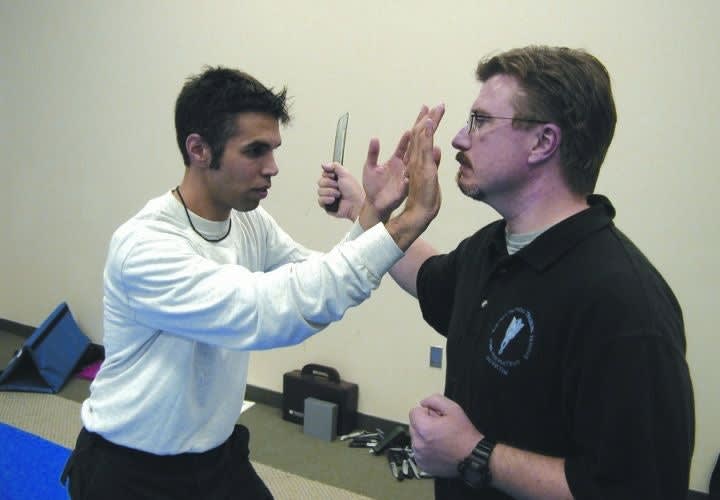
The author (left) demonstrates his technique for blocking a knife swipe while also going on the attack. Note that the block technique guards the most vulnerable arteries on the inside of the wrist and arm against the knife attack.
Some say countering a knife empty handed is ridiculous. I say jumping out of airplanes is ridiculous but people do it, and they do it well. I’ll go even further and say that, as cops, you are under constant threat of an edged-weapon attack and learning how to counter it without drawing your sidearm may someday save your life.
An edged weapon is not just a synonym for a knife. An edged weapon can be anything capable of cutting or stabbing a human being. It can be a hypodermic needle, a box cutter, a broken glass bottle, a sharpened piece of metal, and numerous household items you could encounter while responding to a domestic dispute. Officers responding to domestics have been stabbed with forks, scissors, knitting needles, tweezers, and combs, just to name a few edged weapons.
If you don’t think you should be training in how to counter edged-weapon attacks, consider the following: The bad guys are training how to kill you with blades.
Here’s a statement from a member of the Aryan Brotherhood prison gang that appeared in The New Yorker. “Knife fighting, at its best, is like a dance. Under ideal conditions, the objective is to bleed your opponent—cutting hands, wrist, and arms and as the opponent weakens from blood loss, inflicting further damage to the face (eyes) and torso.”
This quote shows the bad guy’s mindset and tactics. This gang member has studied anatomy. Most people don’t know how to protect the vital areas on the insides of their arms and legs. He does and you should, too.
The bad guys can get their hands on numerous training manuals and videos. Just look at what’s sold in martial arts magazines and over the Internet. I suggest you start studying knife fighting manuals and videos. Then learn an empty-handed system for edged-weapons defense.
Don’t Believe This Stuff
Let’s look at some popular misconceptions about edged-weapon attacks and edged-weapon defense.
Many defensive tactics trainers, including knife defense instructors, will tell you that it’s almost impossible to defend yourself against a skilled knife fighter. I’ve heard them tell their students, do whatever you can to get the hell out of there. That’s a defensive mindset and a defeatist attitude. It sets you up to lose. You can defend yourself against an attack by a skilled knife fighter, and you can do it well.
A much more dangerous misconception is the belief that the gun on your hip will always protect you from a knife attack. The FBI estimates that a motivated knife attacker can charge at you from 21 feet before you can draw and fire your weapon. Most of you probably know this.
What many of you probably haven’t considered is if you shoot a knife-wielding attacker before he or she reaches you, your bullets won’t stop your attacker’s forward momentum. Worse, unless you shoot your attacker in the head, he or she may still be able to stab you, even when mortally wounded.
Empty-handed tactics are needed to back up your firearm, especially if it misfires, becomes jammed in a struggle, or you can’t access it in time to stop an edged-weapon attack.
Be Ready
To respond to an edged-weapon attack, you have to be ready for one. If you treat all attacks as a possible edged-weapon attack this will give you a key advantage.
Often when an officer is stabbed, he or she does not see the blade. So it’s quite common for a wounded officer to think an assailant is punching him until he realizes that he’s been stabbed. The reason for this is simple; many edged-weapon attacks on officers involve tools that are small enough not to be seen in the attacker’s hand, especially at night or under low-light conditions.
Don’t forget that you are fighting a person and not the weapon. Fight your assailant or assailants, not the knife. If you break down the person holding the knife so that he or she can’t function, then that attacker and his or her weapon are no longer a threat to you or anyone else.
Remember, people holding weapons always feel that they are superior over someone without a weapon. The same goes for a group of assailants facing one person or a smaller group. This is their security blanket; you need to take it away from them. And you can do this by injuring them and breaking them down.
Knife attacks are not pretty. No matter how adept you are with hand-to-hand combat, you are likely to get cut. To win, you have to get past this.
Visualizing being cut in training will help you prepare for the reality of a knife attack. Remember, one knife wound is usually not fatal. Multiple knife wounds usually are. The lesson here is to keep fighting even after you’ve been cut.
Use your training to conquer your fear. Managing fear and stress is critical in a knife attack. Channel your fear as inspiration and don’t let it debilitate you. In physical combat, the worst mistakes are made out of fear, which results from improper training.
Block and Strike
Being attacked by an edged weapon is no different than being attacked empty handed. If the attacker jabs, you block and strike at the same time.
Too many people make the mistake of fencing or boxing with a knife fighter. Movement is sometimes your best defense. It’s hard to stab a moving target, and your movement may lead to mistakes by your attacker.
[PAGEBREAK]
There should be no difference in your defensive tactics except in your mindset that the stakes are now higher. This should make you even more focused and determined to win.
An effective unarmed response against an armed attacker must be simple, easy to remember, and easy to repeat. In the movies, you’ll see martial artists make all kinds of fancy moves to counter an edged-weapon attack. Forget that stuff. Remember, the martial artist in a movie wants to look cool. You, in contrast, want to stop an attack that could end your life.
This is why I advocate techniques that involve simple moves that can be applied in multiple situations. For example, the same move that blocks a wide knife slash or a straight thrust works against punches and other weapons. It can also be used standing or on the ground.
Look at the photo at the top of this article. The photo is static, and it doesn’t do justice to the real movements at real speed, but static photos will show you what to do better than full-speed photos.
The photo shows the man in white (the author) defending and attacking at the same time. This is the main philosophy of Wing Chun Kung Fu, which is the basis of my specialty, Bo Fung Do. Even if it’s a quick jab, you defend and attack at the same time with a palm strike, a finger jab, a kick, anything other than a closed-fist punch.
You don’t punch because your fist is weaker than your opponent’s head, and you’re not wearing wraps and big gloves. If you’re primarily a puncher, start trying to break that habit by switching to palm strikes. If you’re not sold, try this exercise. Go palm strike a wall. Now, punch it with your fist. On second thought, don’t. You may break your hand. Get the concept?
You can practice the Bo Fung Do block-and-strike move on your own or with a partner and from either side. Here’s how you do it. Stand square and step forward into the move, first left leg with left arm blocking and right striking, then left leg again with right arm blocking and left striking. Repeat this sequence while stepping with your right leg. Then practice with your left leg forward while stepping with your right and vice versa. Make sure your steps are comfortable and not too wide. And be sure to practice on uneven and slippery ground. As a cop, you can’t choose where you will be attacked.
It’s important that you visualize the attack while you practice solo. And remember, the moves don’t have to be exact as long as the concepts remain the same.
Bo Fung Do works because if you practice attacking and defending at the same time, you automatically train your response to be offensive and not defensive, active instead of reactive. Even if you’re caught by surprise this is your reaction: One hand defends, the other attacks your opponent’s face. Always move into the attack and not away from it.
Yes, escape is sometimes your best option. However, the only way you can safely move away from a knife attack is to put an obstacle or some kind of barrier between yourself and your assailant while accessing your firearm. This can be a parked car, a mailbox, or anything else that can’t be moved and the assailant has to move around.
You react under stress the way you train. There are no rules in the street. You can finger jab. You can rip and tear the body. You can break joints. Your mindset and your training need to reflect this.
Training in empty-hand defensive tactics teaches you how to relax under stress and not to rely on any security blankets. It shows you how to rely on you and you only. Always remember, your survival begins and ends with you.
Alfred Giusto is president of Portland, Maine-based Bo Fung Do Tactics (www.bfdtactics.com). He instructs officers in unarmed combat and has conducted classes at TREXPO.
Keep It Real
Your training should reflect the reality of your work in the street.
That means you should train in street or duty clothes including shoes or boots. Your training area should have mats that allow you to do this.
Also, when possible do some training outside and not just in ideal conditions. Train in cold weather, rainy weather, and icy weather or simulate as best you can. You should train blindfolded, with restrictions on body parts to simulate injuries, in cars, tight spaces, stairs, sitting down, standing, or on the ground. You should learn how to fall and roll safely and then be able to do it on concrete.
More Patrol

Adept Armor Introduces Two New Rifle Plates
Adept Armor has launched two new Level IV ballistic plates, the Emperor and the Archon Mark 2, which brings Adept Armor’s new Quatroid ceramic to the high-threat, performance-value center of the range at 5.2 pounds.
Read More →
POLICE Product Test: Benchmade Bailout
The Benchmade Bailout is a slim, lightweight carry knife with a deep-ride pocket clip and comes in a variety of blade steels and scales. Here is a detailed review of the Taiga Green Bailout, released earlier this year.
Read More →
NLEOMF Announces July 2026 Officer of the Month
NLEOMF honored a Michigan deputy sheriff as the July 2026 Officer of the Month for rescuing a trapped driver from a burning vehicle following a Fourth of July crash.
Read More →
Streamlight to Showcase Newest Lighting Products at National Safety Council’s Safety Congress & Expo 2026
Streamlight will showcase its latest lights, including the Portable Scene Light III and the LiteBox 1Million, at the 2026 National Safety Council (NSC) Safety Congress & Expo.
Read More →
The 2027 World Police & Fire Games Set for Perth, Australia
The 2027 World Police & Fire Games (WPFG) will take place in Perth, Western Australia, from Friday, March 12 through Sunday, March 21, 2027.
Read More →
5.11 Partners with National Fallen Firefighters Foundation to Support #ForThe343
5.11 has joined the nationwide movement honoring the 343 New York City Fire Department firefighters lost on Sept. 11, 2001.
Read More →
Team Wendy Announces Title Sponsorship of the Jorge Pastore Foundation
Team Wendy’s 3-year partnership with the Jorge Pastore Foundation expands access to programs that strengthen those who serve.
Read More →
National Law Enforcement Memorial and Museum Hosting 9/11 25th-Year Commemoration Ceremony
The National Law Enforcement Memorial and Museum is hosting a 9/11 25th Year Commemoration Ceremony on Sept. 11 at 4 p.m.
Read More →
National Law Enforcement Officers Memorial Fund Announces June 2026 Officers of the Month
The National Law Enforcement Officers Memorial Fund (NLEOMF) named 15 officers of the Chico Police Department (California) as the Officers of the Month for June 2026 for their roles in responding to an active-shooter incident at a public library.
Read More →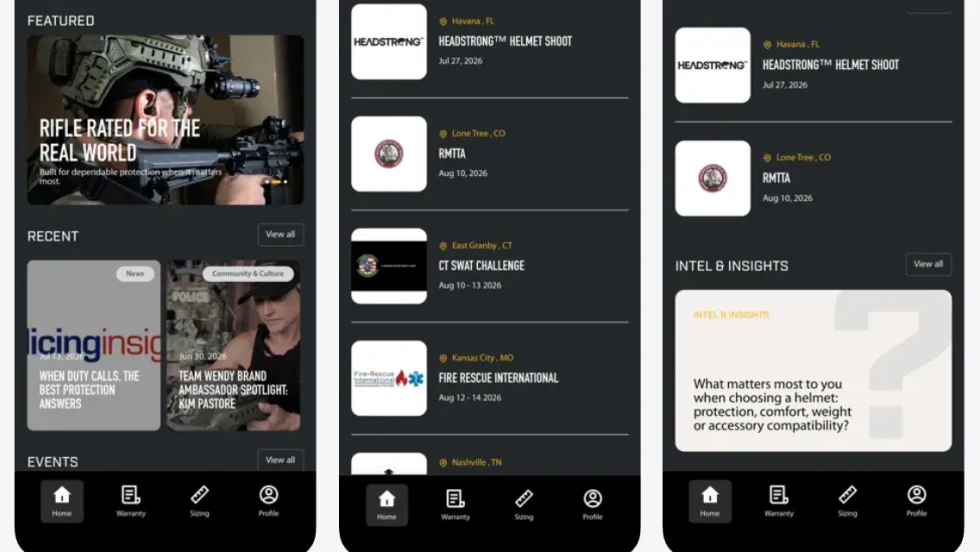
Team Wendy App Creates New Digital Hub for Helmet Owners
The Team Wendy Community App provides one location for warranty registration, size-fit tools, product updates, and community connection. For helmet owners, the new app creates a simpler path to the information and tools that matter most.
Read More →