



Proper Policing in the Land of Armed Civilians
With 42 states now allowing civilians to carry concealed firearms, there is a good chance this man is acting within the law. You will encounter, civilians legally carrying concealed firearms more often today than ever before. How you should respond is largely determined by the behavior of the civilian and the laws in your state.

You are in a convenience store and notice a man with a slight bulge under his sweatshirt bending over to pick up a loaf of bread. You think he may be carrying a concealed firearm. What do you do?
With 42 states now allowing civilians to carry concealed firearms, there is a good chance this man is acting within the law. You will encounter, civilians legally carrying concealed firearms more often today than ever before. How you should respond is largely determined by the behavior of the civilian and the laws in your state.
Illegally carrying a concealed firearm is considered a breach of the peace. In Marden v. State, for example, a police officer overtook a man who fit the description of a robbery suspect. The suspect was outside city limits and beyond the officer's jurisdiction. Upon seeing the officer, the man raised his hands, revealing a gun in his belt that had been covered by his jacket. The officer informed the man he was under arrest for carrying a concealed weapon.
The court held that the arrest was lawful because the suspect's concealed weapon constituted a breach of the peace. The officer's action in making an arrest outside his jurisdiction was justified as being within his capacity as a private citizen.
It is the responsibility of the state to determine who will be issued a permit or license to carry a concealed firearm and that each applicant meets all of the requirements before a permit is issued. In Florida, for instance, applicants are required to be U.S. residents, at least 21 years old and free from any physical infirmity that prevents the safe handling of a firearm. Permits are denied to felons and anyone who habitually abuses alcohol or has been committed for controlled substance abuse.
Applicants must desire a legal means of self-defense and demonstrate a competence with firearms (safety training). Those who have been judged incapacitated or committed to a mental institution are denied concealed firearm permits. The same holds true for applicants who have had a felony adjudication of guilt, a withheld or suspended sentence or recent misdemeanors involving violence convictions.
Most of the other states that allow private citizens to carry concealed firearms have similar requirements regarding age, firearm safety training, felony or violent crime convictions and physical and mental health conditions. Thirteen states require civilians to have a specific need for a permit. Firearms are prohibited in eight states (Illinois, Kansas, Kentucky, Missouri, Nebraska, New Mexico, Ohio and Wisconsin), as well as Washington. D.C.
Offensive Carry
Generally, carrying a concealed firearm without a permit is an offense. But there are exceptions to this rule. Most states, for example, allow a civilian to carry a concealed firearm in his or her own home. The exact areas included in the home vary from state to state, however, and may not include fenced-in property (Pierce v.State), public streets or alleys (Dunbar v. State), parking lots of multiunit apartment buildings (Sherrod v. State) or someone else's home (State v. Stanfield). A motel room, however, can be considered the equivalent of a person's home (Cockin v.State).
Another exception is that a civilian may, in some cases, carry a concealed firearm in his or her place of business. In some states, s limited to employees of businesses whose duties include the protection of money and property, such as guards and watchmen (Com. v. Walton). Other states allow a person to carry a concealed weapon at his or her place of business even if he doesn't own the business and hasn't obtained the permission of his employer (State v. commons).
And in some states, an unlicensed, concealed firearm may be carried in a motor vehicle. Others allow civilians to carry unlicensed firearms when they bring them home from making a purchase at a store, when they are moving, when going to a shooting range or for a number of other lawful uses.
Once a person has a permit or license to carry a concealed firearm, they may carry it anywhere not prohibited by law.[PAGEBREAK]
State restrictions vary. For example, Florida has a long list of places where license holders cannot carry firearms. Included are locations such as police stations, jails, courthouses, schools-including college and university facilities-nonfirearms sporting events, bars, airports and any place where carrying a firearm is prohibited by federal law. Even individuals who have a concealed firearms license may not carry a firearm to one of these restricted places.
Like many states, Georgia also prohibits firearms at public gatherings. The emphasis of such a law is on the gathering of people, not a specific place or location (State v.Burns). Law enforcement officers should be aware of persons near a gathering since the offense of carrying a firearm can occur in the parking lot or in close proximity to the gathering (Hubbard v. State).
Duty to Inform
Civilians generally have no legal duty to inform a law enforcement officer that they are legally carrying a concealed firearm. There is no offense in this, and with law abiding civilians, there is generally no danger to the officer. However, it may be a statutory duty for a civilian who is stopped, detained, questioned or addressed in person by a law enforcement officer, to immediately inform the officer that he or she is carrying a concealed handgun under a permit. In these cases, the officer may secure the firearm during the contact if he feels it is necessary for his own safety or that of others.
How do you know, in the absence of a search, commission of a crime or statutory duty to report, that a civilian is carrying a concealed firearm? You don't. Unless a civilian is careless and lets a firearm print against clothing or exposes it when clothing is pulled away, it won't be seen.
In Byford v. State, an officer saw the butt of a firearm protruding from the defendant's pocket and made a valid arrest. Likewise, an officer had the duty to arrest a suspect when the officer asked him for identification and saw a revolver in clear view when the suspect stepped from his automobile (AI/en \'. State).
Generally, a firearm is considered to be concealed if it cannot be seen by an ordinary, casual observer. It does not have to be absolutely invisible to other persons (Carpenter v. State). This applies to concealed, firearms carried on a person or in a motor vehicle.
For the offense of carrying a concealed firearm without a license or permit, an officer need not be concerned with any reason that a person gives for carrying the weapon. Feelings of a need for self-defense or duress, and the amount of force used against the person are not relevant in a charge of carrying a concealed firearm without a permit (State v. Hope). The person must prove that he or she has a license or permit (Washington v.State). Furthermore, a person's admission to a law enforcement officer that he has no permit to carry a concealed firearm is admissible into evidence (Johnson v. State).
It is an offense to fail to carry a permit or license along with a concealed firearm. You can charge a person with this offense in accordance with the specific requirements of your state statute. For example, in Com v. Sheridan, an officer found a gun while frisking the defendant. When asked, the defendant refused to to say if he had a license to carry the weapon. In that case, there was probable cause to charge the defendant.
Safety First
More states are allowing civilians to carry concealed firearms for self-protection, which means that more law enforcement officers will encounter legally-armed civilians. For the most part, these armed civilians will go unnoticed. You will probably only encounter such a person if you receive a complaint from someone who saw the firearm or a bulge in someone's clothing. In such cases, you should probably warn the carrying individual to be more careful in keeping the firearm concealed. If the civilian is in a location where such carry is not permitted, you are entitled to make an arrest.
An unlicensed person who carries a concealed firearm is a criminal. Take all the precautions necessary to ensure a safe arrest.
Donna Lea Hawley is the president of ParamountTrainingCenter and a former attorney who teaches and writes about concealed weapons and other areas of law.
More Patrol

Adept Armor Introduces Two New Rifle Plates
Adept Armor has launched two new Level IV ballistic plates, the Emperor and the Archon Mark 2, which brings Adept Armor’s new Quatroid ceramic to the high-threat, performance-value center of the range at 5.2 pounds.
Read More →
POLICE Product Test: Benchmade Bailout
The Benchmade Bailout is a slim, lightweight carry knife with a deep-ride pocket clip and comes in a variety of blade steels and scales. Here is a detailed review of the Taiga Green Bailout, released earlier this year.
Read More →
NLEOMF Announces July 2026 Officer of the Month
NLEOMF honored a Michigan deputy sheriff as the July 2026 Officer of the Month for rescuing a trapped driver from a burning vehicle following a Fourth of July crash.
Read More →
Streamlight to Showcase Newest Lighting Products at National Safety Council’s Safety Congress & Expo 2026
Streamlight will showcase its latest lights, including the Portable Scene Light III and the LiteBox 1Million, at the 2026 National Safety Council (NSC) Safety Congress & Expo.
Read More →
The 2027 World Police & Fire Games Set for Perth, Australia
The 2027 World Police & Fire Games (WPFG) will take place in Perth, Western Australia, from Friday, March 12 through Sunday, March 21, 2027.
Read More →
5.11 Partners with National Fallen Firefighters Foundation to Support #ForThe343
5.11 has joined the nationwide movement honoring the 343 New York City Fire Department firefighters lost on Sept. 11, 2001.
Read More →
Team Wendy Announces Title Sponsorship of the Jorge Pastore Foundation
Team Wendy’s 3-year partnership with the Jorge Pastore Foundation expands access to programs that strengthen those who serve.
Read More →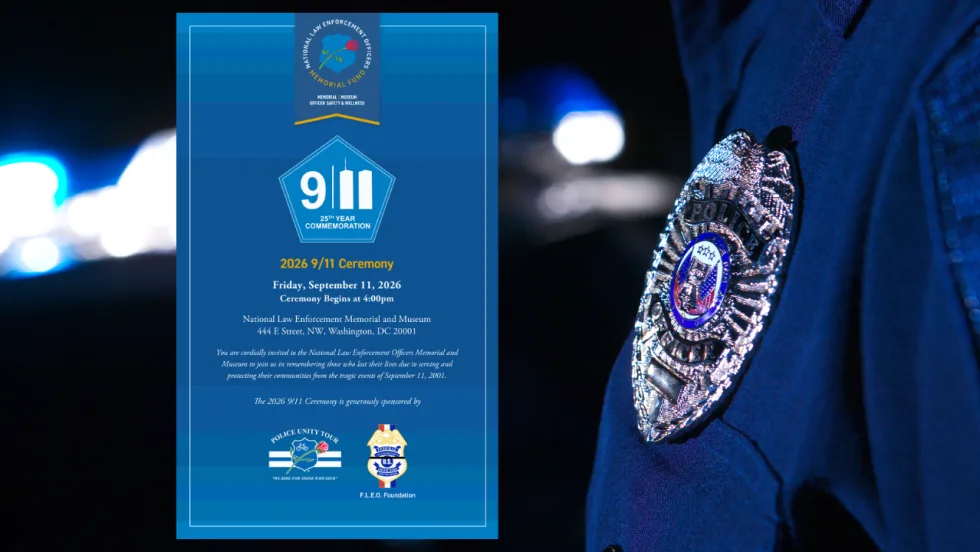
National Law Enforcement Memorial and Museum Hosting 9/11 25th-Year Commemoration Ceremony
The National Law Enforcement Memorial and Museum is hosting a 9/11 25th Year Commemoration Ceremony on Sept. 11 at 4 p.m.
Read More →
National Law Enforcement Officers Memorial Fund Announces June 2026 Officers of the Month
The National Law Enforcement Officers Memorial Fund (NLEOMF) named 15 officers of the Chico Police Department (California) as the Officers of the Month for June 2026 for their roles in responding to an active-shooter incident at a public library.
Read More →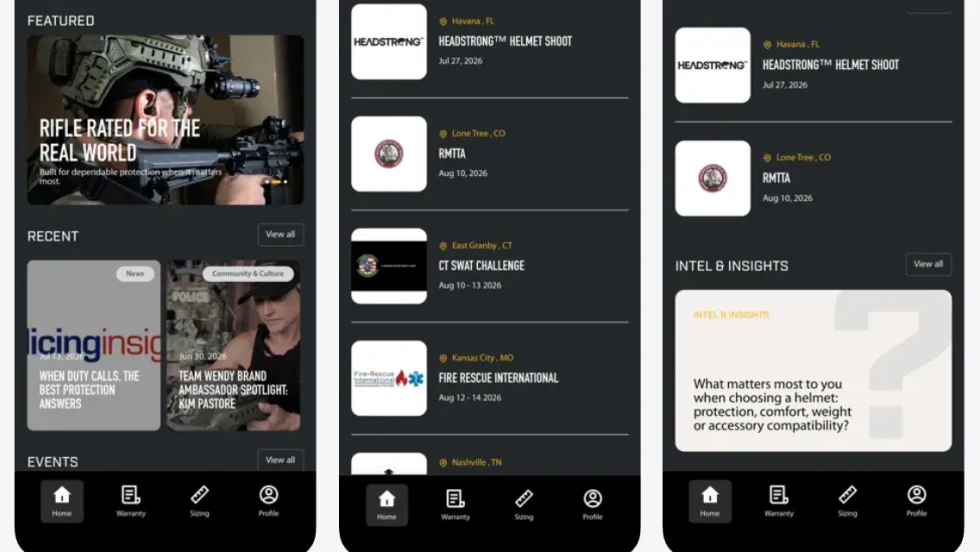
Team Wendy App Creates New Digital Hub for Helmet Owners
The Team Wendy Community App provides one location for warranty registration, size-fit tools, product updates, and community connection. For helmet owners, the new app creates a simpler path to the information and tools that matter most.
Read More →