



Dealing with Confirmation Bias
One of the biggest things you can do to correct confirmation bias is to try to disprove your theories instead of trying to prove them. It seems it is human nature to stop working once you have proven your theory to your own satisfaction.

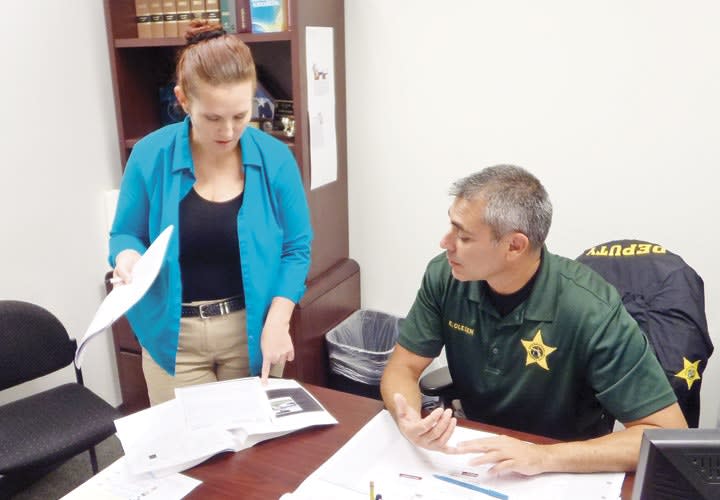
The human brain is more powerful than any computer ever made, but that doesn't mean that it's without limitation. We are subject to cognitive biases that often lead us to make questionable and flawed decisions. Since our brains hate conflict and disagreement, they go to great lengths to avoid them. For that reason we tend to go with things that agree with us and our existing beliefs.
Cognitive dissonance is the holding of two competing beliefs at once. Since this is very hard, we gravitate to one belief and disregard the other. Once we do that, we search for information and like views that prove we are right. Since nobody likes to be wrong, we tend to agree with people who agree with us. In other words, decision-making is sometimes influenced by the path of least resistance.
Confirmation bias is the tendency for people to overvalue information that supports their own beliefs. We tend to cling to views that bolster our pre-existing notions while at the same time ignoring other information no matter how valid or factual. Confirmation bias is a filter we use to see a reality that matches our own expectations. Though there are many cognitive biases, research has shown that confirmation bias is one of the most dependable mental stumbling blocks and therefore one that we in law enforcement need to be wary of.
An All Too Real Example
It is easy to see where this form of bias can create problems in law enforcement. You form an opinion, create a theory, and then you work to prove it right instead of proving it wrong. The incident involving an attorney from Oregon named Brandon Mayfield is an example that has been referenced in numerous scientific, political, and social journals. He was erroneously linked by the FBI to the 2004 Madrid train bombings in Spain.
Following the 2004 Madrid train bombings, two latent fingerprints were found by Spanish authorities on a bag containing detonating devices. The Spanish National Police shared the fingerprints with the FBI through INTERPOL. The FBI came up with 20 possible matches for one of the fingerprints from their database. One of the possible matches was Mayfield.
His prints were in the FBI system because of Mayfield's military service and from an arrest two decades earlier where charges were dropped. Despite finding that Mayfield's print was not an identical match to the print left on the bag of detonators, FBI fingerprint examiners still rationalized away the differences, according to a report by the Department of Justice's Office of the Inspector General.
In our post-9/11 world, certain details of the attorney's life convinced the FBI that Mayfield was involved. For example, Mayfield had converted to Islam after meeting his future Egyptian wife. Mayfield also performed work for the Modest Means Program of the Oregon State Bar, which matched attorneys who are willing to work at reduced rates for low-income clients. While participating in that program, he represented one of the Portland Seven, a group of men who tried to travel to Afghanistan to fight for Al Qaeda and the Taliban against U.S. and coalition forces, in a child custody case.
The FBI started connecting these circumstantial dots which in their minds condemned Mayfield as a terrorist sympathizer. The FBI arrested Mayfield as a material witness in connection with the Madrid attacks and detained him (under The Patriot Act) for over two weeks without ever being formally charged. When the FBI finally sent Mayfield's fingerprints to the Spanish authorities, they disagreed with the FBI's findings. The Spanish authorities also informed the FBI they had other suspects in the case, not linked to anyone in the USA. The FBI completely disregarded all of the information supplied by the Spanish authorities and proceeded to focus on Mayfield anyway.
There is no doubt in my mind that confirmation bias played a major role as case agents in the FBI worked hard to prove Mayfield was their man. An FBI internal review would later acknowledge that there were serious errors in their investigation which resulted in Mayfield receiving a formal apology and a $2 million lawsuit settlement.
How to Deal with Confirmation Bias
One of the biggest things you can do to correct confirmation bias is to try to disprove your theories instead of trying to prove them. It seems it is human nature to stop working once you have proven your theory to your own satisfaction.
I have heard statements such as, "I know she is lying. I know she did it." But when I have asked the person how he knew and what evidence did he have to contradict the information from their interview, the answer I receive far too often is, "Because I just know; my gut tells me she is full of crap." Don't get me wrong, gut feelings or instincts shouldn't be ignored, as they are borne out of tenure and experience. However, as a standalone, they are by no means conclusive of anything.
My experience has shown me that gut feelings or instincts provide possible directions, clues, and avenues to follow up on; but that's all. To keep hammering away at someone just because you're convinced it's him without any other evidence is a grave injustice because it will lock you out from other possibilities. In doing so, this practice will keep you from finding the true guilty party. We need to be careful how much weight we put on circumstantial evidence and in placing a zealot's faith in gut feelings or intuition.
Here are some suggestions adapted from Dr. D. Kim Rossmo's 2005 research paper Criminal Investigative Failures for how to curtail confirmation bias, presented in no particular order.
1. Create training that familiarizes your agency's officers and investigators with confirmation bias. It can be as easy as passing out a copy of this article during roll call.
2. Encourage an atmosphere of open inquiry where the goal is to try your best to remain impartial and neutral (keep an open mind to all possibilities).
3. Don't reach conclusions until enough information has been collected and analyzed.
4. Avoid tunnel vision; consider different perspectives.
5. Organize brainstorming sessions and seek creativity rather than consensus. In patrol, that can mean bouncing your ideas off your zone partner and sergeant.
6. Ensure you have a thick skin and be prepared to accept objections, doubt, and criticism in order to find the truth. You have to be wary of the "groupthink" phenomenon in which everyone agrees to avoid waves.
7. Encourage alternative and unpopular points of view.
8. Ask, "How do we know what we think we know?"
9. When appropriate, seek out expert opinions. For example, if you don't know about certain types of construction equipment, seek out someone who does and have him or her brief you.
10. Encourage research, reading, and further study in investigative procedures.
Work Backwards
Now I'd like to share how I work to avoid confirmation bias in the field. I like to use the example of how I conduct an internal investigation. My office requires supervisors to conduct their own internal investigations under certain circumstances, leaving the more serious ones to our Internal Affairs Section. I approach the complaint by working it backwards.
First, I try my very best to prove the officer is innocent. I take everything he or she says and the evidence the officer provides and see if it adds up. I then look at all possibilities and see which one can't be eliminated. In doing so, I try to keep confirmation bias at bay right at the onset of the investigation. Inevitably, one of two things will happen: I will find something to prove the officer's innocence or the facts that prove the officer's guilt will fall into place. I never apply Napoleonic justice which assumes the individual is guilty and it's up to the accused to prove his or her innocence.
The only way to curtail confirmation bias is to keep an open mind and wait to sift through all of the available evidence before you settle on an opinion. Correlation does not equal causation; just because someone was in the area doesn't mean he did it; you need to find more. The danger lies in forming your opinion too early.
Studies have shown that we work harder at proving ourselves right instead of working to find the right person. That's a big difference and an even bigger mistake if you get caught up in it. Challenge your opinions and try to prove them wrong before you go forward. Think of it as a form of checks and balances.
Perhaps the simplest way I can summarize how to fight confirmation bias is to quote from Sir Arthur Conan Doyle's fictional character Sherlock Holmes: "Eliminate all other factors, and the one which remains must be the truth."
Amaury Murgado is a special operations lieutenant with the Osceola County (Fla.) Sheriff's Office. He is a retired master sergeant from the Army Reserve, has over 27 years of law enforcement experience, and has been a lifelong student of martial arts.
More Patrol

Streamlight Portable Scene Light III Wins 2026 OH&S New Product of the Year Award
Streamlight’s Portable Scene Light III has won the 2026 Occupational Health & Safety (OH&S) New Product of the Year Award in the Lighting category.
Read More →
Adept Armor Introduces Two New Rifle Plates
Adept Armor has launched two new Level IV ballistic plates, the Emperor and the Archon Mark 2, which brings Adept Armor’s new Quatroid ceramic to the high-threat, performance-value center of the range at 5.2 pounds.
Read More →
POLICE Product Test: Benchmade Bailout
The Benchmade Bailout is a slim, lightweight carry knife with a deep-ride pocket clip and comes in a variety of blade steels and scales. Here is a detailed review of the Taiga Green Bailout, released earlier this year.
Read More →
NLEOMF Announces July 2026 Officer of the Month
NLEOMF honored a Michigan deputy sheriff as the July 2026 Officer of the Month for rescuing a trapped driver from a burning vehicle following a Fourth of July crash.
Read More →
Streamlight to Showcase Newest Lighting Products at National Safety Council’s Safety Congress & Expo 2026
Streamlight will showcase its latest lights, including the Portable Scene Light III and the LiteBox 1Million, at the 2026 National Safety Council (NSC) Safety Congress & Expo.
Read More →
The 2027 World Police & Fire Games Set for Perth, Australia
The 2027 World Police & Fire Games (WPFG) will take place in Perth, Western Australia, from Friday, March 12 through Sunday, March 21, 2027.
Read More →
5.11 Partners with National Fallen Firefighters Foundation to Support #ForThe343
5.11 has joined the nationwide movement honoring the 343 New York City Fire Department firefighters lost on Sept. 11, 2001.
Read More →
Team Wendy Announces Title Sponsorship of the Jorge Pastore Foundation
Team Wendy’s 3-year partnership with the Jorge Pastore Foundation expands access to programs that strengthen those who serve.
Read More →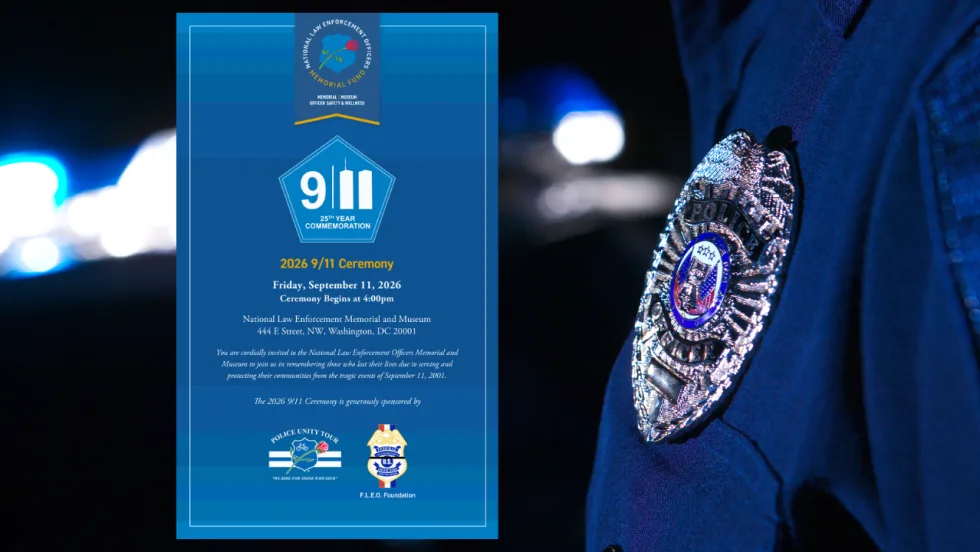
National Law Enforcement Memorial and Museum Hosting 9/11 25th-Year Commemoration Ceremony
The National Law Enforcement Memorial and Museum is hosting a 9/11 25th Year Commemoration Ceremony on Sept. 11 at 4 p.m.
Read More →
National Law Enforcement Officers Memorial Fund Announces June 2026 Officers of the Month
The National Law Enforcement Officers Memorial Fund (NLEOMF) named 15 officers of the Chico Police Department (California) as the Officers of the Month for June 2026 for their roles in responding to an active-shooter incident at a public library.
Read More →