



Dave Smith: Unicorns and Super Predators
The 1990's Crime Bill had major impact on public safety, now we need to go back to locking up career criminals again.

Way back in the early 1990s, America was in the grip of a terrible crime epidemic. The anti-incarceration movement, along with other policies we would certainly recognize as active today, had failed miserably. Murder, robbery, and rape had all become our nation’s shame, and the shifting of power in Congress forced then President Clinton to act. At that time a theory of the Super Predator had been proposed by John P. Dilulio, Ph.D.; he introduced the term and, as part of his research about the “Moral Poverty” among the youth of America, identified it as a critical factor in the crime wave.
For you young folks under 40, this was a time when politicians at least claimed to care about such things as borders, national security, crime, inflation, and secure elections; this is all truly a hard to remember time as it seems like another age. President Clinton responded to the nation’s anger that he had not dented the crime problem after spending untold billions on social programs and “rehabilitating not punishing” philosophies that showed no positive results. The Clinton Crime Bill of 1994 was developed in response to this unrest.
The Bill included an assault weapons ban, Community Oriented Police Programs, Youth Programs, Mandatory Sentencing, and funding for 100,000 new police officers were the foundation of President Clinton’s now much maligned program. Taking career criminals off the street and adding certainty of punishment made those of us that still believed that traditional criminological theories of crime were the rational choice cheer the passage of this Bill. Everyone recognized the fact that crime was committed by a relatively small number of individuals and for many of those criminals the only solution was to warehouse them in prisons; this old fashioned “punish bad behavior” model brought about excellent results.
The problem was prisons filled up with lots of criminals from a vary narrow cross-section of America. Even though criminals were no longer terrorizing their communities or recruiting the young from their own socio-economic background, none of that seemed to be acknowledged or valued.
The young across America, were given a vast array of programs to deter their criminality and develop their moral character. In retrospect, the Crime Bill of 1994 saved many lives and guided a large number of youths away from crime and into productive lives.
Drug Awareness Resistance Education (DARE), Gang Resistance Education and Training (GREAT), and boot camps for young offenders were just a few of the programs developed to stem the tide of criminality that plagued the country, while Liberal pundits, sociologists, and activists continued to decry the resulting rise in prison populations. So, the backlash began.
As the crime rate dove to record low levels, credit was given to everything but the Crime Bill and its punitive measures. Data was used to suggest there never had been a rising youth violence trend, and all those increases in murder by youth was simply due to the fact that they had started using guns to attack people.
Ah, the guns were at fault. No mention was made of the thousands of police added to protect the streets, the courts being forced away from leniency and back into punishment; nope, all that was branded as evil and by 2016 even politicians like Hillary Clinton were lamenting police presence. In fact, the very inventor of the term Super Predator, Dr. Dilulio himself, denied his own theory, even though the data and research going into this theory was remarkable by its sheer volume and analysis. In spite of this, the pillorying of the theory ramped up on such platforms as Wikipedia and the New York Times. I’m surprised the good doctor did not get a whipping from the intellectual elite due to the fact that one of his keys to reducing criminality among the morally impoverished urban youth was his cry for more “churches instead of jails.”
Dilulio’s concept of Moral Poverty is also still alive and well, despite the political slight of hand that suggests otherwise. One could easily say today’s schools and social media are about as morally impoverished as it's possible to be. Amorality is a standard on most social media platforms and the sexualization of our youth has become commonplace. The percentage of people who believe in God much less those who actually live by any Biblical or religious code is at an all-time low. The collapse of morality in our country is a fair warning and we would do well to take note and push back on this trend. One place to start is to revive youth programs rooted in traditional morality.
Finally, defunded police programs need to be refunded, but that’s no longer enough. Prestige needs to be given back to those who serve and protect us, and the law enforcement profession needs to be again regarded as noble and necessary. Villains need to be arrested, incarcerated and vilified, while heroes need to exalted.
Dave Smith is an internationally recognized law enforcement trainer and is the creator of “JD Buck Savage.” You can follow Buck on Twitter at @thebucksavage.
More Patrol

Adept Armor Introduces Two New Rifle Plates
Adept Armor has launched two new Level IV ballistic plates, the Emperor and the Archon Mark 2, which brings Adept Armor’s new Quatroid ceramic to the high-threat, performance-value center of the range at 5.2 pounds.
Read More →
POLICE Product Test: Benchmade Bailout
The Benchmade Bailout is a slim, lightweight carry knife with a deep-ride pocket clip and comes in a variety of blade steels and scales. Here is a detailed review of the Taiga Green Bailout, released earlier this year.
Read More →
NLEOMF Announces July 2026 Officer of the Month
NLEOMF honored a Michigan deputy sheriff as the July 2026 Officer of the Month for rescuing a trapped driver from a burning vehicle following a Fourth of July crash.
Read More →
Streamlight to Showcase Newest Lighting Products at National Safety Council’s Safety Congress & Expo 2026
Streamlight will showcase its latest lights, including the Portable Scene Light III and the LiteBox 1Million, at the 2026 National Safety Council (NSC) Safety Congress & Expo.
Read More →
The 2027 World Police & Fire Games Set for Perth, Australia
The 2027 World Police & Fire Games (WPFG) will take place in Perth, Western Australia, from Friday, March 12 through Sunday, March 21, 2027.
Read More →
5.11 Partners with National Fallen Firefighters Foundation to Support #ForThe343
5.11 has joined the nationwide movement honoring the 343 New York City Fire Department firefighters lost on Sept. 11, 2001.
Read More →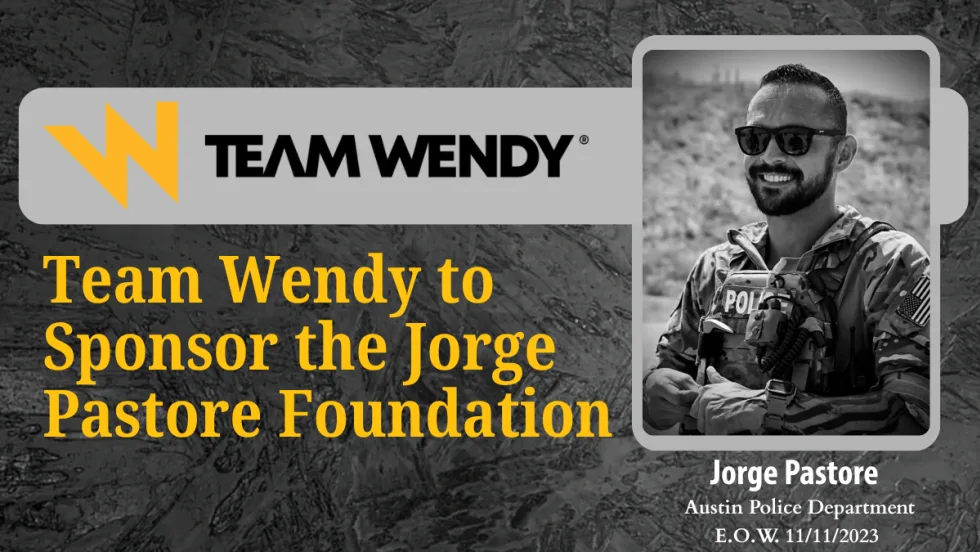
Team Wendy Announces Title Sponsorship of the Jorge Pastore Foundation
Team Wendy’s 3-year partnership with the Jorge Pastore Foundation expands access to programs that strengthen those who serve.
Read More →
National Law Enforcement Memorial and Museum Hosting 9/11 25th-Year Commemoration Ceremony
The National Law Enforcement Memorial and Museum is hosting a 9/11 25th Year Commemoration Ceremony on Sept. 11 at 4 p.m.
Read More →
National Law Enforcement Officers Memorial Fund Announces June 2026 Officers of the Month
The National Law Enforcement Officers Memorial Fund (NLEOMF) named 15 officers of the Chico Police Department (California) as the Officers of the Month for June 2026 for their roles in responding to an active-shooter incident at a public library.
Read More →
Team Wendy App Creates New Digital Hub for Helmet Owners
The Team Wendy Community App provides one location for warranty registration, size-fit tools, product updates, and community connection. For helmet owners, the new app creates a simpler path to the information and tools that matter most.
Read More →