



Booby Traps
Often engineered with little more than rudimentary know-how, real world booby traps may lack the sophisticated engineering of those in the "Saw" films, yet prove every bit as lethal.

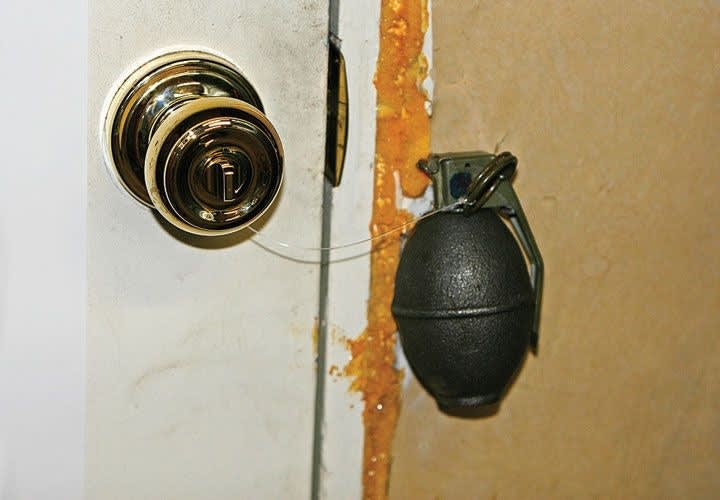
Often engineered with little more than rudimentary know-how, real world booby traps may lack the sophisticated engineering of those in the "Saw" films, yet prove every bit as lethal. And unlike time-delay or remote-detonated explosives, the booby trapper's conceit is that his victim actually activates his own peril. An ill-timed footstep, a switch of a light, or the sudden movement of some seemingly harmless object can put lethality in motion. To further hedge their bets, booby trappers may attempt to lure the victims into activating the device by using "bait."
Whatever the nature or purpose of a booby trap, law enforcement officers have a vested interest in familiarizing themselves with the various means by which a booby trap can be effected. The recent cowardly assaults on police officers in Hemet, Calif., are reflective of the types of dangers officers may encounter when the bad guys decide to use booby traps against local authorities.
In Hemet, a wave of booby traps was used against gang investigators. In one incident, a ballistic device strapped to a fence at the gang unit's compound propelled a bullet within inches of an officer's face. In another, someone rerouted a natural gas line at the compound, filling the building with flammable vapor. Someone also attached an explosive device to an unmarked police car after its driver entered a convenience store.
To counter the booby trap campaign and any further assaults, the Hemet Police Department has authorized expenditures to fortify the police department building. More importantly, a series of search warrants served on 35 homes resulted in the arrests of 16 people for a variety of weapons, narcotics, and parole violation charges.
The attempted assaults on Hemet officers are not unique.
Cops need to know more about how to avoid and counter these devices because they are starting to be more and more a part of the criminal arsenal. For example, Las Vegas authorities recently recovered an abandoned stolen Cadillac Escalade in which the suspects had set a trap. They ran a wire from a light bulb in the passenger side door to a full five-gallon gas can. Fortunately, the low-tech contraption did not detonate when the door was opened by law enforcement officers.
And in Northern California, Butte County Sheriff's Department officials discovered plastic baggies inside the gas filler tubes of 12 patrol vehicles. The baggies were rendered visible when the gas cap was removed and subsequent investigation found their contents to be granular substances with a very strong alkaloid substance. Once exposed to water and gasoline, the substance becomes volatile. No explosions or serious injuries have been reported from these incidents. However, two employees who were exposed to the substance reported having skin irritation.
Officers can also be maimed or killed by booby traps intended for others. Devices left as deterrents to enemy gang members or rival narcotics dealers, as well as those rigged simply to destroy incriminating evidence, can be lethal.
Anticipating the Threat
Booby traps are probably not on the mind of the average street cop going about his business. Nor should they be. But if you deal with gang members, radical groups, or narcotics dealers then you should be anticipating this threat. And the more information that an officer has about the variables of the locations or persons he deals with, the greater likelihood he can determine the nature of such a threat and mitigate it.
One of the more obvious police operations where you are likely to face booby traps is during the service of search warrants. Assuming you get inside the location and have otherwise secured the inhabitants, it's not a bad idea to ask them about the prospects of coming across booby traps.
Sometimes, this actually works. When Wisconsin authorities served a warrant on a marijuana cultivation site in Dane County, the suspect identified booby traps surrounding some of the marijuana plants, thereby preventing injuries to any on scene.[PAGEBREAK]
Of course, there's no guarantee that an honest reply will be forthcoming. When two southern Kentucky police officers asked John Preston if he had any hidden threats inside his home, Preston reportedly told them no. But while trying to remove a shotgun from a gun cabinet, both officers were nearly killed when a rigged trigger caused the weapon to discharge. Aside from suffering hearing loss, the officers were uninjured. Preston ended up facing additional felony charges.
Malicious MacGyvers
One way to determine if you might be facing a booby trap threat is to consider the personality and actions of the subjects you are dealing with. Certain personalities are red flags. Consider the multiple homicide suspect determined to go out in a blaze of glory. The Columbine shooters rigged a series of explosive booby traps; so too have other suspects who were determined to take out as many people as possible by any means possible.
After eight people were killed in Appomattox County, Va., earlier this year, a tactical team making entry into the crime scene located an explosive booby trap allegedly left behind by suspect Christopher Speight. And inside the Texas mobile home where Dep. Shane Detwiler of the Chambers County (Texas) Sheriff's Office was shot twice in the head and killed, authorities recovered more than 100 homemade explosive devices and booby traps that his killer had fashioned.
Regardless of who you're dealing with, remember that just about anybody can make booby traps. And the know-how is readily available on Websites and in books such as the "Anarchist's Cook Book," "Malice Aforethought," and "Deathtrap."
And just about anything can constitute a booby trap. Taut wire has been rigged between trees in an attempt to maim or kill ATV-riding border patrol agents. Rigged firearms, incendiary devices, and precariously situated heavy objects have been exploited effectively. Even starved canines and exotic animals such as black mamba snakes have been used. One man opened his mailbox and was bitten by a rattlesnake that had been left inside.
But perhaps the most pervasive threats are combustibles. Often, there are telltale signs, and unless your subject is a "do-it-yourself" Bondo, plaster, and duct tape kind of guy, you might want to consider the presence of such things possible red flags.
Spotting the Trap
Explosive devices, including booby traps, have been responsible for the deaths of patrol officers and arson investigators alike, with some 73 law enforcement officers killed by bomb blasts in the United States. Among these victims was recognized LAPD bomb expert Det. Arleigh McCree who was killed in 1986 by booby trapped pipe bombs.
Technology is helping to identify such threats. Property profiling can help as well. Windows that have been covered up can be a telltale sign of everything from a marijuana cultivation site to a paranoid anti-government type. Also look for disproportionate attention given to video surveillance systems and other electrical devices on properties that aren't otherwise maintained. Indeed, overgrowth itself may conceal threats such as bear traps and Punji stake-filled pits.
While many agencies go out of their way to train their SWAT personnel on booby trap threats-indeed, many SWAT competitions have booby traps included in their exercises-Sgt. Derek Yoshino of the Los Angeles County Sheriff's Department believes law enforcement can do more to teach its patrol personnel how to anticipate and deal with booby traps.
To that end, the department has in the past conducted a "Hogan's Alley" kind of training for its patrol personnel: Deputies were put through a house that had been rigged with a variety of booby trap devices. The deputies' sole objective was to identity the threats (as real threats would generate a response from experts trained in defusing such devices).[PAGEBREAK]
"As far as first responders go, we show them when they're going into a location what they should be looking for," Yoshino explains. "First, they have to be mindful of where they step and before they touch anything to look for any type of wiring or alterations to what they're going to touch. When you go into a place, you don't turn the lights on until you check to see that the light bulbs weren't booby trapped. If there's a throw rug on the ground, you want to look to make sure there are no wires coming out from underneath the rug because there might be a pressure plate under there. You want to look for fishing line or wires hanging in the house. We even had a situation where a guy rigged his house up with fishing line to make it look like it was booby trapped. Just be aware of your surroundings before you proceed into a building or an unknown area."
Lt. Jim Cruise of the Vermont State Police is in charge of its Arson Investigations Department. He acknowledges that in the wake of 9/11, law enforcement has paid commensurate attention to training many of its personnel on the kinds of dangers they may encounter. Still, Cruise believes that there is a need for even greater emphasis on identifying booby traps.
"Gauging threats can be difficult and taking in a lay of the land can sometimes be your only chance to identify threats before encountering them," says Cruise. "It's not always about what you're seeing. It's about where you're seeing it. It's when that sixth sense is honing on something and you have to acknowledge your gut feelings."
Abetting that sixth sense may mean looking for things that don't mesh with the environment. It also means recognizing those tools routinely used to fashion booby traps, including blasting caps, ammonium nitrate, safety fuses, Kinepax, boosters, smokeless and black powders, tail fuses, as well as any empty containers that might have housed such objects. Also look for everyday items that might be adulterated with booby traps such as flashlights and alarm clocks.
Cruise believes that today's technology has also availed law enforcement a means of rapidly disseminating intel out to the troops that need it.
"Computers have really torn down many of the territorial barriers within our profession. We can get the word out on threats to other agencies and bureaus that much quicker."
A Deadly Future?
Booby traps have been around for centuries, notably exploited in wars. The Viet Cong would fire upon American soldiers who'd defensively throw themselves down to the ground, often to find themselves impaled upon Punji spikes. In World War II, Bouncing Betty mines were placed in the ground with sensors or trip wires protruding from them awaiting hapless foot soldiers. The detonations were delayed so the mine could spring into the air and blast shrapnel at head height.
When British troops came upon a billet that had been abandoned by the retreating Germans, they found its front door invitingly half open. To skirt the anticipated booby trap, they entered cautiously through a window and approached the front door from the inside. Their observations confirmed their suspicions: Attached to the door was an explosive charge apparently designed to function when the door was moved. Abandoning the house, they attached a line to the doorknob of the front door. A conveniently situated slit trench was just across the street. They laid down therein and pulled the line. A second trap hidden in the trench and connected to the door exploded and killed them all.
Some militarized threats have been averted through the use of technological countermeasures, such as minesweepers. It follows that law enforcement will increasingly rely on a variety of detection devices and mitigators to deal with domestic threats.
How real is the threat of booby traps for the average officer? Maybe not much. But it could be growing.
There are a lot of angry people in America on all sides of the political equation, and some of them want to express their anger against the government by attacking you. Also, the Mexican drug cartels continue to make further encroachments into America's law enforcement jurisdictions, and they have been known to employ night vision goggles, electronic intercept collection, encrypted communications, sea-going submersibles, helicopters, automatic weapons, machine guns, RPGs, rockets, mines, and booby traps.
Militia groups are growing, as well. Some swell along racial lines; others around ideological causes such as eco-terrorism and anti-abortion. Then there are those who just want to destroy the system. Might we be seeing incidences of stateside IEDs? While one would hope not, it is more prudent to recognize the possibility.
In light of the possibility of similar attacks in the near future, it is incumbent upon you to learn about their various advocacies and preferred means of getting their messages across. It is also a call to greater vigilance for the places officers frequent both on duty and off, and to adopt sound daily routines such as routine inspection of their patrol vehicles before and during their shifts.
As Lt. Cruise notes, "Information in the right hands makes our job safer. And more deadly when it's not in the right hands."
Related Articles:
More Patrol

Adept Armor Introduces Two New Rifle Plates
Adept Armor has launched two new Level IV ballistic plates, the Emperor and the Archon Mark 2, which brings Adept Armor’s new Quatroid ceramic to the high-threat, performance-value center of the range at 5.2 pounds.
Read More →
POLICE Product Test: Benchmade Bailout
The Benchmade Bailout is a slim, lightweight carry knife with a deep-ride pocket clip and comes in a variety of blade steels and scales. Here is a detailed review of the Taiga Green Bailout, released earlier this year.
Read More →
NLEOMF Announces July 2026 Officer of the Month
NLEOMF honored a Michigan deputy sheriff as the July 2026 Officer of the Month for rescuing a trapped driver from a burning vehicle following a Fourth of July crash.
Read More →
Streamlight to Showcase Newest Lighting Products at National Safety Council’s Safety Congress & Expo 2026
Streamlight will showcase its latest lights, including the Portable Scene Light III and the LiteBox 1Million, at the 2026 National Safety Council (NSC) Safety Congress & Expo.
Read More →
The 2027 World Police & Fire Games Set for Perth, Australia
The 2027 World Police & Fire Games (WPFG) will take place in Perth, Western Australia, from Friday, March 12 through Sunday, March 21, 2027.
Read More →
5.11 Partners with National Fallen Firefighters Foundation to Support #ForThe343
5.11 has joined the nationwide movement honoring the 343 New York City Fire Department firefighters lost on Sept. 11, 2001.
Read More →
Team Wendy Announces Title Sponsorship of the Jorge Pastore Foundation
Team Wendy’s 3-year partnership with the Jorge Pastore Foundation expands access to programs that strengthen those who serve.
Read More →
National Law Enforcement Memorial and Museum Hosting 9/11 25th-Year Commemoration Ceremony
The National Law Enforcement Memorial and Museum is hosting a 9/11 25th Year Commemoration Ceremony on Sept. 11 at 4 p.m.
Read More →
National Law Enforcement Officers Memorial Fund Announces June 2026 Officers of the Month
The National Law Enforcement Officers Memorial Fund (NLEOMF) named 15 officers of the Chico Police Department (California) as the Officers of the Month for June 2026 for their roles in responding to an active-shooter incident at a public library.
Read More →
Team Wendy App Creates New Digital Hub for Helmet Owners
The Team Wendy Community App provides one location for warranty registration, size-fit tools, product updates, and community connection. For helmet owners, the new app creates a simpler path to the information and tools that matter most.
Read More →