



12 Things You Need to Know About LPR
License plate recognition is one of the most effective but most misunderstood crime prevention tools available to law enforcement.

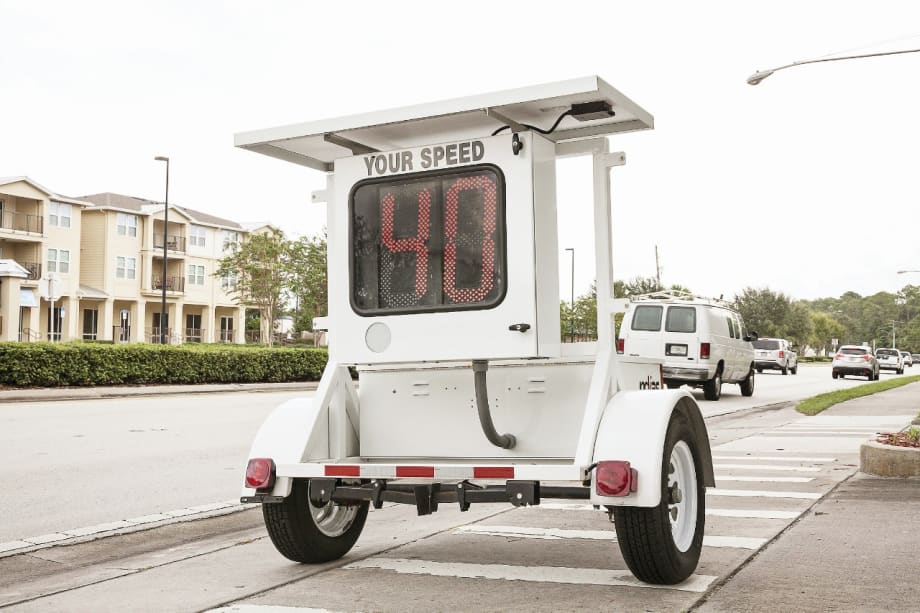
Portable LPR systems such as this NDI Road Warrior can constantly monitor an area and be moved as needed. Photo: NDI Recognition Systems
License plate recognition (LPR) is one of the most powerful tools now available to law enforcement agencies. These systems have the ability to identify vehicles that may have wants and warrants associated with them, and they provide a force multiplier for agencies by increasing officer efficiency.
Here are 12 things that agencies planning on acquiring LPR and officers operating these systems should know about the technology and its use.
1. It's Not New
Although LPR is often thought of as 21st century technology, it was actually developed in the United Kingdom in the 1970s as an anti-terror and anti-crime tool and was widely used in Europe for stolen car recovery and other police operations by the 1990s. It took about a decade longer for the technology to catch on in the United States. One reason is the wide variety of license plates in the United States. European countries, including the UK, use very basic license plate designs, just numbers and letters in a rectangle with no or very little imagery. In contrast, the US has 50 states, five territories, and one district all with a host of different available plate designs that tell the world the owner's military service experience, college affiliation, sports team allegiance, and hobbies.
2. The Components of LPR
An LPR system basically consists of optical character recognition software, analytical software, databases, and cameras with infrared and visible light spectrum imaging capability. The active infrared imaging camera of an LPR system lets it capture license plates in low-light, nighttime conditions, and in sunlight so bright that it would obscure the characters in an image captured by a visible spectrum camera.
3. The Role of the Evangelist
One of the keys to the successful implementation of new equipment into a law enforcement agency is the "evangelist." The evangelist is not just an officer who believes in the technology, he or she is the person who can preach its benefits to the brass and to fellow officers. For LPR the evangelist is the person who is willing to learn everything available about how it works and what it can do. If an agency wants to do more than scratch the surface of the benefits provided by LPR, then it needs a motivated officer who is enthusiastic about the technology and can excite other officers about its capabilities.
4. Benefits of the Technology
LPR has many uses and offers numerous benefits to agencies that implement and apply the technology. Some of the earliest LPR successes involved the detection of unregistered vehicles, enforcement of parking regulations, and recovery of stolen vehicles, but LPR systems have also helped solve a wide variety of criminal cases, including murders, abductions, and drug and human trafficking. Power users of LPR systems are constantly developing new and innovative ways to apply the technology.
5. Procedures and Policies
Just as with any law enforcement tool or technology, it's important for agencies to establish clear procedures and policies for the use of LPR systems. Issues that need to be addressed include: training for officers who operate the systems, storage and access to the data, and what databases will be used. Training can be a simple 15-minute orientation. But in order to get the most out of their systems, agencies should look into getting more advanced training for their LPR operators. Storage and access to data is a policy concern that agencies will have to address as well. LPR makes some people in the community nervous even though all it does is automate the process of running a plate. To reduce resistance to LPR use, it's best to address any "Big Brother" concerns from the beginning of the program by establishing policies about access to data. Databases are available from a variety of sources, including the companies that make and sell the systems and official law enforcement entities. The quality of the databases available to your agency will be a huge factor in the success of your LPR program.
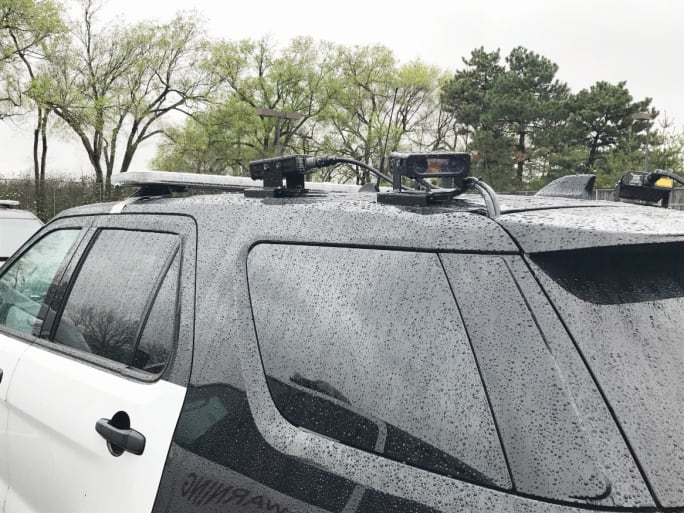
Patrol vehicle with forward- and rear-facing ELSAG cameras. This is a typical LPR configuration for a mobile system. Photo: Glenexa (KS) PD
6. Fixed, Mobile, and Portable
When most people, including law enforcement officers, think of LPR, they tend to envision officers driving around all day using mobile systems. But the truth is that much of license plate recognition is conducted by fixed systems that read plates 24 hours per day, seven days per week. These systems can relay their hits to patrol officers and even to aerial units for follow up. Mobile systems offer just that, mobility. They can cover areas of the jurisdiction that are not monitored by fixed systems. Then there are portable systems often installed in trailers. These offer some of the benefits of both fixed and mobile systems. They are constantly in position monitoring an area, and they can be moved as needed. Trailers are particularly well suited to investigative operations where, for example, officers are trying to determine the presence of specific vehicles in a residential area being plagued by burglaries. Using a variety of systems, agencies can set up what's called a "geofence." A geofence notifies officers when vehicles with specific license plates enter or exit a set geographic area.
7. Hits are Not Probable Cause
Just because an LPR system has alerted you about a hit does not mean you have probable cause to make a stop. Some law enforcement agencies have made some embarrassing and potentially costly—in terms of liability—felony stops on people based on LPR alerts, later to find the stops were not warranted. Experts recommend that operators verify whether the vehicle is really associated with a warrant. False hits can occur because a database has not been updated or has an error, because the plate being read is dirty or damaged, and because of numerous other reasons.
8. Not Just a Plate Reader
LPR systems will sometimes read characters that are not on license plates. The technology is designed to look for letters and numbers in a rectangle at a certain size. Experts say the systems have been known to read text on billboards in the distance that to the system look like license plates, as well as bumper stickers, mailboxes, and other rectangular shapes with letters and numbers. This really isn't a major problem, and it can even be beneficial. In one case, a read of a bumper sticker actually led to recovery of a stolen trailer full of firearms.
9. Camera Placement and Care
LPR cameras can be placed in fixed positions such as on light poles or on vehicles and even trailers used for road warnings or speed enforcement. On patrol vehicles, LPR cameras are often set up in pairs, one forward facing and one rear. This is ideal for a two-lane road because each camera scans a lane. Some agencies use four cameras per vehicle for enhanced coverage. Typical placement of the cameras on a vehicle is either level with the license plates on a push bar or bumper or looking down from the vehicle's trunk lid or roof. Cameras are generally aimed at setup to a range of 16 to 20 feet for optimal image capture. The cameras usually do not require any additional maintenance by operators other than the occasional cleaning. The exception to this is that cameras can get knocked out of position. Experts recommend you look at the cameras as you do your walk around of your patrol vehicle before driving off.
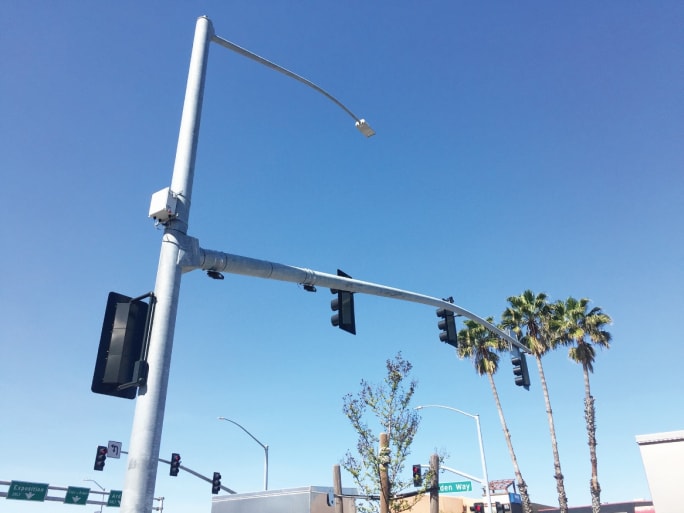
A fixed LPR system,from Vigilant Solutions in place in Sacramento, CA. Experts say fixed systems are the real workhorses of an LPR program. Photo: Sacramento County SD
10. Return on Investment
LPR systems are not inexpensive, but experts say they are affordable. Like any other major capital purchase of technology, the key to justifying the expense of LPR systems is finding return on the investment (ROI). The biggest return on an LPR investment is bolstering the security of the jurisdiction, reducing crime, and enhancing officer safety. But such things are hard to quantify. Most administrators who greenlight an LPR program will want to see hard figures for ROI. The primary monetary benefits from an LPR program come from recovering fines from parking citation scofflaws and motorists with expired registrations.
11. Big Data
LPR is part of a complex set of tools that contemporary law enforcement agencies can use to fight crime and make the public safer by enhancing officer efficiency. These tools are most effective when they integrate with other software and systems. Data collected from LPR can be used with predictive policing software, records management systems, and computer-aided dispatch (CAD) tools.
12. The Future of LPR
Computers, software, and cameras are all constantly improving. Which means that LPR is improving as well. The big breakthrough in LPR that's on the horizon is the incorporation of artificial intelligence into the technology. This will make the systems even more accurate and better capable of generating actionable law enforcement intelligence.
This article was produced with the assistance of Derek Forseth, digital video product manager for Data911 (www.data911.com); Jim Craige, operations manager for ALPR at Leonardo/ELSAG (www.elsag.com); Julian Jimenez, LPR solutions product manager for L3 Technologies (www.mobile-vision.com); Heather Fraser of NDI Recognition Systems (www.ndi-rs.com); and Kyle Hoertsch, director of public safety client relations for Vigilant Solutions (www.vigilantsolutions.com).
More Patrol

Adept Armor Introduces Two New Rifle Plates
Adept Armor has launched two new Level IV ballistic plates, the Emperor and the Archon Mark 2, which brings Adept Armor’s new Quatroid ceramic to the high-threat, performance-value center of the range at 5.2 pounds.
Read More →
POLICE Product Test: Benchmade Bailout
The Benchmade Bailout is a slim, lightweight carry knife with a deep-ride pocket clip and comes in a variety of blade steels and scales. Here is a detailed review of the Taiga Green Bailout, released earlier this year.
Read More →
NLEOMF Announces July 2026 Officer of the Month
NLEOMF honored a Michigan deputy sheriff as the July 2026 Officer of the Month for rescuing a trapped driver from a burning vehicle following a Fourth of July crash.
Read More →
Streamlight to Showcase Newest Lighting Products at National Safety Council’s Safety Congress & Expo 2026
Streamlight will showcase its latest lights, including the Portable Scene Light III and the LiteBox 1Million, at the 2026 National Safety Council (NSC) Safety Congress & Expo.
Read More →
The 2027 World Police & Fire Games Set for Perth, Australia
The 2027 World Police & Fire Games (WPFG) will take place in Perth, Western Australia, from Friday, March 12 through Sunday, March 21, 2027.
Read More →
5.11 Partners with National Fallen Firefighters Foundation to Support #ForThe343
5.11 has joined the nationwide movement honoring the 343 New York City Fire Department firefighters lost on Sept. 11, 2001.
Read More →
Team Wendy Announces Title Sponsorship of the Jorge Pastore Foundation
Team Wendy’s 3-year partnership with the Jorge Pastore Foundation expands access to programs that strengthen those who serve.
Read More →
National Law Enforcement Memorial and Museum Hosting 9/11 25th-Year Commemoration Ceremony
The National Law Enforcement Memorial and Museum is hosting a 9/11 25th Year Commemoration Ceremony on Sept. 11 at 4 p.m.
Read More →
National Law Enforcement Officers Memorial Fund Announces June 2026 Officers of the Month
The National Law Enforcement Officers Memorial Fund (NLEOMF) named 15 officers of the Chico Police Department (California) as the Officers of the Month for June 2026 for their roles in responding to an active-shooter incident at a public library.
Read More →
Team Wendy App Creates New Digital Hub for Helmet Owners
The Team Wendy Community App provides one location for warranty registration, size-fit tools, product updates, and community connection. For helmet owners, the new app creates a simpler path to the information and tools that matter most.
Read More →