



K-9 Training Challenges
A police K-9 isn't a simple weapon used to attack suspects. At least not anymore. Temperament, sensory ability, and certain natural drives are just some of the considerations. Not just any dog has what it takes to work in law enforcement.

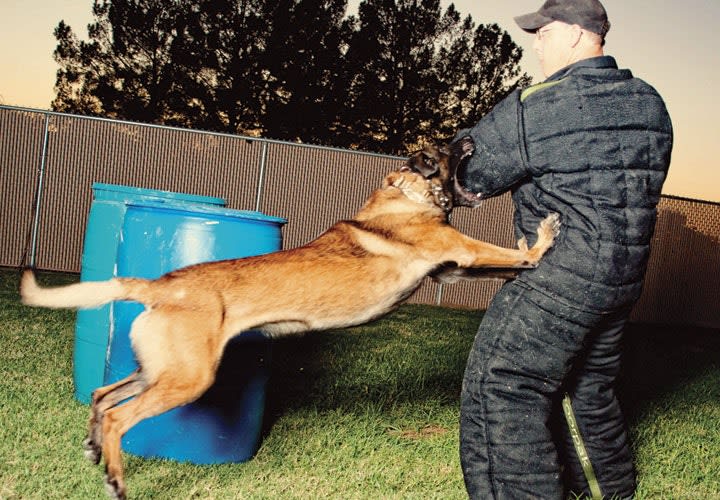
Photo: Mark W. Clark
Editor's note: Please view our related photo gallery, "Police Dogs."
A police K-9 isn't a simple weapon used to attack suspects. At least not anymore. Temperament, sensory ability, and certain natural drives are just some of the considerations. Not just any dog has what it takes to work in law enforcement.
In the 1960s, police used dogs to attack rioters. Doberman Pinschers were the breed of choice, and their inherently aggressive tendencies were encouraged. They weren't trained to respond reliably to commands, and officers needed to physically remove them from a bite by pulling at their leash, according to Mike Johnson, president of the American Police Canine Association.
"The problem with those dogs is you never knew when they were going to turn on you, even on their own handlers," explains Johnson. "Basically, they were just chainsaws."
As a veteran officer, Johnson has seen how drastically the philosophy has changed. Police K-9s are now expected to meet the new needs of law enforcement, which include both biting and being friendly, all on cue. Training has changed to reflect that.
When Johnson started as a K-9 handler in 1986, dogs were no longer "chainsaws," but they were taught using compulsory training, forcing dogs to perform tasks. Now the standard is not forcing but encouraging with positive reinforcement such as toys for a job well done, he says. "Nationally, the experiences I see are dogs being trained with positive reward-based training." That requires more than riling up a dog enough to bite. Thus, finding and training a police dog is much more involved.
Fine Breeding
Before training can begin, you first need to find the right dog, which is easier said than done. But working with an experienced breeder can help narrow down the search.
The most popular breeds now are German Shepherds, Belgian Malinois, Labrador Retrievers, and Dutch Shepherds. Most are sourced in Europe and are purchased by a law enforcement agency between the age of one year and 18 months old. They are not tiny puppies, but they aren't ready to go out on the street, either. These dogs can cost from $7,700 for an untrained dog and from $13,500 up to $20,000 for a fully trained dog. But the advantage is they come with a guarantee.
"When I started we took donated dogs because no one was willing to pay for them. But it cost a lot of money and man hours to find a dog that might be qualified," says Jim Matarese, who worked with five K-9s in his career and now serves as the treasurer of the United States Police Canine Association (USPCA). "Now you can purchase a dog with a guarantee of health for six months or a year, you have papers certifying they don’t have any genetic anomalies, and you can replace it if needed. That saves money."
Even if you're working with a top-notch breeder, trainers need to put prospective K-9s through their paces to determine if they're viable. "In law enforcement K-9 training, we’re looking for a dog that has all the genetic traits we need, and not every dog from a particular litter may be a police dog candidate," says Officer Danny Jones, a K-9 trainer with the Metropolitan Police Department in Washington, D.C., and Region 3 president for the United States Police Canine Association (USPCA).
Essential Traits
Desirable traits for K-9s depend on how the dog will be used. A keen nose is essential for almost every dog in police work. For tracking, scent is one of the most important traits for a dog to have. But patrol dogs must be able to perform a wide range of tasks, so it's more difficult to find the right one. And it requires more ongoing training in all of those fields.
"If they don't have a good search or retrieve drive, it limits training," says Johnson. And this holds true for all police K-9s. Some dogs sound good on paper, but if they don't like finding scents and or aren't motivated by getting a reward, they won't have the desire to work.
"The balance in a prey and defense drive would be a primary focus of what you're looking for when you do a dog selection," agrees Jones. "But that's not going to be a cure-all for any issue. A dog may have some other issue that may not allow him to be a police dog."
Some dogs are sensitive to loud sounds, which is a problem when they'll constantly hear gunfire and sirens in the course of a shift. Others don't like walking on certain types of surfaces like smooth tiles or cement stairs. These are the things that officers must find out at the beginning and there are reasons certain dogs might need to be returned to their breeders.
Temperament is another such key trait. All K-9s also must be highly sociable animals. They’re required to interact with other officers, walk through the police department without incident, and even feel comfortable around children while visiting a school. "They need to interact with the public without being a risk to the public unless they're told to do their job," says Johnson. Matarese also believes the need for sociability is related to funding.
"Today, law enforcement is focused on high-performance dogs with good genetic drive, which they need to do the job," says Matarese. "But at the same time, due to the fact that they have a lot of public interaction, handlers also have to take these dogs into demonstrations for public support from the community in order to fund programs," says Matarese. This can be a fine line to walk. And once the right dog is found, it takes the right training to make it work.
Initial Training
Law enforcement agencies can choose to purchase dogs with or without law enforcement training. While some initial training might make a K-9 ready to get on the street more quickly, it might end up delaying the process, too.
"It may take you a huge effort to correct something that the dog has been trained to do already that you may not want," cautions Jones. That's why his agency only takes on green dogs, those that have no prior training.
On the other side of the spectrum, purchasing a trained dog and skipping the more traditional training period of several months to acclimate a dog to its handler could pose other problems.
"Administrators think it's a good idea instead of spending three months in training. But an inexperienced handler, given just two weeks with a dog and learning ways to control a dog, creates problems” says Matarese. "I like to see the handler and dog each train each other and learn how each other works. If there’s an issue, the handler has the time to correct the problem."
Whichever type of dog you choose, when it comes to matching up dogs and handlers to begin training, it helps if they complement each other, says Matarese. "If the dog is more excited, it's better to have a handler that's calmer, and vice versa," he says. "A calmer dog might need an energetic handler to help get the dog pumped up." The size of the dog and handler also need to be considered. If you have say a 100-pound dog and give it to a shorter handler it could be a problem.
Maintenance Training
Both K-9s and handlers must continue to train in every aspect of their jobs, from day one until the dog is retired. Federal recommendations call for 16 hours a month, but many agencies practice much more.
"It's an ongoing educational process that people in this field will continue as long as they carry a dog," says Johnson. "It never stops just when they get out of handler school. That's when their education is started."
Considering how often this training takes place, it's important not to build in mistakes during the process. This is one reason several handlers and K-9s should train together. If they're watching each other, they can catch each other's mistakes. This of course also helps all handlers know how to work together effectively, and be able to give commands to each other's K-9s if it's ever necessary.
During training, handlers strive to acclimate dogs to every possible environment they might encounter in as realistic situations as possible. "We have in-service maintenance training where we cover the gamut," says Johnson. "We do group training, but we set up one area each for narcotics, aggression, obedience, building search, and tracking. Everybody goes and rotates. We call it station work."
Key skills to work on include passive resisters and verbal control, says Johnson. If a suspect is standing still but holding a gun or other threat, a dog must be trained to attack when needed, even though the suspect isn't moving. For a dog to reliably perform tasks such as going after and biting a passive resister, the handler must have total verbal control of the K-9. "Some don't care if a dog will release on a verbal command from a bite," says Johnson. "The problem is if you have a 32-degree black belt and you go in that close to remove the dog, chances are you'll get hurt. Or he could pull a knife and jab you."
This and all aspects of training must not just be performed, but also documented. Certification is not required in all states, but it is recommended. Otherwise, a defense attorney might use your lack of certification to create doubt in the minds of the jury, even if it's not legally required. Documentation, however, is always required. Any missing documentation of training could discredit the use of a K-9 in an incident and endanger an entire case. "You must make sure the recertification or retraining is performed and all the information is documented correctly to make sure that dog is still providing that level of service that he was trained to do," adds Jones.
While training is ongoing, Jones says it's a good feeling knowing your new K-9 is on the right track to becoming an important part of the team. "That's the ultimate satisfaction I would believe in any training program: to have that dog complete his training and placed in service and perform his job well."
More Training
Registration Underway for Sixth Annual First Responders Relay
The California Police Athletic Federation’s annual First Responder Relay will welcome first responder teams from across the globe to compete along Ventura's scenic coastline on Oct. 11. Registration is underway.
Read More →
Vector Solutions Launches Comprehensive Online Dispatch Training Catalog for Emergency Communications Professionals
Vector Solutions’ new catalog of 35 expert-developed online courses can help emergency communication centers strengthen training, meet certification requirements, and simplify continuing education.
Read More →
Tools for Active Shooter Response Training
What technologies help prepare officers for active shooter response situations? This behind-the-scenes look at law enforcement training explores shot simulators, smart firearms, laser target systems, and the tools used to build safer, more effective training environments.
Read More →
Two-Officer Tactical Doorway Entry Techniques
Entering a room during active-threat situations requires communication, coordination, and disciplined tactical movement. In this video, trainers from the United States Deputy Sheriff’s Association demonstrate critical room entry concepts, including fatal funnel awareness, team coordination, and safe tactical movement.
Read More →
High Compressed Ready Explained | Muzzle Control For Room Entry
In this video, Mike Willis, law enforcement national training and program director for the United States Deputy Sheriffs’ Association, demonstrates the high compressed ready position and discusses muzzle control during room entry.
Read More →
Why Attend the DroneSense Innovation Summit by Versaterm?
Let’s hear from Ryan Bracken, head of product, about why your agency should send someone to the first annual DroneSense Innovation Summit by Versaterm in April.
Read More →
Caswell Live Fire Spins Off from InVeris
Caswell Live Fire has spun off from parent company InVeris, coinciding with the 100th anniversary of Caswell’s founding. Over the past 100 years, Caswell has developed pioneering solutions that support military, law enforcement, and commercial clients worldwide.
Read More →
When Do You Transport a Wounded Officer Instead of Waiting for EMS?
Thumbnail for video series POLICE Topics, Tactics & Tips with a yellow headline that reads When Do You Transport a Wounded Officer Instead of Waiting for EMS?
Read More →
How to Pick Your High-Risk Stop Location for Tactical Advantage
Hear veteran trainer Mike Willis, of the United States Deputy Sheriff’s Association, explain several considerations that can help you wisely pick your best spot to initiate high-risk or felony traffic stops.
Read More →
Coffee Break with Police Experts: Using Your Patrol Vehicle for Cover
In this video, hear from Dustin Mowery, a product specialist at Team Wendy, as he discusses how to best use a patrol vehicle for cover.
Read More →