



NTOA Releases Updated SWAT Standard for Law Enforcement
The new SWAT Standard has been renamed the NTOA Tactical Response and Operations Standard due to expansion beyond SWAT teams.

The National Tactical Officers Association (NTOA), a nonprofit membership organization dedicated to serving the law enforcement community, has announced the latest update to its SWAT Standard. This document establishes a basic set of standards for law enforcement (LE) agencies and serves as an efficient, core set of concepts and principles that improve standardization within the profession of tactical LE services.
The NTOA's mission is to enhance the performance and professional status of LE personnel by providing a credible and proven training resource, as well as a forum for the development of tactics and information exchange. In line with this mission, the NTOA first offered the SWAT Standard in 2008. In 2011, the Standard was reviewed, expanded and updated to represent the most contemporary best practices being used in the LE community.
In recent years, tactical LE operations have come under significant scrutiny, and the need for increased standardization and professionalism is even more evident than ever before. Earlier this year, the NTOA board of directors authorized another review and update of the SWAT Standard. A Standard Review Committee (SRC) was established with 11 members, each having significant and diverse backgrounds in LE tactical operations. The committee was comprised of five state tactical officer association representatives, a retired police chief, a deputy police chief, two representatives from the FBI and two representatives from NTOA.
An open comment period was established for NTOA members to offer their input and suggestions. Subsequently, the SRC evaluated each of these comments and made changes where necessary. Committee members also agreed that two significant topics were missing from the document: suggested team types for specific missions and a glossary.
Over the last several years, many NTOA members have shared stories about how they had successfully proposed increases to their team's capabilities by referencing the NTOA SWAT Standard, but were disappointed that the document did not contain suggested team types. The SRC was careful to link these types to previously existing mission capabilities and general assumptions of the most common types of deployments that teams encounter. Including a glossary was also vitally important to ensure that a common language is utilized in training documents, courtroom testimony and between teams during multijurisdictional operations.
With the latest version going far beyond merely SWAT teams, the document has been renamed the NTOA Tactical Response and Operations Standard. It is important to remember that any agency that chooses to use this Standard as a benchmark for performance and operations does so voluntarily.
The NTOA does not mandate compliance with this Standard or attach such compliance as a prerequisite for any benefit granted under membership. This and future versions of this Standard are living documents and will require the NTOA to seek out those best practices and ensure that they are accurately reflected in the Standard.
The latest version of the NTOA Tactical Response and Operations Standard can be downloaded from the NTOA website at http://ntoa.org.
For more information on the National Tactical Officers Association, visit http://ntoa.org or call 800-279-9127.
About the National Tactical Officers Association
The National Tactical Officers Association operates with Veritas – truth, honesty and integrity – in all our relationships. https://www.ntoa.org/
More Procedures & Policies
No Waiting: Detective Busts Missing Persons Myth
Detective David Lee Stephens wants the public and every law enforcement agency to know there is no truth nor logic to the widely held belief that one must wait 24 or 48 hours to report a missing person.
Read More →
Trump Issues Executive Order He Says Will Help Police Fight Crime
“My Administration is steadfastly committed to empowering State and local law enforcement to firmly police dangerous criminal behavior and protect innocent citizens,” Trump said.
Read More →NYPD Restricts Vehicle Pursuits to Suspects Wanted for Serious Crimes
The revamped policy, which takes effect Feb. 1, bars police from pursuing suspects for traffic infractions, violations or non-violent misdemeanors, police Commissioner Jessica Tisch said.
Read More →NYPD Going “Old School” with Uniform, Facial Hair Policy
“It’s absolutely ludicrous that you have an officer with pink hair and nails longer than their fingers,” one Manhattan officer said. “We’re a police department not a hip hop department. Let’s go back to being police officers.”
Read More →AZ POST Considers Revision to Marijuana Rules for Recruits
“My recommendation for your consideration is we go for a six-month window,” said Matt Giordano, executive director. “We would go to six months of the last use.
Read More →
Time to Change Our Pursuit Policies
Complicated guidelines that require officers to make decisions during the heat of the moment are not working.
Read More →Baltimore Police Complying with Key Consent Decree Requirements, DOJ Says
If the court grants the motion, BPD must maintain compliance with the provisions for one year before the court can terminate these sections of the consent decree.
Read More →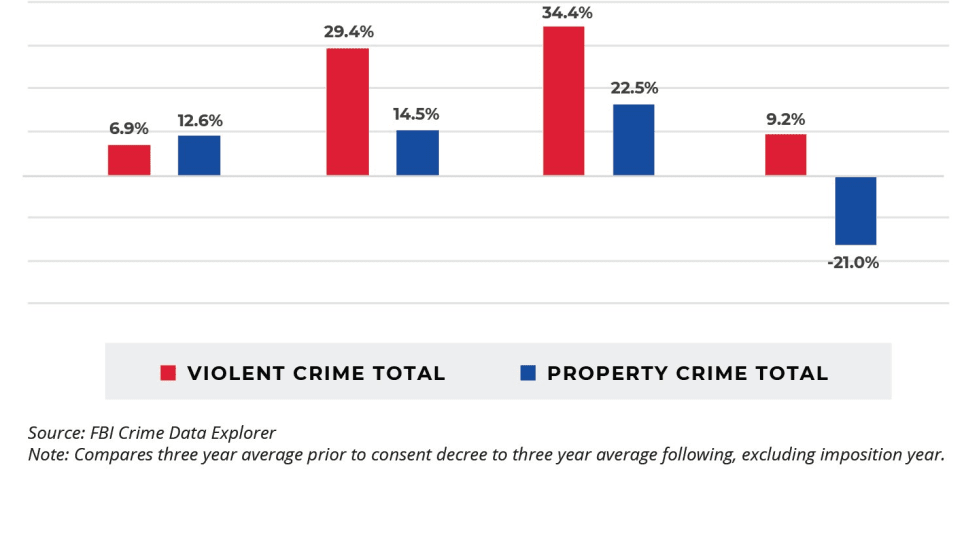
Study Finds Consent Decrees Onerous, Ineffective, and Often Harmful
The report concludes: “When a consent decree is truly warranted, it must focus on the most urgent concerns. The violations should be clearly identified and fully supported by rigorous evidence."
Read More →DOJ and Consent Decree Monitor Praise Albuquerque PD for Reforms
Monitors tracking civilian oversight, one of the largest remaining roadblocks in reaching full compliance, called it “a mess” that was being cleaned up, and advocates applauded the work done by the department to come so far, so fast.
Read More →
Portland Loosens Restrictions on Vehicle Pursuits
“We have seen a significant propensity for criminal suspects to elude traffic stops, often driving extremely dangerously despite no officers chasing them,” the Bureau said in a statement.
Read More →