



Van Jones: A Window Into Extreme Leftist Thinking
Generally, I don't pay a lot of attention to the mutterings of extreme partisans on either side of the political divide. But a recent Rolling Stone interview with former Obama administration Green Jobs advisor Van Jones gave such insight into the brain waves of extreme leftists that it got me thinking.


Photo: Wikimedia
Generally, I don't pay a lot of attention to the mutterings of extreme partisans on either side of the political divide. But a recent Rolling Stone interview with former Obama administration Green Jobs advisor Van Jones gave such insight into the brain waves of extreme leftists that it got me thinking.
Jones is author and co-author of two books. His latest, called "Rebuild the Dream," currently holds the number 25 spot on the New York Times Bestseller List. He also served as Special Advisor for Green Jobs, Enterprise, and Innovation at the White House Council on Environmental Quality in the early days of the Obama administration.
Jones was deposed from his White House czar throne in 2009 when right-wing partisans discovered that he was a Marxist, a supporter of convicted cop killer Mumia Abu-Jamal, and he had signed a 911Truth petition. Still, he remains a darling of MoveOn.org, the Occupy Movement, and other left-wing groups.
Which is why he is doing interviews in Rolling Stone. Now that we've established the identity of Mr. Jones, we can discuss what he had to say in Rolling Stone. Talking about patriotism he said that conservative Americans who describe themselves as patriots "seem to resent most of America's achievements over the last century, including unions and public education and environmental protection."
And that got me to thinking. What really were America's greatest achievements during the 20th century? It’s a 100-year period that historians call "The American Century," and for good reason. First let's look at what Jones refers to as our greatest achievements:
Unions: I find it kind of interesting that Mr. Jones believes unions are an American achievement of the 20th century, since trade unionism grew out of the Industrial Revolution in Europe and America in the 19th century.
Public Education: Again, this is a 19th-century development, although it was certainly critical to American success in the 20th century.
Environmental Protection: At first when this concept was developed by Teddy Roosevelt it was that the government would conserve some wild lands and resources for future generations. Environmental protection as we know it today sprung up with the publication of Rachel Carson's "Silent Spring" in 1962. That book led to the establishment of the Environmental Protection Agency.
Depending on your point of view, you can argue that Jones' list includes major achievements of American culture in the 20th century. But I think they pale in comparison to some of the following:
The Civil Rights Movement—Americans who had been oppressed for 400 years rose up and demanded equality, and they transformed society with relatively little violence when compared to other cultural upheavals.
Computers—From the gymnasium-sized Eniac in 1946 to the first home systems in the 1970s, American engineers created a technology that turned science fiction into reality.
Victory in World War I and World War II—The first generation of Americans born in the 20th century went to Europe to defeat German imperialism. The second generation of 20th-century Americans joined with the Allies to defeat fascism and destroy imperial Japan. More remarkable, those same Americans then extended a hand of friendship to their former enemies.
The Moon Shot—Americans were the first to set foot on another world, and we are still enjoying the technologies developed for this remarkable achievement.
And what about this one:
The World's Most Professional Law Enforcement—You could argue that the English really developed the first professional police corps, and you would be right. But Americans have taken this concept far beyond what the 19th-century Brits could have ever envisioned.
From the formation of the FBI in 1935 to the rise of police officer standards in the latter part of the century, Americans in the 20th century developed the most professional and civilized law enforcement corps the world had ever seen.
Certainly some of the evidence rules and use-of-force laws established in the late 1900s cause you frustration, especially when you know that the guy you just arrested is guilty as sin, but the result of those laws and rules and your training is that you reflect the best aspects of your nation. No other people in any other era could say that about their police. And that's a major American achievement of the American Century, even if Mr. Jones would never admit it.
More Patrol

Adept Armor Introduces Two New Rifle Plates
Adept Armor has launched two new Level IV ballistic plates, the Emperor and the Archon Mark 2, which brings Adept Armor’s new Quatroid ceramic to the high-threat, performance-value center of the range at 5.2 pounds.
Read More →
POLICE Product Test: Benchmade Bailout
The Benchmade Bailout is a slim, lightweight carry knife with a deep-ride pocket clip and comes in a variety of blade steels and scales. Here is a detailed review of the Taiga Green Bailout, released earlier this year.
Read More →
NLEOMF Announces July 2026 Officer of the Month
NLEOMF honored a Michigan deputy sheriff as the July 2026 Officer of the Month for rescuing a trapped driver from a burning vehicle following a Fourth of July crash.
Read More →
Streamlight to Showcase Newest Lighting Products at National Safety Council’s Safety Congress & Expo 2026
Streamlight will showcase its latest lights, including the Portable Scene Light III and the LiteBox 1Million, at the 2026 National Safety Council (NSC) Safety Congress & Expo.
Read More →
The 2027 World Police & Fire Games Set for Perth, Australia
The 2027 World Police & Fire Games (WPFG) will take place in Perth, Western Australia, from Friday, March 12 through Sunday, March 21, 2027.
Read More →
5.11 Partners with National Fallen Firefighters Foundation to Support #ForThe343
5.11 has joined the nationwide movement honoring the 343 New York City Fire Department firefighters lost on Sept. 11, 2001.
Read More →
Team Wendy Announces Title Sponsorship of the Jorge Pastore Foundation
Team Wendy’s 3-year partnership with the Jorge Pastore Foundation expands access to programs that strengthen those who serve.
Read More →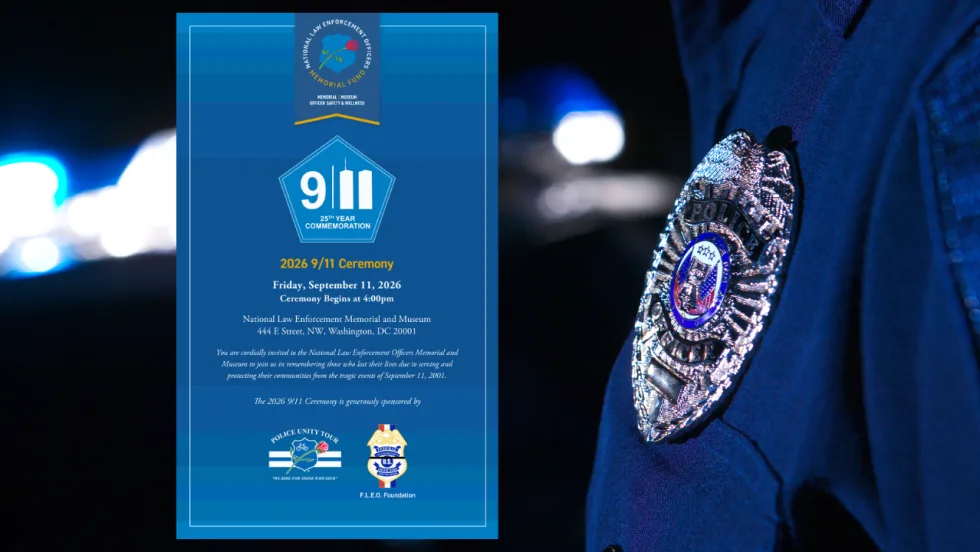
National Law Enforcement Memorial and Museum Hosting 9/11 25th-Year Commemoration Ceremony
The National Law Enforcement Memorial and Museum is hosting a 9/11 25th Year Commemoration Ceremony on Sept. 11 at 4 p.m.
Read More →
National Law Enforcement Officers Memorial Fund Announces June 2026 Officers of the Month
The National Law Enforcement Officers Memorial Fund (NLEOMF) named 15 officers of the Chico Police Department (California) as the Officers of the Month for June 2026 for their roles in responding to an active-shooter incident at a public library.
Read More →
Team Wendy App Creates New Digital Hub for Helmet Owners
The Team Wendy Community App provides one location for warranty registration, size-fit tools, product updates, and community connection. For helmet owners, the new app creates a simpler path to the information and tools that matter most.
Read More →