



The School of Hard Knocks
The introduction comes in the form of a three-minute round of body sparring in a 6X6-foot ring against the trainers, all noted martial artists and police DT instructors in their own right. Both the students and the instructors wear 16-ounce boxing gloves and headgear, but they still get hit and it still hurts.

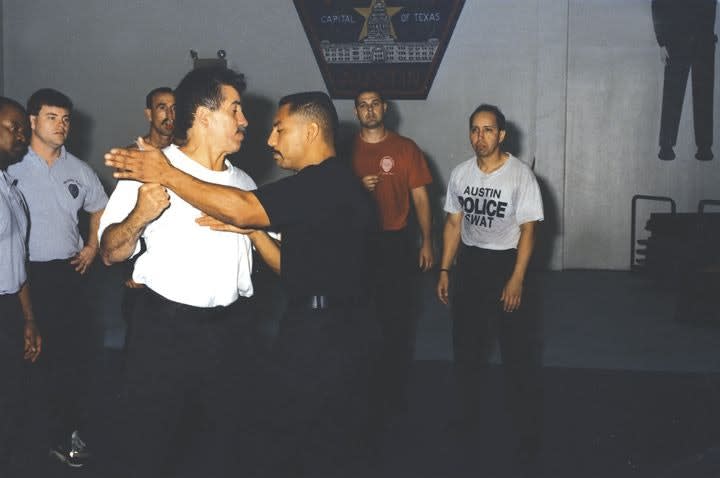
Police Combative Academy principles Louis Marquez, left, and Hans Marrero, right, demonstrate an open-hand technique designed to knock a knife out of a suspect’s hand.
It's 0800 on a sure-to-be-hot Phoenix morning and the diverse group of police defensive tactics trainers arriving at the Police Combative Academy have looks of apprehension and enthusiasm in their eyes.
It's their first day of the Academy's Close Quarter Battle-Level 1 Instructor Course, and they know that before the day is over they will be really tired and really sore, and they will have learned a lot of painful lessons on how to teach their fellow officers how to win when it gets nasty on the street.
CQB is not a classroom program, so the trainers don't spare any time immersing their students in physical combat. The first thing the students learn is how to wrap their hands properly in preparation for their introduction to the program.
The introduction comes in the form of a three-minute round of body sparring in a 6X6-foot ring against the trainers, all noted martial artists and police DT instructors in their own right. Both the students and the instructors wear 16-ounce boxing gloves and headgear, but they still get hit and it still hurts.
Police Combative Academy trainer and principle Louis Marquez says the point of this first exercise is not to convince the students that the instructors are better fighters, nor is it to inflict pain. Its purpose, according to Marquez, is to change the students' mindsets and teach them some vivid lessons about street combat.
"The three-minute round is critical to the success of the program," explains Marquez, a retired Austin (Texas) Police Department SWAT officer. "It dispels many defensive tactics myths, including myths about the length of the usual officer-subject confrontation. It also alerts the students to their own strengths and weaknesses. And it sets the tone for the rest of the week."
Ambitious and Demanding
That tone is hard work, lots of sweat, and a crash course on numerous techniques for defeating armed and unarmed adversaries in street combat. Topics covered include but are not limited to: ground fighting, weapons retention, weapons disarming, edged weapons, fighting stances, multiple attackers, joint manipulations, effective pressure point tactics, weapons of opportunity, offensive mindset, target selection, and how to override an attacker's central nervous system.
"Our curriculum is ambitious and demanding," says Police Combative Academy principle Hans Marrero. "I don't know of anything else like it in the field of police defensive tactics. It's an intensive five days with over 50 hours of hands-on instruction. And all of the attacks, counters, and defensive techniques that we teach are performed at real-time and real-speed."
However, just because the Academy's CQB instructor program is intensely physical that doesn't mean that it should be reserved for SWAT officers or elite athletes. "Anybody in good shape can take our program," says Marrero, a retired Marine Corp gunnery sergeant and martial arts expert. "And it's not gender-restrictive. So you don't have to be some big hulking guy to successfully complete the course. We've had both male and female graduates, and they've ranged in size and weight from five-two, 100 pounds, to six-four, 240 pounds."
The CQB instructor course is also about more than just fighting. Marquez says the program was designed to not only teach instructors how to teach their students to win street confrontations, it also helps attendees cultivate the physical, philosophical, and leadership qualities necessary to train officers effectively. The program incorporates learning modules on the concepts of leadership, honor, duty, responsibility, and police ethics, and it was recently added to the College of William and Mary's MBA curriculum.[PAGEBREAK]Passing It On
The idea behind the Police Combative Academy is a tried-and-true strategy of training one individual to take the information back to his or her agency. Consequently, Marquez and Marrero say they are very selective about who they choose to accept into the instructor program.
"It's an enormous responsibility," says Marrero. "The instructor is responsible for the well-being of and safety of their students and teaching them the right way to win in life-and-death confrontations. This is why we are so selective and demanding when it comes to awarding our trainer certifications. We don't award certifications for trainers or instructors unless they've earned them. Our standards are incredibly high and they're hard to meet. That's why our CQB Certifications are so coveted in the law enforcement-defensive tactics arena."
In order to achieve instructor certification from the Academy, students are required to clear a number of performance hurdles during the week-long course. For example, students must demonstrate to the trainers that they can expertly perform a series of six self-defense counters, alone and with a partner under a specific time limit.
"We don't teach officers to be 'survivors,' we teach officers how to be 'victorious.' That's this Academy's core belief and it becomes the officer's mantra by the end of the week's training," Marquez says.
Because the Academy is about teaching officers to win in real street combat, students are not granted the luxury of showing their skills under ideal conditions like they would be in a martial arts "kata" test. "The counters are performed while fresh, while exhausted, outside, inside, under all conditions and in both regular lighting and low light," Marrero explains.
The self-defense counters are just one part of the Police CQB Program. Instructor candidates must also show their proficiency in repelling multiple attackers and fighting on the ground. The ground-fighting module employs an array of "combative techniques" designed to gain control and repel the attack.
Marquez says the key to the program is that it is not about martial arts and fighting. It's about real-world police defensive tactics. "Our program bears little resemblance to sport ground-fighting or mixed martial arts because all of our counters and drills end in a "handcuffing" position. When a cop is faced with a violent individual or with violent individuals, control of those people and the situation is paramount. So our instructors learn how to train their students to assess, counter, control, and resolve the situation."
Because the Academy's training is specifically tailored to police defensive tactics, weapons retention and weapons disarming are major areas of focus in the instructor-training program. Marquez says that in the course of the five-day instructor program, weapons retention and weapons disarming involving handguns, edged weapons, and long guns are examined and drilled from all possible angles of attack.
"The weapons retention and weapons disarmament drills ensure that all of the instructor candidates become competent and comfortable in 'worst case' scenarios," Marquez explains. "We place a lot of emphasis on weapons retention because we know that a large number of officers are killed with their own guns."
Guns are not the only weapons covered in the program. The Academy's trainers include Felix Valencia, an edged weapons expert.
"Felix is one of the preeminent edged weapons trainers in the United States," says Marrero. "And what he teaches through our program thoroughly covers both the offensive capabilities of edged weapons and how to defend against. Considering the prevalence of knives and bad guys who know how to use them out on the streets, we believe this is critical training for all police officers and especially defensive tactics instructors."
Graduation Day
After their final exercise-a cumulative test of both their academic knowledge and physical skills-the students are certified as CQB trainers-level 1. But there's also a "change" in the students, a bonding phenomenon that occurs when cops or soldiers train at this intensity. So the week ends with a formal graduation exercise during which the new trainers are congratulated and welcomed by the training cadre.
There are many benefits gained by the individual officer who completes the Police Combative Academy's CQB instructor program. But the real winner is the officer's agency, which gains a more competent DT trainer who can design, manage, and supervise a better DT program for his or her agency.
The Police Combative Academy's CQB Program has been adopted by numerous agencies throughout the United States and Canada. And it has received medical endorsement from James St. Ville, a prominent Phoenix-area orthopedic surgeon and bio-engineer. St. Ville is also a member of the Police Surgeon's Association.
For further information see the CQB Website at www.policeCQB.com.
More Patrol

Streamlight Portable Scene Light III Wins 2026 OH&S New Product of the Year Award
Streamlight’s Portable Scene Light III has won the 2026 Occupational Health & Safety (OH&S) New Product of the Year Award in the Lighting category.
Read More →
Adept Armor Introduces Two New Rifle Plates
Adept Armor has launched two new Level IV ballistic plates, the Emperor and the Archon Mark 2, which brings Adept Armor’s new Quatroid ceramic to the high-threat, performance-value center of the range at 5.2 pounds.
Read More →
POLICE Product Test: Benchmade Bailout
The Benchmade Bailout is a slim, lightweight carry knife with a deep-ride pocket clip and comes in a variety of blade steels and scales. Here is a detailed review of the Taiga Green Bailout, released earlier this year.
Read More →
NLEOMF Announces July 2026 Officer of the Month
NLEOMF honored a Michigan deputy sheriff as the July 2026 Officer of the Month for rescuing a trapped driver from a burning vehicle following a Fourth of July crash.
Read More →
Streamlight to Showcase Newest Lighting Products at National Safety Council’s Safety Congress & Expo 2026
Streamlight will showcase its latest lights, including the Portable Scene Light III and the LiteBox 1Million, at the 2026 National Safety Council (NSC) Safety Congress & Expo.
Read More →
The 2027 World Police & Fire Games Set for Perth, Australia
The 2027 World Police & Fire Games (WPFG) will take place in Perth, Western Australia, from Friday, March 12 through Sunday, March 21, 2027.
Read More →
5.11 Partners with National Fallen Firefighters Foundation to Support #ForThe343
5.11 has joined the nationwide movement honoring the 343 New York City Fire Department firefighters lost on Sept. 11, 2001.
Read More →
Team Wendy Announces Title Sponsorship of the Jorge Pastore Foundation
Team Wendy’s 3-year partnership with the Jorge Pastore Foundation expands access to programs that strengthen those who serve.
Read More →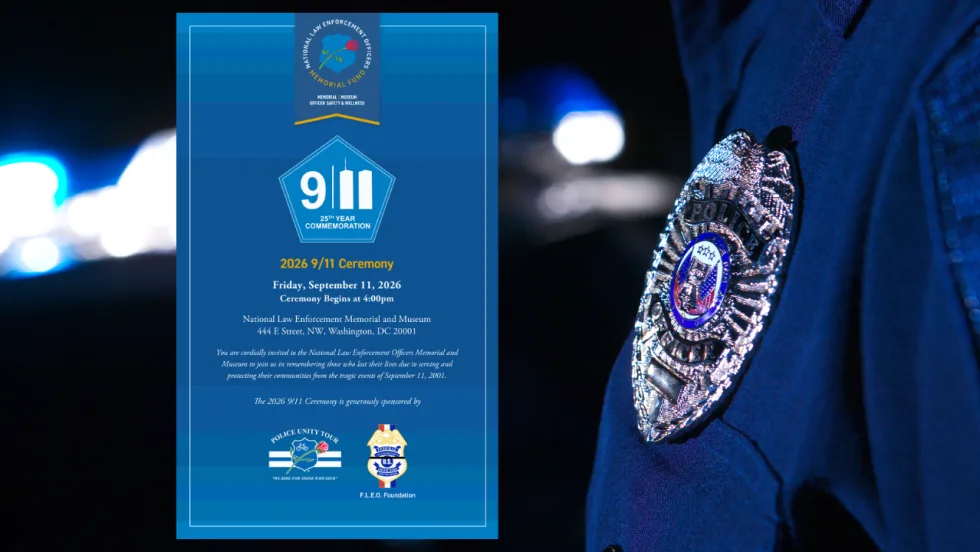
National Law Enforcement Memorial and Museum Hosting 9/11 25th-Year Commemoration Ceremony
The National Law Enforcement Memorial and Museum is hosting a 9/11 25th Year Commemoration Ceremony on Sept. 11 at 4 p.m.
Read More →
National Law Enforcement Officers Memorial Fund Announces June 2026 Officers of the Month
The National Law Enforcement Officers Memorial Fund (NLEOMF) named 15 officers of the Chico Police Department (California) as the Officers of the Month for June 2026 for their roles in responding to an active-shooter incident at a public library.
Read More →