



Stop and Identify
During a temporary detention, does a person have a duty to identify himself or herself to the detaining officer? Can a person be arrested for refusing to do so? The answer to both questions is, "Sometimes."

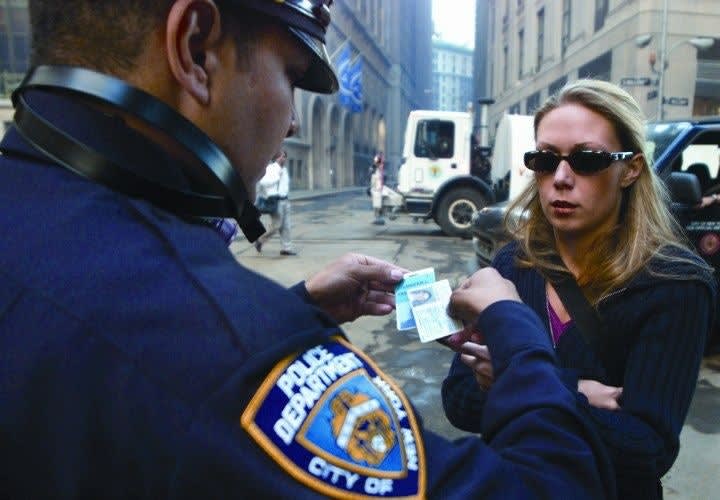
During a temporary detention, does a person have a duty to identify himself or herself to the detaining officer? Can a person be arrested for refusing to do so? The answer to both questions is, "Sometimes."
Luckily for all of us, we're not living in a totalitarian regime where we have to produce identification papers on demand of the secret police. On the other hand, some situations arise where police need to know the identity of a person being detained. Identifying suspects, eliminating non-suspects, running warrant checks, enforcing domestic violence restraining orders, and many other law enforcement duties may require that identification be obtained from the person being detained.
The willful failure to produce ID in such circumstances could amount to unlawful obstruction or delay of official duty, which is an arrestable offense in most jurisdictions. In other circumstances, however, ID may not be required, and the refusal to ID may not necessarily support an arrest. Three significant decisions of the U.S. Supreme Court have addressed this issue, including one decision in the 2004 term of the court.
Brown v. Texas
Zackary Brown was stopped by police officers in El Paso one afternoon in 1977, when they saw him walking away from another man in an alley that had a high incidence of narcotics activity. The officers asked Brown to identify himself and explain what he was doing in the area. He refused and was arrested for violating a state statute that required identification upon being lawfully stopped by a peace officer.
The Supreme Court ruled that police reliance upon the "stop and identify" statute "to detain Brown and require him to identify himself violated the Fourth Amendment because the officers lacked any reasonable suspicion to believe he was engaged or had engaged in criminal conduct."
The general guideline that emerges from this ruling is that ID cannot be demanded from a person you have no reasonable suspicion to detain, and the failure to ID in such a case does not provide probable cause for arrest.
Kolender v. Lawson
Also in 1977, officers in San Diego arrested Edward Lawson when he refused to present identification after being stopped for walking at night in areas with high crime rates. The California statute under which Lawson was arrested required a person to provide "credible and reliable" identification to an officer who stopped him, and to account for his presence.
Although the Supreme Court might simply have applied the holding of Brown v. Texas and ruled the detention unlawful under the Fourth Amendment, the court went further, declaring the statute itself unconstitutional. According to the majority, the California statute was "unconstitutionally vague on its face" because it allowed officers the discretion to decide what kind of ID was sufficiently "credible and reliable" to avoid arrest.
As it had in the Brown case, the Supreme Court in the Kolender case sidestepped the issue of whether, and under what circumstances, an arrest for failure to ID might be constitutionally permissible. The answer waited 27 more years.[PAGEBREAK]
The Hiibel Case
One afternoon in Humboldt County, Nev., a caller told the Sheriff's Department that a man was assaulting a woman in a pickup truck on Grass Valley Road. A responding deputy saw a truck parked on the side of the gravel road with a woman inside and a man outside. The deputy approached the man, Larry Hiibel, and told him there was a reported assault. The deputy requested ID. Hiibel refused to ID. Eleven times.
Hiibel was warned that refusal to ID would result in arrest, and when he continued to refuse to provide any kind of ID, he was arrested and charged with willfully resisting, delaying, or obstructing an officer in the discharge of official duty under a Nevada statute. Hiibel was convicted and appealed to the U.S. Supreme Court, arguing that he had a Fourth and Fifth Amendment right to refuse to identify himself.
This time, the Supreme Court upheld the conviction.
As to the Fourth Amendment issue, the court held that as long as police have a reasonable suspicion that would justify a temporary detention under Terry V. Ohio, a state statute could reasonably require a subject to furnish at least his name without violating the Fourth Amendment. "The principles of Terry permit a State to require a suspect to disclose his name in the course of a Terry stop," said the court. If the refusal to ID amounted to a violation of state law regarding obstruction or delay of an officer, an arrest would not be unlawful.
The court did impose an important qualification, however: "Under these principles, an officer may not arrest a suspect for failure to identify himself if the request for identification is not reasonably related to the circumstances justifying the stop."
This means that a refusal to ID will not always be grounds for arrest. Rather, the circumstances must be such that there is a need to obtain ID for some legitimate investigative or safety purpose related to the activity or suspicions that warranted the stop. In the Hiibel case, for example, the deputy might have needed to determine whether the suspect was the subject of a domestic violence restraining order.
As to Hiibel's Fifth Amendment argument, the court said that the Fifth Amendment only prohibits compelling information of an incriminating nature. Because nothing in the circumstances of this case indicated that merely giving his name was likely to incriminate Hiibel, there was no Fifth Amendment prohibition in requiring ID or arresting for the refusal to ID.
Once again, however, the court left wiggle room for a Fifth Amendment challenge. In any "unusual circumstances" where stating a name might "have given the police a link in the chain of evidence needed to convict the individual of a separate offense," a Fifth Amendment challenge might succeed. (The court gave no examples of any such unusual circumstances.)
Stop, ID, and Arrest
From these cases, a few general rules appear. First, a suspect's initial detention must be justified by a reasonable, articulable suspicion that the person may be involved in criminal activity. This is the familiar Terry rule that applies to both vehicle stops and pedestrian detentions. (But note that in the case of a legitimate vehicle stop for a suspected traffic offense, state laws generally require the driver to display a driver's license, which will satisfy any ID requirement.)
Second, during a justifiable detention, the Fourth Amendment is not violated by a demand for identification to ascertain and verify the person's name.
Third, if the person refuses to ID, an arrest under a statute that criminalizes delay or obstruction of official duty is permissible under the Fourth Amendment, provided there was an evident need to obtain the person's name related to the circumstances justifying the stop.
And fourth, there should be no Fifth Amendment issue with requesting ID and arresting for refusal if the above rules are satisfied and the person's name is not used to provide a necessary link to convict him or her of some other crime.
The ruling inHiibel, of course, takes on additional meaning at a time when the ability to identify detainees may have national security ramifications.
Attorney Devallis Rutledge, a former police officer and prosecutor, defends officers and agencies at Manning & Marder, Kass, Ellrod, Ramirez.
More Patrol

Team Wendy Introduces the EXFIL Endurance Ballistic Helmet, Engineered to Reduce the Burden of Extended Wear
Team Wendy has launched its EXFIL Endurance, a new lightweight ballistic helmet engineered to deliver protection, comfort, and fit during demanding, extended operations.
Read More →
The First Responders Children’s Foundation National First Responders Day Roll Call of Heroes Ceremony Returns to Times Square, NYC
First Responders Children’s Foundation (FRCF), in collaboration with T-Mobile, will host the Roll Call of Heroes ceremony in Times Square to commemorate National First Responders Day on Wednesday, Oct. 28. During the event, FRCF will present 18 Hero Awards.
Read More →
Streamlight to Showcase Newest Lighting Products for Law Enforcement Professionals at IACP 2026
Streamlight will showcase its newest lights for law enforcement at the International Association of Chiefs of Police Annual Conference & Expo. Featured lights will include the TLR-3 X, the PolyTac 1X, and more.
Read More →
Streamlight Portable Scene Light III Wins 2026 OH&S New Product of the Year Award
Streamlight’s Portable Scene Light III has won the 2026 Occupational Health & Safety (OH&S) New Product of the Year Award in the Lighting category.
Read More →
Adept Armor Introduces Two New Rifle Plates
Adept Armor has launched two new Level IV ballistic plates, the Emperor and the Archon Mark 2, which brings Adept Armor’s new Quatroid ceramic to the high-threat, performance-value center of the range at 5.2 pounds.
Read More →
POLICE Product Test: Benchmade Bailout
The Benchmade Bailout is a slim, lightweight carry knife with a deep-ride pocket clip and comes in a variety of blade steels and scales. Here is a detailed review of the Taiga Green Bailout, released earlier this year.
Read More →
NLEOMF Announces July 2026 Officer of the Month
NLEOMF honored a Michigan deputy sheriff as the July 2026 Officer of the Month for rescuing a trapped driver from a burning vehicle following a Fourth of July crash.
Read More →
Streamlight to Showcase Newest Lighting Products at National Safety Council’s Safety Congress & Expo 2026
Streamlight will showcase its latest lights, including the Portable Scene Light III and the LiteBox 1Million, at the 2026 National Safety Council (NSC) Safety Congress & Expo.
Read More →
The 2027 World Police & Fire Games Set for Perth, Australia
The 2027 World Police & Fire Games (WPFG) will take place in Perth, Western Australia, from Friday, March 12 through Sunday, March 21, 2027.
Read More →
5.11 Partners with National Fallen Firefighters Foundation to Support #ForThe343
5.11 has joined the nationwide movement honoring the 343 New York City Fire Department firefighters lost on Sept. 11, 2001.
Read More →