



Saving Money Through Training
Officers who fall behind on core training and who stop getting regular updates on recent case law become a civil liability to themselves and their employers.

This is my fifth recession since entering law enforcement more than 40 years ago. I've seen the same pattern repeated enough times to be able to predict the law enforcement ramifications of the current economic downturn. Here's what happens.
First, there's a hiring and spending freeze in most law enforcement agencies. Then promotions and raises slow down. Economic crimes increase significantly throughout the duration of the recession—drug sales, thefts, burglaries, frauds, and robberies (and when robberies go up, the murder rate follows). Even domestic violence increases, as frustrated, out-of-work people lose patience and take out their problems on spouses and children.
Because departments are unable to replace retiring and departed officers, most jurisdictions will have fewer officers confronting bigger caseloads. That causes clearance rates to decline, and that's not good news in a country where we're able to clear only 62 percent of murders, 40 percent of rapes, 26 percent of robberies, and 12 percent of burglaries and auto thefts in the best of times. (FBI Uniform Crime Reports, 2007)
What's the first budget item most departments cut? Training. Training is considered nonessential—a luxury that's affordable in good times, but something no one will miss when the dollars get tight. But I've also seen the price agencies pay down the road after they cut training, and it's often much higher than the cost of continued training would have been.
Put simply, officers who fall behind on core training and who stop getting regular updates on recent case law become a civil liability to themselves and their employers. Within six to 18 months after necessary training is curtailed, claims and lawsuits start pouring in. One particular cause of action, known as a "Canton claim," will multiply, because it's based on a department's failure to train.
City of Canton, Ohio v. Harris
Individual officers can be sued under the federal civil rights statute for violating a person's constitutional rights under color of authority. (Title 42, United States Code, section 1983) In Monell v. New York DSS, the U.S. Supreme Court held that a plaintiff could also sue the officer's agency or employing municipality (city or county) if it could be shown that a constitutional violation resulted from an official policy or practice of the department. This sort of claim was expanded in 1989 to allow a lawsuit based on the agency's "deliberate indifference to the duty to train its officers" in the constitutional limits of their authority.
Geraldine Harris sued the City of Canton for allegations of mistreatment while she was in police custody. She argued that the City's failure to provide adequate training to its officers constituted a "policy or practice" that would support a Monell claim. The U.S. Supreme Court agreed. The court held that where a department's obligation to provide ongoing training is obvious and the training is not conducted, this will establish the "deliberate indifference" that creates civil liability. Said the court:
"For example, city policymakers know that their police officers will be required to arrest fleeing felons. The city has armed its officers with firearms, in part to allow them to accomplish this task. Thus, the need to train officers in the constitutional limitations on the use of deadly force can be said to be so obvious that failure to do so could properly be characterized as 'deliberate indifference' to constitutional rights." (Canton v. Harris)
[PAGEBREAK]
Examples of Canton Claims
It is common for plaintiffs' attorneys who are suing officers over alleged violations of constitutional rights to include a Canton claim. If the jury finds that the officer did indeed violate the standards laid down in some controlling court decision, the employer can also be liable on the Canton claim if the evidence establishes that officers were denied training necessary to prevent the kind of violation that occurred.
In Bordanaro v. McLeod, for example, a federal appeals court found that a Massachusetts city could be held liable under Canton where departmental training "failed to address contemporary law enforcement issues, specifically up-to-date standards governing search and seizure, hot pursuit, and the use of deadly force."
Other federal appellate decisions have affirmed Canton claims for failing to train officers regarding to their due process duties not to suppress evidence favorable to the defense (Walker v. City of New York); or for failure to train on arrest and use-of-force law (Brown v. Bryan County, Oklahoma); or for omitting training on how to handle intoxicated persons. (Kniepp v. Philadelphia)Davis v. Mason County illustrates the principle that the cost of neglecting training can be far higher than the price of providing it. Five sheriff's deputies were sued for using excessive force when making arrests. The four plaintiffs also alleged that the sheriff and the county had been deliberately indifferent to their duty to train. After evidence at trial showed that deputies had not been provided with updated training on the constitutional limits on the use of force, the jury returned verdicts against the officers and the agency.
The judgment against Mason County included $528,000 in compensatory damages, $320,000 in punitive damages against the individual deputies, and $323,560 in attorney's fees and costs. The deliberate indifference of the sheriff's department to the duty to train deputies may have saved some training expense, but it wound up costing the county $1,171,560. On appeal, the full judgment was upheld, the appellate court concluding that "The training that the deputies received was woefully inadequate, if it can be said to have existed at all."
A "Conscious Choice" Not to Train
In discussing the "deliberate indifference" standard in Canton, the Supreme Court said this: "Where a failure to train reflects a deliberate or conscious choice by a municipality, a city can be liable for such a failure under § 1983." In other words, if a sheriff, police chief, or public safety director makes a conscious choice to cut training as a cost-saving step, and if the lack of training then results in an officer violating a person's constitutional rights, the agency head or the municipality may be subject to damages for deliberate indifference to the duty to train, under Canton.
When a budget squeeze does require some measured reduction in training, the prudent officer will seek out legal updates on his or her own, in order to stay abreast of recent developments. And the prudent agency head will try to find cost-effective ways to continue to provide training on constitutional law topics, including new case decisions on search and seizure, interrogation, identification procedures, and disclosure of evidence. Instead of sending officers away to seminars, for example, it may be wiser to bring instructors to the officers. Increased use of video, Internet training, and professional publications can help. POLICE Magazine brings you timely coverage of significant new constitutional decisions in monthly "Point of Law" articles and other features by a variety of experts.
A reflexive decision to start every budget-cutting cycle with a suspension of training may amount to a "deliberate or conscious choice" not to train. Such a step may not be in the agency's or municipality's long-term financial interest. The cost of training is a relative bargain, compared to the price of neglecting it.
Devallis Rutledge is a former police officer and veteran prosecutor who currently serves as Special Counsel to the Los Angeles County District Attorney. He is the author of 11 books, including "Courtroom Survival, The Officer's Guide to Better Testimony."
More Patrol

Adept Armor Introduces Two New Rifle Plates
Adept Armor has launched two new Level IV ballistic plates, the Emperor and the Archon Mark 2, which brings Adept Armor’s new Quatroid ceramic to the high-threat, performance-value center of the range at 5.2 pounds.
Read More →
POLICE Product Test: Benchmade Bailout
The Benchmade Bailout is a slim, lightweight carry knife with a deep-ride pocket clip and comes in a variety of blade steels and scales. Here is a detailed review of the Taiga Green Bailout, released earlier this year.
Read More →
NLEOMF Announces July 2026 Officer of the Month
NLEOMF honored a Michigan deputy sheriff as the July 2026 Officer of the Month for rescuing a trapped driver from a burning vehicle following a Fourth of July crash.
Read More →
Streamlight to Showcase Newest Lighting Products at National Safety Council’s Safety Congress & Expo 2026
Streamlight will showcase its latest lights, including the Portable Scene Light III and the LiteBox 1Million, at the 2026 National Safety Council (NSC) Safety Congress & Expo.
Read More →
The 2027 World Police & Fire Games Set for Perth, Australia
The 2027 World Police & Fire Games (WPFG) will take place in Perth, Western Australia, from Friday, March 12 through Sunday, March 21, 2027.
Read More →
5.11 Partners with National Fallen Firefighters Foundation to Support #ForThe343
5.11 has joined the nationwide movement honoring the 343 New York City Fire Department firefighters lost on Sept. 11, 2001.
Read More →
Team Wendy Announces Title Sponsorship of the Jorge Pastore Foundation
Team Wendy’s 3-year partnership with the Jorge Pastore Foundation expands access to programs that strengthen those who serve.
Read More →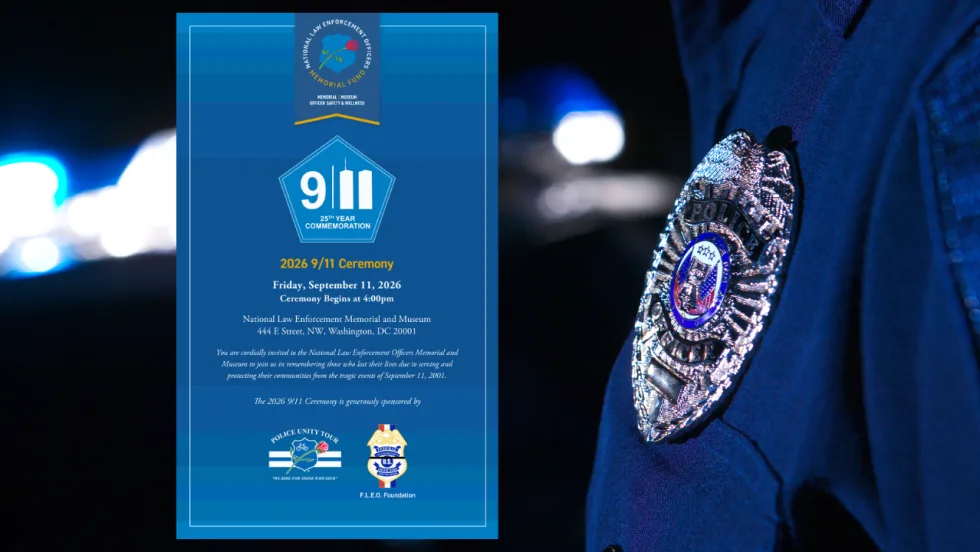
National Law Enforcement Memorial and Museum Hosting 9/11 25th-Year Commemoration Ceremony
The National Law Enforcement Memorial and Museum is hosting a 9/11 25th Year Commemoration Ceremony on Sept. 11 at 4 p.m.
Read More →
National Law Enforcement Officers Memorial Fund Announces June 2026 Officers of the Month
The National Law Enforcement Officers Memorial Fund (NLEOMF) named 15 officers of the Chico Police Department (California) as the Officers of the Month for June 2026 for their roles in responding to an active-shooter incident at a public library.
Read More →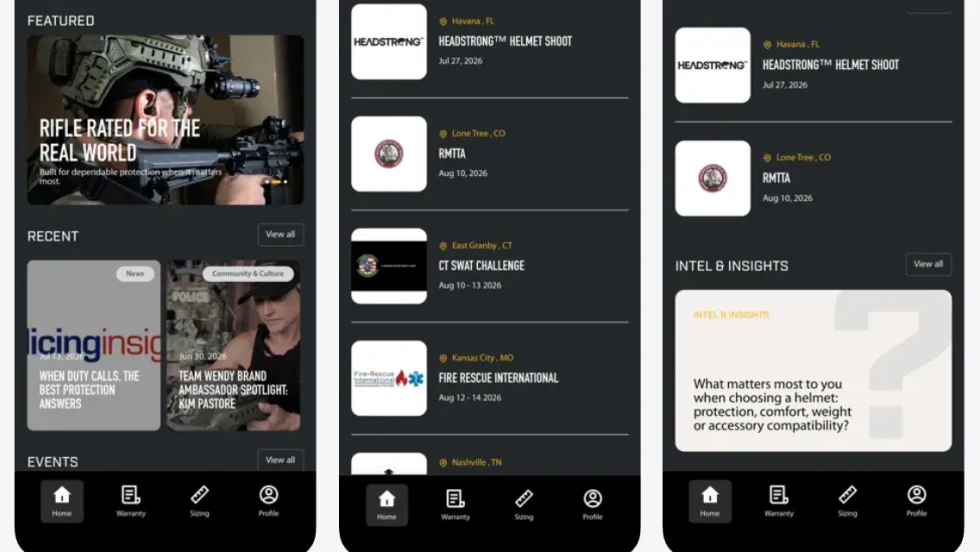
Team Wendy App Creates New Digital Hub for Helmet Owners
The Team Wendy Community App provides one location for warranty registration, size-fit tools, product updates, and community connection. For helmet owners, the new app creates a simpler path to the information and tools that matter most.
Read More →