



Robbery in Progress
As you approach the store's entrance, you realize the clerk is being robbed at gunpoint. As far as you can tell, no one else is in the store. You also note that there are two people getting gas at the pumps and there are no other people around.

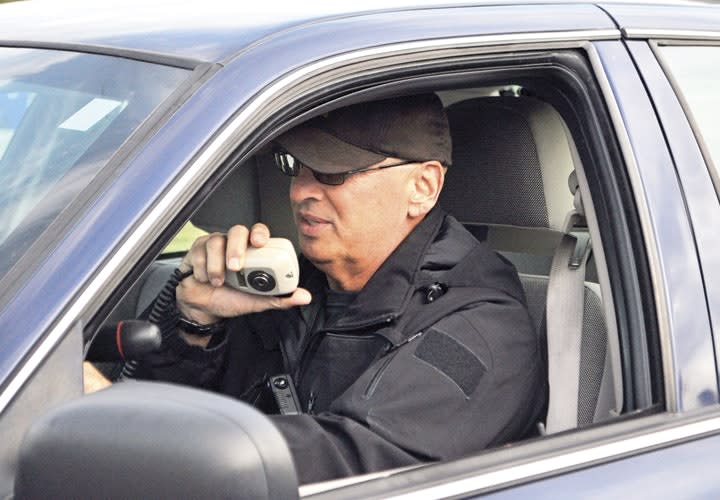
Photo: Amaury Murgado
In every call for service, you should think things through before you begin your response. Each call can be broken down into three phases: pre-response, response, and post response. The following scenario is designed to help you think things through rather than give you a specific way to handle the call.
Situation
It's 10:00 on a Sunday when you arrive at a convenience store to get a cup of coffee. You pay attention to officer safety considerations and drive up from an angle that allows you to see the parking lot and inside the store. You take a few seconds to look around, don't see anything suspicious, and you decide to park. You call dispatch to advise them you will be checked out at the store for a few minutes. You park on the blind side of the building and get out of your patrol car.
As you approach the store's entrance, you realize the clerk is being robbed at gunpoint. As far as you can tell, no one else is in the store. You also note that there are two people getting gas at the pumps and there are no other people around.
Initial Thoughts
You have several things in your favor. You parked your patrol car out of view, dispatch already knows where you are in case things go bad, and you haven't been seen by the suspect yet. Though you can't see anyone else in the store, you can't confirm there isn't another employee in the back or someone in the bathroom. You are fortunate that there are only two people at the pumps getting gas.
Because there is no one else around, you can focus on what's going on inside the store. You have to make use of your time because there is no telling when the suspect will leave or if he will decide to hurt someone.
Pre-Response
Think It Through:
1. Do you have a clear picture of the situation thus far?
2. What are your priorities?
3. How do you plan for now and yet consider what might happen later?
4. Do you set up to rush-in or wait until the suspect comes out?
In order to get a clear picture of what you are facing, you need to take inventory of your situation. Take a quick 360-degree look around so you know what to factor in. Right now the only thing you know for sure is what you see.
Your priorities always start and end with the preservation of life. Focus on the now and plan for contingencies if you have time. Though you don't know the full intentions of the suspect, you do know the suspect has covered his face, hasn't hurt the clerk, and has not fired his gun in anger. Your experience tells you that more often than not, under these circumstances, the suspect will take the money and run. For your planning and decision-making framework, you decide to treat this as a barricaded suspect with a hostage.
If the suspect starts shooting, it changes the situation to an active shooter and you have to take immediate action. For now, that becomes your only contingency.
Response
Think It Through:
1. How do you secure the parking lot?
2. What information are you going to give dispatch?
3. What instructions are you going to give your backup?
4. How will you set up on the suspect?
Since the only two people in the area are getting gas, you decide to call it in before acting. You only give dispatch a quick rundown and ask for emergency traffic. You know that during the first few moments of an in-progress call, responding units have poor radio discipline and will be stepping all over themselves on the radio. That gives you enough time to order the bystanders to get in their cars and leave. After you do, one drives off and the other just runs away, leaving his car near the pumps.
As the radio traffic dies down you're able to tell your backup where you want them over the radio. You are fortunate enough that you have several officers on their way. Using the number system, where the number one is always the front of the building and the rest of the numbers are assigned in a clockwise direction, you ask that the closest officer take side three (the back) and the next closest meet you at the corner of side one and four where you parked.
You have decided that it's better to take the suspect down outside rather than rush in and risk the clerk getting shot, or risk being spotted and forcing a hostage situation. You plan to capitalize on the element of surprise by ambushing the suspect. You are counting on changing his O.O.D.A. Loop (observe, orient, decide, act) by giving him a stimulus he was not expecting but now has to consider.
Once a second officer arrives, you motion to her to set up on you. She takes up a position near the pumps by the parked car that was left by the citizen who ran. This allows two separate fields of view on the target and takes care of any potential cross-fire. She barely gets in position when the suspect comes out of the door and moves into the parking lot.
As you yell, "Police, drop your gun!" the suspect instinctively turns toward the sound of your voice. Your backup sees this and follows with "Drop the gun now!" The suspect looks like he wants to run, but hesitates long enough to realize there are two of you, thinks better of it, and drops the gun. Your ambush took away his initiative and changed his O.O.D.A. Loop. If he had tried to shoot, he was out in the open and both of you had a strong shooting position behind cover.
Using your backup as a cover officer, you go through your felony arrest procedures and secure the suspect. You call off the rest of your backup and clear the channel from emergency traffic. While your backup deals with your prisoner, you make sure no one got hurt inside the store, secure the crime scene, and start your paperwork.
Post-Response
Think It Through:
1. What are your priorities now that the suspect is secured?
2. What needs to be done as far as the crime scene?
3. What do you need to shore up the case?
Once the suspect is secured you go into paperwork mode. However, you need to maintain your perspective; this is your case and you are still working your investigation. Your next priority is evidence collection and crime scene preservation.
You need to control the crime scene, start a crime scene log, and think about processing. You need to get a detailed written statement and ask if there is any surveillance video. Depending on your policies, you might consider getting your detectives involved with the interview of the suspect.
Final Thoughts
There are no hard and fast rules for tactics other than the situation itself will guide you on what to do. We tailor our tactics to meet our needs. For example, we are often taught that only one person should give commands so as not to create any confusion. But in this case, we used confusion as a tactic to affect the suspect's O.O.D.A. Loop.
We chose to handle the suspect outside rather than inside. This choice has pros and cons and can be argued ad infinitum. Your only guide is the totality of the situation, and each call is different. Your choice could have been made for you if the suspect saw you and never came outside.
There are always multiple possibilities and potential responses. Thinking it through now saves you time later.
Amaury Murgado is a special operations lieutenant with the Osceola County (Fla.) Sheriff's Office. He has been a lifelong student of martial arts.
More Patrol

Team Wendy Introduces the EXFIL Endurance Ballistic Helmet, Engineered to Reduce the Burden of Extended Wear
Team Wendy has launched its EXFIL Endurance, a new lightweight ballistic helmet engineered to deliver protection, comfort, and fit during demanding, extended operations.
Read More →
The First Responders Children’s Foundation National First Responders Day Roll Call of Heroes Ceremony Returns to Times Square, NYC
First Responders Children’s Foundation (FRCF), in collaboration with T-Mobile, will host the Roll Call of Heroes ceremony in Times Square to commemorate National First Responders Day on Wednesday, Oct. 28. During the event, FRCF will present 18 Hero Awards.
Read More →
Streamlight to Showcase Newest Lighting Products for Law Enforcement Professionals at IACP 2026
Streamlight will showcase its newest lights for law enforcement at the International Association of Chiefs of Police Annual Conference & Expo. Featured lights will include the TLR-3 X, the PolyTac 1X, and more.
Read More →
Streamlight Portable Scene Light III Wins 2026 OH&S New Product of the Year Award
Streamlight’s Portable Scene Light III has won the 2026 Occupational Health & Safety (OH&S) New Product of the Year Award in the Lighting category.
Read More →
Adept Armor Introduces Two New Rifle Plates
Adept Armor has launched two new Level IV ballistic plates, the Emperor and the Archon Mark 2, which brings Adept Armor’s new Quatroid ceramic to the high-threat, performance-value center of the range at 5.2 pounds.
Read More →
POLICE Product Test: Benchmade Bailout
The Benchmade Bailout is a slim, lightweight carry knife with a deep-ride pocket clip and comes in a variety of blade steels and scales. Here is a detailed review of the Taiga Green Bailout, released earlier this year.
Read More →
NLEOMF Announces July 2026 Officer of the Month
NLEOMF honored a Michigan deputy sheriff as the July 2026 Officer of the Month for rescuing a trapped driver from a burning vehicle following a Fourth of July crash.
Read More →
Streamlight to Showcase Newest Lighting Products at National Safety Council’s Safety Congress & Expo 2026
Streamlight will showcase its latest lights, including the Portable Scene Light III and the LiteBox 1Million, at the 2026 National Safety Council (NSC) Safety Congress & Expo.
Read More →
The 2027 World Police & Fire Games Set for Perth, Australia
The 2027 World Police & Fire Games (WPFG) will take place in Perth, Western Australia, from Friday, March 12 through Sunday, March 21, 2027.
Read More →
5.11 Partners with National Fallen Firefighters Foundation to Support #ForThe343
5.11 has joined the nationwide movement honoring the 343 New York City Fire Department firefighters lost on Sept. 11, 2001.
Read More →