



Missing Elderly Man with Dementia
You get a call about a missing elderly white male who left his residence somewhere between 21:00 and 04:00 while his caregiver was sleeping. The gentleman is 74 years old and expected to be walking in dress clothes. He has a habit of wandering off.


In every call for service, you should think things through before you begin your response. Each call can be broken down into three phases: pre-response, response, and post-response. The following scenario is designed to help you think things through rather than give you a specific way to handle the call.
Situation
You get a call about a missing elderly white male who left his residence somewhere between 21:00 and 04:00 while his caregiver was sleeping. The gentleman is 74 years old and expected to be walking in dress clothes. He has a habit of wandering off but lately the problem has compounded because he has been diagnosed with dementia and is in the early stages of Alzheimer's. The man hasn't eaten since dinner time (18:00) and his caregiver advises he has recently been talking a great deal about his deceased wife and often wonders where she is.
Initial Thoughts
You have some experience with this person because he is listed in your wanderers program at the agency. You have a complete history and a list of emergency contacts. You also have access to all the reports generated in the past to see where he has been found before. You worry about the dementia/Alzheimer's part because that adds another dimension to an already complicated situation. It's no longer an issue of someone strutting his last vestiges of independence but someone who does not comprehend reality very well. He doesn't drive, which should limit your search area unless he called a taxi or a Good Samaritan drove him out of the area. The initial search is the same as for any missing person. If that fails you will have to get creative and be prepared for the long haul.
Pre-Response
Think It Through Questions
How many people are needed to secure the area?
Do you have any new places to search?
Is a K-9 bloodhound available?
Is the information in your database up to date?
In cases like this, the initial set-up is the same. Secure the last known exit point for the bloodhound, get any updated information on the missing person, and start the search. Check the house and property first and then expand to a structured search pattern after. Make sure that the caregiver who is reporting the incident stays put and waits for the initial responding officer. You also make sure that an updated description has been given out in case one of the responding officers spots the missing man on the way in to the call.
Response
Think It Through Questions
What can you do to work smarter?
What can you do in order to focus your search in the most probable area?
Does a detective need to respond in case of foul play?
How long do you search before you stop?
The keys to the kingdom are with the caregiver. You must conduct a thorough debrief because only she can give you the clues you need. How has the victim's behavior changed? Does his talking more about his wife provide any clues as to where he might be heading? Has he made any references to past friends, workmates, or favorite spots that can be useful? While that's going on, you organize a structured search. You assign officers distinct zones. Once done, the officers come back to the command post and get their next assignment. You also assign a roving patrol that has no determined search pattern. That officer searches roadways and waits for any specific assignments as created by new information.
You also work in tandem with your dispatch to call taxi companies, local hospitals, and adjoining jurisdictions for any word of a found person or John Doe. You review the list of past locations and compare it with what the caregiver gave you.
After about an hour, the man is still missing. The bloodhound didn't track anywhere and the helicopter hasn't seen anyone. There have been no calls of an elderly gentleman all dressed up walking the streets. That's when it occurs to you to ask the caregiver where the victim's wife was buried. You know that with this type of condition, moments of lucidity are often possible. You have a hunch and send your roving patrol to the cemetery. Just 20 minutes later, he is found by his wife's grave. The officer finds the victim crying and asking when his wife died and why wasn't he told. You know it's going to be one of those sad nights but he is returned home unharmed. You log the new location in your database.
Post-Response
Think It Through Questions
How could you miss the cemetery in the first stages of the search?
Did you debrief the caregiver well enough?
How can you stop this from happening again?
Is there any way you could improve your response?
I have handled calls like this where the missing elderly person just kept hiding as our officers came near. I had one that hid in a culvert and the helicopter could never see him. One time an elderly gentleman was found on a swing in a local park. The assigned officer never checked it even though he stated he had. Usually one just gets out of bed in the middle of the night, gets dressed, and leaves seemingly without a reason. The key is to figure out the reason. Make sure you search the house for clues and debrief the caregiver. Sometimes the answer lies in what the people took with them, how they were dressed, or what they said the night before. Make sure you discuss all these things with everyone involved before you cut them loose.
Final Thoughts
We started a wanderer file in my agency's database for situations just like this. Although it was helpful in that it provided emergency contact information and a way to flag reports, it didn't really do much of anything else. Over the years we suggested using tracking devices that we could use in cooperation with habitual wanderers' families. The last time I looked there were at least 10 lifesaving location devices available. Although we could never get one adopted at our agency I would strongly suggest looking into it as an option for yours.
My agency currently promotes a program called MedicAlert + Alzheimer's Association Safe Return. It's a 24-hour national response service that requires a yearly fee. It does not include a location device but does include some type of jewelry with a corresponding ID number that taps into a national database that helps reunite the missing person with his or her family. There are always multiple possibilities and potential responses. Thinking it through now saves you time later.
Amaury Murgado is a special operations lieutenant with the Osceola County (Fla.) Sheriff's Office. He has over 28 years of law enforcement experience, is a retired master sergeant from the Army Reserve, and holds a Master of Political Science from the University of Central Florida.
More Patrol

Adept Armor Introduces Two New Rifle Plates
Adept Armor has launched two new Level IV ballistic plates, the Emperor and the Archon Mark 2, which brings Adept Armor’s new Quatroid ceramic to the high-threat, performance-value center of the range at 5.2 pounds.
Read More →
POLICE Product Test: Benchmade Bailout
The Benchmade Bailout is a slim, lightweight carry knife with a deep-ride pocket clip and comes in a variety of blade steels and scales. Here is a detailed review of the Taiga Green Bailout, released earlier this year.
Read More →
NLEOMF Announces July 2026 Officer of the Month
NLEOMF honored a Michigan deputy sheriff as the July 2026 Officer of the Month for rescuing a trapped driver from a burning vehicle following a Fourth of July crash.
Read More →
Streamlight to Showcase Newest Lighting Products at National Safety Council’s Safety Congress & Expo 2026
Streamlight will showcase its latest lights, including the Portable Scene Light III and the LiteBox 1Million, at the 2026 National Safety Council (NSC) Safety Congress & Expo.
Read More →
The 2027 World Police & Fire Games Set for Perth, Australia
The 2027 World Police & Fire Games (WPFG) will take place in Perth, Western Australia, from Friday, March 12 through Sunday, March 21, 2027.
Read More →
5.11 Partners with National Fallen Firefighters Foundation to Support #ForThe343
5.11 has joined the nationwide movement honoring the 343 New York City Fire Department firefighters lost on Sept. 11, 2001.
Read More →
Team Wendy Announces Title Sponsorship of the Jorge Pastore Foundation
Team Wendy’s 3-year partnership with the Jorge Pastore Foundation expands access to programs that strengthen those who serve.
Read More →
National Law Enforcement Memorial and Museum Hosting 9/11 25th-Year Commemoration Ceremony
The National Law Enforcement Memorial and Museum is hosting a 9/11 25th Year Commemoration Ceremony on Sept. 11 at 4 p.m.
Read More →
National Law Enforcement Officers Memorial Fund Announces June 2026 Officers of the Month
The National Law Enforcement Officers Memorial Fund (NLEOMF) named 15 officers of the Chico Police Department (California) as the Officers of the Month for June 2026 for their roles in responding to an active-shooter incident at a public library.
Read More →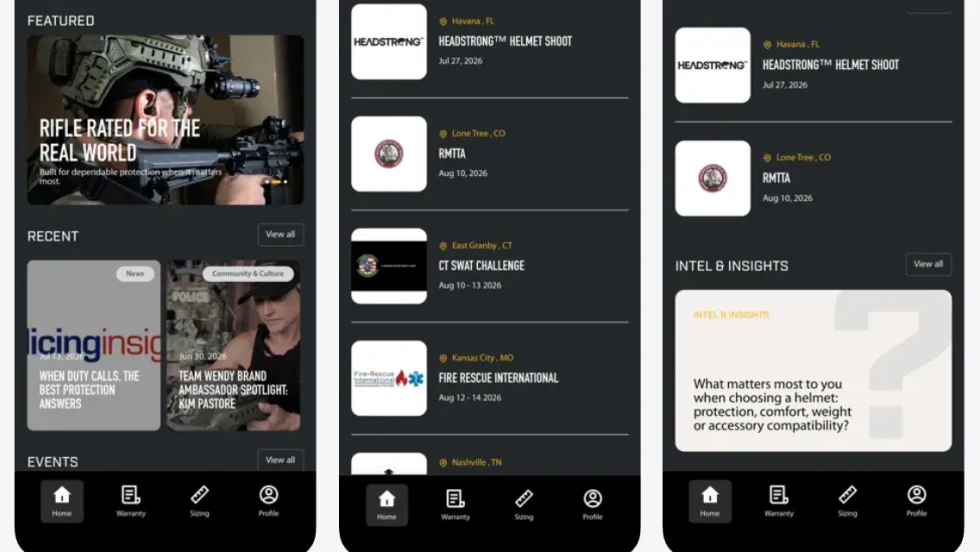
Team Wendy App Creates New Digital Hub for Helmet Owners
The Team Wendy Community App provides one location for warranty registration, size-fit tools, product updates, and community connection. For helmet owners, the new app creates a simpler path to the information and tools that matter most.
Read More →