



Limiting SWAT Liability
The good old days of being able to kick down doors, port windows, and throw flash bangs as officers run through a house are over. The modern theories of SWAT tactics now depend less on the old style dynamic entries on every warrant service. Instead, more teams are implementing the concepts of surround and call-out, limited penetration, wait and take down, sustained negotiations, and other similar tactics.

The good old days of being able to kick down doors, port windows, and throw flash bangs as officers run through a house are over. The modern theories of SWAT tactics now depend less on the old style dynamic entries on every warrant service. Instead, more teams are implementing the concepts of surround and call-out, limited penetration, wait and take down, sustained negotiations, and other similar tactics.
These tactics are evolving because of the dramatic rise in civil litigation, with an increasing emphasis on risk management. Modern-day tactical teams must be as conversant with risk management tools as they are with the latest tactical equipment. Today, every SWAT team member must not only train for his or her particular role on the team, but must also train for the role of being a risk manager and must be ever vigilant for potential issues that can result in civil litigation.
In the past few years, police litigation has skyrocketed in terms of both the number of lawsuits and the amount of money needed to defend these lawsuits (and to pay out large verdicts when they occur). Although there is no absolute protection from lawsuits, a municipality and its police officers can protect themselves from significant jury awards by being conversant with the legal issues that will arise and by taking a few preventive steps to help combat the tide of litigation.
The Cost of Litigation
The proliferation of lawsuits filed recently against SWAT teams has caused every agency, no matter where they are located, to reexamine themselves and conduct a cost-benefit analysis to determine if it is economically feasible to maintain a SWAT team.
Defending a SWAT lawsuit is very expensive, even if you are successful in defending the case. If you lose a case, the sums involved can be staggering, especially for smaller agencies. In one high-profile case, the City of Dinuba, Calif., lost a federal civil rights lawsuit for $12 million.
The case arose out of a search warrant service where one of the residents of the house searched was shot and killed by SWAT team members. After the jurors returned the huge verdict, the City of Dinuba ultimately settled with the family for $6 million. The City immediately disbanded the team.
Thereafter, another California SWAT team became embroiled in a high-profile shooting case in which an 11-year-old boy was accidentally shot and killed during the service of a search warrant. This case ultimately was settled out of court for $3 million.
These two cases demonstrate the staggering expenses associated with defending SWAT cases, even if you prevail. This is why sound risk management tools are now so important in managing a SWAT team.
In Command
SWAT team commanders must be conversant with risk management tactics since they will be held accountable for the actions of their teams. Those commanders who have had to deal with civil litigation are the most likely to be acutely aware of the pitfalls of not being risk aware.
Capt. Tom Spencer of the Los Angeles County Sheriff’s Department is the commanding officer of the Special Enforcement Bureau (SEB), which includes the high-risk units of the Special Weapons Team (SWT), the Canine Services Detail, and the Emergency Services Detail (SWAT-trained paramedics).
Spencer says that reducing liability is one of his responsibilities. Part of his philosophy is simple, yet effective. “Training should be spent on the things that most often occur, such as barricaded suspects and search warrants.”
He firmly believes that “good training reduces the need to resort to deadly force. Teams need to train to resolve incidents without firing a shot.”
Spencer also says that it’s not enough for SWAT teams to train on tactics; they also need to train in the proper use of their equipment. If properly documented, this training can also help prove team members’ overall competency should they need to fight a civil suit.
“SWAT teams need proper equipment and the equipment must be properly maintained,” he says. “When equipment is purchased, the team must train with the equipment and know how to use the equipment properly.”
Spencer’s philosophy appears to be working. SEB averages approximately 185 to 200 call-outs per year and the team currently has only one pending lawsuit—arising over the service of a search warrant—which is the first one in years to be filed.
Defining Policy and Procedure
Deputy Chief of Police Mike Hillman, of the Los Angeles Police Department, has been involved with SWAT teams for many years and is known throughout the law enforcement world. He believes that SWAT teams must engage in more proactive risk management than ever before.
While a SWAT team can prepare itself to enter a fortified building or encounter an armed suspect, there are some areas where a team is vulnerable to attack. Not by a hostile suspect, but by a more dangerous adversary: an educated attorney. The first area of attack in a lawsuit will be on the team’s policies and procedures.
In today's litigious society, SWAT teams cannot afford NOT to have guidelines and policy.
According to Hillman, “Policy is the mandate of the chief of police or sheriff and must be approved by him or her. If expectations of the chief or sheriff are to implement and be held to the policy standard, then that policy must be approved by him or her.”
Hillman provides an example. “Whether it be the Bomb Squad, Air Operations, or SWAT, there are procedures that are implemented by either the commanding officer or subordinates. Most of the time these procedures are used as guides for training of new personnel, in-service, and the like. The problem is the chief of police or sheriff probably does not know what has been written at a lower level that takes on the form of ‘written policy.’ If it is written and persons are being held to it, then it is a policy.”
In civil lawsuits, experienced attorneys will look for materials written by the department that hold personnel to a certain standard. That standard may not have been approved by the chief of police. Yet, as Hillman is quick to point out, "there is no unofficial policy." Therefore, if there are “unofficial policy documents” floating around the department that are not approved by a high-ranking official, then those documents either have to be approved or discarded.
A department generally has operational protocols that include selection, training, procedures, and guidelines for SWAT personnel. In some agencies, such as LAPD, documents that currently exist, but not signed by the Commanding Officer of SWAT or the Commanding Officer of Special Operations Bureau are considered "guidelines." Policy statements that include orders amending a "guideline" may be considered to be policy as they have been reviewed and approved by policy-level personnel.
According to Hillman, “The bottom line here is that SWAT commanders need to have a document in place that states in essence, ‘If it is not signed by me, or the chief of police, and isn't in the department manual, then it is merely a guideline.’ If you want to hold personnel accountable for an operational procedure, then the department must make it a policy and put it in writing. Otherwise, consider it a ‘guideline’ and make a written statement to that effect.”
Keep a Journal
One risk-management tool that should be employed whenever a SWAT team is activated is an operational journal. There is no specific format, but it’s important to have some form of documentation detailing individuals present, time spent on the issue, activity taken, and decisions made.
The journal should start from the first telephone call, and account for all notifications, individual deployments, negotiator contact, significant negotiation issues, suspect(s) response, long rifle deployment, extraordinary tactical options, evacuation, investigative steps to identify the subject and/or essential elements of information. Fire services actions, mental health decisions, and family statements, impacting the decisions made, should all be documented and stored for future use.
To make it complete, the journal needs to continue throughout the last event and should close with any subsequent measures taken after the incident is resolved. For example, if at the conclusion of a surrender the primary negotiator promises to meet with the subject and discuss "whatever,” it should be noted in the journal. This step shows compassion, honesty, and follow-through. And as law enforcement deals with recidivists, they may deal with that subject in the future.
In addition, the journal should capture any damage assessment and refer to electronic photos of the location as a result of SWAT actions.
Training Records
Another area of concern for SWAT teams is keeping up-to-date training records. The value of training records and related documents as a defense against inadequate or negligent training allegations cannot be overemphasized.
It would be extremely difficult to convince a court or jury that a SWAT team or team member had received proper training without producing appropriate documentation. This includes a detailed record of any classes taken and all curricula used.
Course syllabi can be extremely helpful in court because they contain a brief statement regarding each subject covered and why it is important. Properly prepared syllabi and lesson plans along with training records can safely be disclosed during discovery proceedings without fear of divulging sensitive tactical information.
Know When SWAT Is Needed
In addition to practicing the mantra “documentation, documentation, documentation,” there are several risk management tools that every SWAT team should implement to help defend itself in a civil lawsuit.
In preparing for the service of a warrant, a team should create a matrix to determine if a warrant service is sufficiently high risk to necessitate a SWAT team serving the warrant. A detailed list of the criteria that determine a need for SWAT should be included in the team’s policy and procedure manual. The list should include the following:
• Suspect has a propensity for violence
• Suspect may have firearms at the location
• Location is barred or fortified and/or has counter-intrusion devices present
• Information indicates that the suspect has access to firearms and may use them against law enforcement
• Any other undefined circumstance wherein investigators believe a SWAT team is valuable
All teams should conduct a thorough debriefing as soon as practical after every deployment of the team in order to improve future performance. The lessons learned should somehow be stored in a database for future reference and to serve as a training source.
Again, documentation is a must in order to mount a successful defense. For example, when a warrant service occurs, someone needs to be tasked with writing a report that captures how long knock notice was given, what was said, and how many times knock notice was given. If residents are detained and handcuffed, someone must be tasked with writing a report on who was handcuffed, why they were handcuffed, the length of time they were handcuffed, and who did the handcuffing.
The SWAT team’s use-of-force policy should be the same as the agency’s overall use-of-force policy. SWAT teams should not be operating under a different use-of-force policy than other members of the same agency. It might seem counter-intuitive, but straying from this across-the-board treatment will cause problems in court.
Likewise, SWAT teams should not be causing unnecessary property damage. In the case of United States v. Ramirez, 523 U.S. 65 (1998), the United States Supreme Court held that causing unnecessary property damage could be a separate Fourth Amendment violation in and of itself. Thus, a warrant could be valid, the entry could be valid and the evidence lawfully seized, but if a SWAT team breaks more windows and doors than are viewed as reasonable to effect the warrant service, the department and its members can be subjected to a federal civil rights lawsuit.
Finally, a department should conduct a periodic audit of its SWAT team to ensure that the department can continue to support the team. The focus must be on determining if the team is receiving sufficient training time, proper supervision, and if the policies and procedures of the team comport with the law.
There is no absolute guarantee that a department will not face a lawsuit resulting from the use of a SWAT team. However, a department can reduce its exposure to a lawsuit if it takes the time to implement some sound risk management tools. Hopefully, the tools provided will assist in providing a solid defense when a SWAT team is the subject of a civil lawsuit.
Eugene P. Ramirez is a founding member of Los Angeles law firm Manning & Marder, Kass, Ellrod, Ramirez, LLP. He has worked as a Deputy District Attorney for the L.A. County District Attorney's Office and as a reserve police officer.
More Patrol

Adept Armor Introduces Two New Rifle Plates
Adept Armor has launched two new Level IV ballistic plates, the Emperor and the Archon Mark 2, which brings Adept Armor’s new Quatroid ceramic to the high-threat, performance-value center of the range at 5.2 pounds.
Read More →
POLICE Product Test: Benchmade Bailout
The Benchmade Bailout is a slim, lightweight carry knife with a deep-ride pocket clip and comes in a variety of blade steels and scales. Here is a detailed review of the Taiga Green Bailout, released earlier this year.
Read More →
NLEOMF Announces July 2026 Officer of the Month
NLEOMF honored a Michigan deputy sheriff as the July 2026 Officer of the Month for rescuing a trapped driver from a burning vehicle following a Fourth of July crash.
Read More →
Streamlight to Showcase Newest Lighting Products at National Safety Council’s Safety Congress & Expo 2026
Streamlight will showcase its latest lights, including the Portable Scene Light III and the LiteBox 1Million, at the 2026 National Safety Council (NSC) Safety Congress & Expo.
Read More →
The 2027 World Police & Fire Games Set for Perth, Australia
The 2027 World Police & Fire Games (WPFG) will take place in Perth, Western Australia, from Friday, March 12 through Sunday, March 21, 2027.
Read More →
5.11 Partners with National Fallen Firefighters Foundation to Support #ForThe343
5.11 has joined the nationwide movement honoring the 343 New York City Fire Department firefighters lost on Sept. 11, 2001.
Read More →
Team Wendy Announces Title Sponsorship of the Jorge Pastore Foundation
Team Wendy’s 3-year partnership with the Jorge Pastore Foundation expands access to programs that strengthen those who serve.
Read More →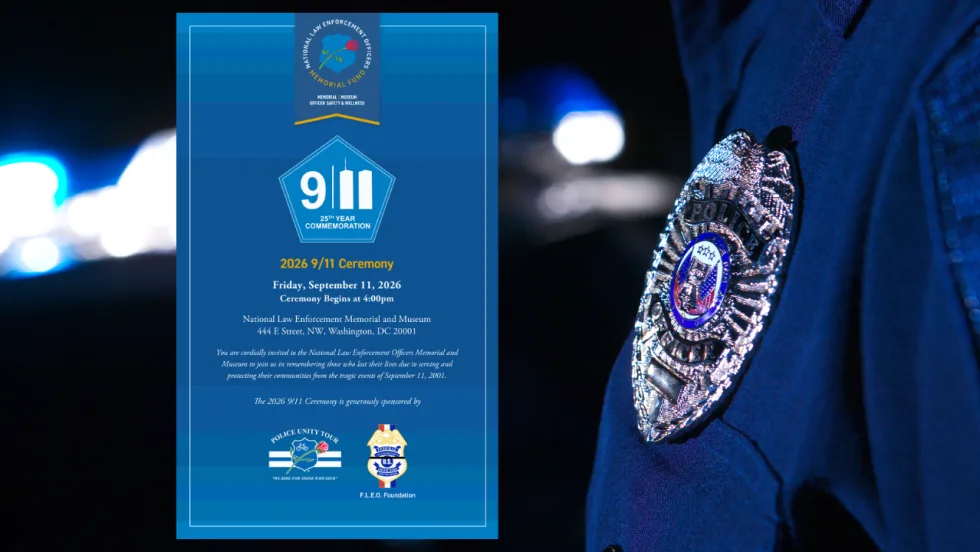
National Law Enforcement Memorial and Museum Hosting 9/11 25th-Year Commemoration Ceremony
The National Law Enforcement Memorial and Museum is hosting a 9/11 25th Year Commemoration Ceremony on Sept. 11 at 4 p.m.
Read More →
National Law Enforcement Officers Memorial Fund Announces June 2026 Officers of the Month
The National Law Enforcement Officers Memorial Fund (NLEOMF) named 15 officers of the Chico Police Department (California) as the Officers of the Month for June 2026 for their roles in responding to an active-shooter incident at a public library.
Read More →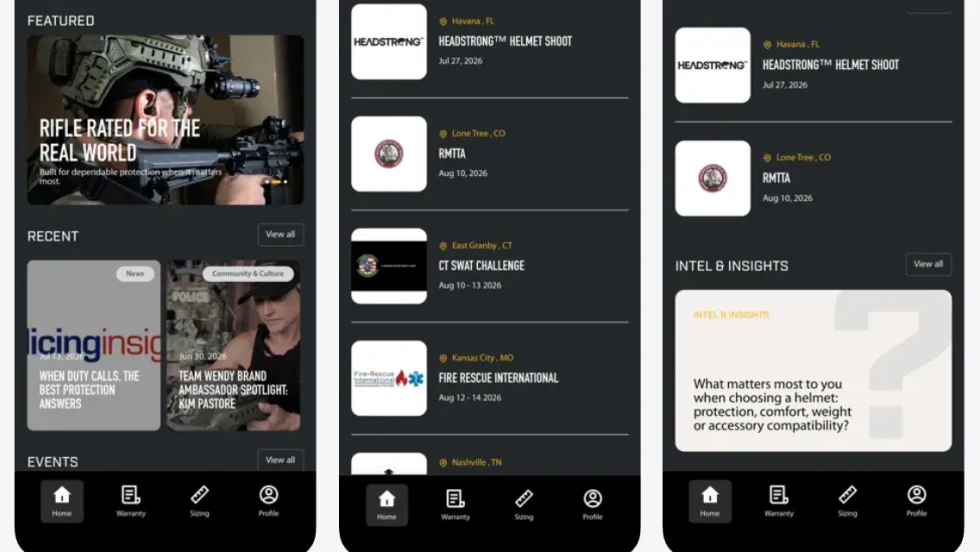
Team Wendy App Creates New Digital Hub for Helmet Owners
The Team Wendy Community App provides one location for warranty registration, size-fit tools, product updates, and community connection. For helmet owners, the new app creates a simpler path to the information and tools that matter most.
Read More →