



Defense Dollars
Most cities and counties have increased police and fire funding since 9-11, but in many cases, budget bumps can barely meet newly established needs.

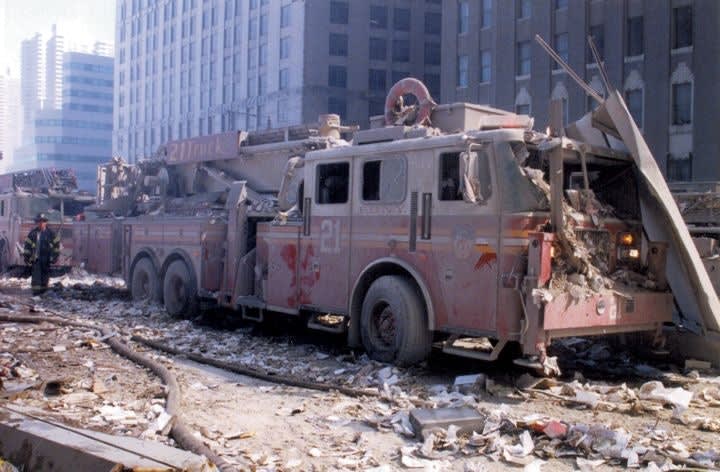
Public safety agencies around the country have spent the past year preparing for a terrorist attack. They have drawn up strategic plans and staged mock incidents and table-top events. They have implemented agreements to share information and formed regional response teams. They have become experts in gas masks and protective clothing. Some say these tactics are akin to closing the barn door after the horse has escaped. Others say the United States is finally responding to warnings issued years earlier, often by those who were once considered lone voices in a wilderness of government and public denial.
One of the biggest stumbling blocks has been funding, typically the lack of it. Most cities and counties have increased police and fire funding since 9-11, but in many cases, budget bumps can barely meet newly established needs. One county recently estimated that the cost of upgrading its communications infrastructure for police, fire, and health would be at least $100 million. Another county reports that the cost of outfitting first responders in the appropriate personal protective equipment (PPE) would be upward of $25 million. New York City says the cost of installing repeaters for the Fire Department's communications system will run anywhere from $150 million to $250 million.
Seizing Initiative
The federal government is attempting to help state and local agencies defray some of these costs through proposed funding in the President's budget for the newly formed Office of Homeland Security. If approved by Congress, money from the First Responder Initiative would be distributed to each state on a "base-plus population" formula. With this formula, each state receives a base amount. Additional funds are distributed according to the state's percentage of the nation's population.
The money will flow first from federal coffers and then through the Federal Emergency Management Agency (FEMA). Each state will be free to devise its own plan for how the funds will be allocated. One state will distribute funds through "operational areas," whose boundaries mirror county boundaries. Other states may create regions based on agency proximity or the ability to coordinate a regional response. Funds will again be allocated using the base-plus formula.
States will have to decide how to direct the money to police, fire, and health. One idea is to create a council from each area that includes representatives from each discipline. The council would recommend how the funds should be distributed after an initial division of 20 percent to each discipline. The remaining 40 percent of the area's funding could be discretionary and distributed according to priority of need.
But at this point, these are only ideas. The First Responder Initiative has yet to complete its trek through Congress. That will be accomplished later this year. The plan also has its disadvantages, namely that only $3.5 billion of the proposed $38.5 billion would trickle down to local agencies. When distributed throughout the nation and then stacked up against the cost of terrorism preparedness, it seems a pittance.
Mike Byrne, senior director for Response and Recovery in the Office of Homeland Security, defends the plan. "(This money) is a 1,000 percent increase over what was previously available. It also recognizes that this is a new threat, and that it is appropriate for the federal government to help state and local agencies prepare. It doesn't mean that preparation is totally a federal government responsibility. It would also be inappropriate for us to take over local responsibility. What this money will do is support the local efforts to get where they need to be," says Byrne, a 20-year veteran of the Fire Department of New York, who joined FEMA in 1999.
"We are trying to accomplish three things," Byrne says. "We want to make the funding as flexible as possible, which is why each community will do its own risk and vulnerability assessments. We are confident that the local community knows what it needs better than we do. Second, we want to encourage the development of regional aid agreements. A city like New York might need a large number of HazMat units, where in other parts of the country, two or three counties might develop a single HazMat capability. Third, we are looking to develop a national approach to training and exercise. All states have emergency response teams, and we are looking for them to make those more robust and to add in the challenge of weapons of mass destruction and terrorism. We hope they won't compromise or hinder regional approaches, but we would like to see them link their plans together so they speak a common language and operate in a cooperative environment."
Funding Requirements
Agencies will be required to use First Responder Initiative funds in four areas:
Planning-To support state and local governments in developing plans to prepare for and respond to a terrorist attack.
Equipment-To pay for PPE, chemical and biological detection systems, and interoperable communications equipment.
Training-To pay for training fire, police, and EMS workers to use such equipment, and to operate in a chemically or biologically contaminated environment.
Exercises-To support regular simulation and table-top exercises to improve response capabilities, practice mutual aid, and assess operational improvements and deficiencies.
These requirements dovetail with recommendations recently issued in a report produced by McKinsey & Company for the Fire Department of New York. The report takes a detailed look at the response by FDNY and EMS on Sept. 11, and in particular, problems with communication, command and control, and tracking of dispatched units and patients treated by EMS.
Some journalists have used the report as a jumping-off point in attempts to indict public safety agencies in other areas of the country. But the report was not issued for that purpose. It was commissioned by the FDNY to find the gaps in service and find ways to alleviate them.
According to the study, the department struggled with communications when the repeater system in the World Trade Center was destroyed. Also, command and tactical channels were unreliable in high-rise areas and provided only sporadic communication, which "left chiefs not knowing whether their messages failed to get through, whether the units failed to acknowledge because they were busy with rescue operations, or whether the units did acknowledge but the acknowledgement did not get through," the report says.
"Chief officers in the lobbies of WTC 1 and WTC 2 also had very little reliable information on what was happening outside. They had no reliable sources of intelligence, and had no external information about the overall status of the incident area, the condition of the towers, or the progression of the fires. ...They had no access to television reports or reports from an NYPD helicopter that was hovering above," the report says.[PAGEBREAK]
As one might expect in an incident of such unprecedented magnitude, command and control was shattered and confusion reigned. The report found that EMS ambulances that were not assigned, insisted on going to the scene. Firefighters desperate to help, mobilized at the site, rather than a staging area. The magnetic board that fire officials used to track dispatched units was destroyed when the towers collapsed, leaving no way to track units or personnel. The FDNY issued a full recall of personnel, but since no recall had been issued in 30 years, no one really knew how to manage such a thing nor was there any training for fire department personnel, or any recall procedure for EMS personnel. The department also had no official process for evaluating the need for mutual aid, or any formal method of requesting or managing it. And finally, FDNY did not have an accurate database of each employee's emergency contact information.
The report lauds how the disaster was handled, given the capabilities of the department and the enormity of the attack. It also makes a number of recommendations so the department will be better prepared for future incidents.
They include:
Operations-Expand the use of the Incident Command System; improve support to incident commanders to better perform command and control functions, planning, logistics, and inter-agency coordination; improve its ability to assess the needs of the rest of the city during major incidents and to deploy the resources to meet those needs.
Planning and Management-Anticipate future needs, develop, expand, and update procedures to exchange operational information with other agencies; improve the ability to assess risks across the city to create specific response plans for key locations, and prioritize training and investments in new resources.
Communications and Technology-Improve the process of evaluating, acquiring, and deploying technology and communications equipment and infrastructure; improve radio communications; improve the tracking of department personnel and patients treated by EMS.
It Can't Happen Here
It would be easy to read the McKinsey Report's recommendations and treat them as something relevant only to a city like New York, and applicable only in a large scale incident like the September 11 disaster. That would be a terrible mistake, says Sgt. John Sullivan, the designer of the Los Angeles Sheriff's Department's Terrorism Early Warning group and a nationally recognized expert on global terrorism.
"Anybody who thinks it won't happen in their city should call Sam Gonzales, the former chief of the Oklahoma City Police Department. Prior to that incident, 75 percent of all incidents occurred in Washington D.C. or New York City. Nobody ever imagined an attack in Oklahoma City, but they had one. Nobody ever anticipated a biochem incident would be real, but look at the anthrax attacks in Trenton, N.J., and in Florida," Sullivan says.
Sullivan also cites the 1984 incident in The Dalles, Ore., where 751 people were poisoned by lab-cultured salmonella that was dumped into salad bar dressings and coffee creamer in 38 restaurants. The perpetrators were followers of Bhagwan Sri Rajneesh, whose goal was to use a biological weapon on the eve of an upcoming election. Presumably, if enough voters became ill, they would stay home, not vote, and the Rajneesh's slate of candidates would sweep the election. "It was the first attack of a biological nature that had a political bias," Sullivan said. "And it didn't happen in a big city."
No city is immune, he adds, which makes preparation an important step. He suggested some specific activities, all of which fit the funding requirements of the Homeland Security's First Responder Initiative.
1. Integrate your public safety response. "When it comes to managing an attack, this is the area where we have traditionally failed," Sullivan says. "We all know our skills and our own discipline. We tend to work by ourselves and view other disciplines as competitors for funding or prestige. But when it comes to terrorism, no one agency can do it alone. We need the skill sets that other disciplines have."
2. Focus on exercise and training. Look at how an adversary might attack. Find your vulnerabilities and come up with ways to close those gaps. The TEW brings in experts from all disciplines, including other police agencies, to accomplish this task. "Using outside expertise prevents tunnel vision or group think, which is what happens when everyone starts to agree with each other because they think that's what is expected," Sullivan explains.
3. Determine your own capabilities and those of your response partners. What are the shortfalls, and conversely, how can you leverage one another's strengths?
4. Develop common practices and equipment standards. "We can build greater capabilities by synchronizing our response efforts, but also by working toward open architectures in communications, protocols, and planning methodologies," Sullivan says. "Even something like interchangeable canisters on our gas masks is important in a multi-agency response."
The consequences of a terrorist attack are wide-ranging, and terrifying. Agencies that can build their first-responder capability through planning and preparation not only will make their communities safer, they will strengthen their daily response capabilities. The First Responder Initiative may be a way to support those efforts.
Lois Pilant is the former editor of a law enforcement magazine, a writer for the National Institute of Justice, and a frequent contributor to POLICE.
More Patrol

Team Wendy Introduces the EXFIL Endurance Ballistic Helmet, Engineered to Reduce the Burden of Extended Wear
Team Wendy has launched its EXFIL Endurance, a new lightweight ballistic helmet engineered to deliver protection, comfort, and fit during demanding, extended operations.
Read More →
The First Responders Children’s Foundation National First Responders Day Roll Call of Heroes Ceremony Returns to Times Square, NYC
First Responders Children’s Foundation (FRCF), in collaboration with T-Mobile, will host the Roll Call of Heroes ceremony in Times Square to commemorate National First Responders Day on Wednesday, Oct. 28. During the event, FRCF will present 18 Hero Awards.
Read More →
Streamlight to Showcase Newest Lighting Products for Law Enforcement Professionals at IACP 2026
Streamlight will showcase its newest lights for law enforcement at the International Association of Chiefs of Police Annual Conference & Expo. Featured lights will include the TLR-3 X, the PolyTac 1X, and more.
Read More →
Streamlight Portable Scene Light III Wins 2026 OH&S New Product of the Year Award
Streamlight’s Portable Scene Light III has won the 2026 Occupational Health & Safety (OH&S) New Product of the Year Award in the Lighting category.
Read More →
Adept Armor Introduces Two New Rifle Plates
Adept Armor has launched two new Level IV ballistic plates, the Emperor and the Archon Mark 2, which brings Adept Armor’s new Quatroid ceramic to the high-threat, performance-value center of the range at 5.2 pounds.
Read More →
POLICE Product Test: Benchmade Bailout
The Benchmade Bailout is a slim, lightweight carry knife with a deep-ride pocket clip and comes in a variety of blade steels and scales. Here is a detailed review of the Taiga Green Bailout, released earlier this year.
Read More →
NLEOMF Announces July 2026 Officer of the Month
NLEOMF honored a Michigan deputy sheriff as the July 2026 Officer of the Month for rescuing a trapped driver from a burning vehicle following a Fourth of July crash.
Read More →
Streamlight to Showcase Newest Lighting Products at National Safety Council’s Safety Congress & Expo 2026
Streamlight will showcase its latest lights, including the Portable Scene Light III and the LiteBox 1Million, at the 2026 National Safety Council (NSC) Safety Congress & Expo.
Read More →
The 2027 World Police & Fire Games Set for Perth, Australia
The 2027 World Police & Fire Games (WPFG) will take place in Perth, Western Australia, from Friday, March 12 through Sunday, March 21, 2027.
Read More →
5.11 Partners with National Fallen Firefighters Foundation to Support #ForThe343
5.11 has joined the nationwide movement honoring the 343 New York City Fire Department firefighters lost on Sept. 11, 2001.
Read More →