



Death Takes A Holiday
The murder rate has been dropping nationwide, and nowhere is it dropping faster than on the streets of America's formerly most dangerous cities.

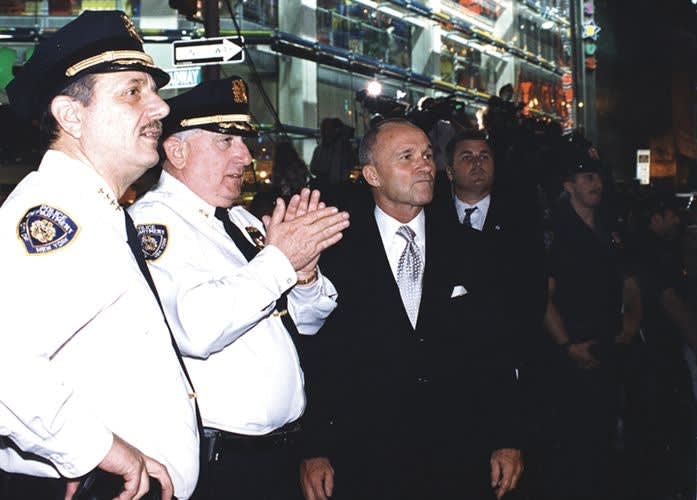
NYPD commissioner Raymond Kelly (in suit and tie) walks Broadway with some of his staff officers.
For decades now, the FBI's crime statistics have painted certain U.S. cities as the nation's murder capitals. Almost anyone who reads newspapers could name these cities from memory. But an unusual thing has been happening on the streets of America. The murder rate has been dropping nationwide, and nowhere is it dropping faster than on the streets of America's formerly most dangerous cities.
Manhattan Murder Mystery
An unusual murder story has been unraveling in New York City. While other major cities have shown slight fluctuations in homicide rates, some up, some down, the Big Apple has the lowest homicide rate in 40 years.
The extraordinary decline in homicides in New York is clearly evident from the last decade of statistics. A total of 2,245 people were murdered in the city in 1990. In 2000, that body count dropped to 671, in 2001 to 648 (not counting the World Trade Center homicides), and last year to 580. In short, 74 percent fewer people were slain in the nation's largest city last year than in 1990.
Comparing New York City's 74 percent decline in homicides to the national average of 33 percent begs the question, why did death take a holiday in New York City?
According to Raymond Kelly, commissioner of the New York Police Department, a lot of the credit for the Big Apple's declining murder rate goes to good policing and innovative police procedures.
"While the crime rate goes up in other cities, ours continues to go down," Kelly says. "I think it has to do with focusing on a couple of things. It's looking at the worst of the worst and prioritizing."
One of the priorities of the NYPD is curtailing the violent crime associated with narcotic sales. For example, NYPD officers have made more than 6,000 arrests in one area of Manhattan in what they have named "Operation Crack Down."
Kelly says "Crack Down" has been a very successful campaign. "That operation has impacted on drug availability and has, to a certain effect, caused people to go out of the jurisdiction to get drugs. That means if there are drug disputes, they are going on in other places, so we are not having them take place here," he explains.
Another factor that Kelly believes has contributed to lowering the homicide rate is the department's emphasis on low-level crimes. "We are continuing our quality-of-life, minor violations approach," he says. "When you do that, and when you check people's records, you are getting into the recidivist population, and you are taking them off the streets. You take care of the little things and the big things take care of themselves."
"Operation Clean Sweep" is another program that Kelly credits with helping dial down the violence in New York's streets. Clean Sweep focuses on panhandling and other minor violations, but Kelly says it also prevents murders. "You would be surprised-even in that universe of people-we are able to get people who are wanted on warrants. The warrant squad may not be going after them, but when they are doing low-level things and they are turning up on warrants, then we are putting those people away," he explains.
Statistical analysis and computer software have also played a role in the NYPD's crime prevention campaigns. The department has used CompStat to target geographic zones that have a high level of violent crimes. In addition, new recruits have been assigned to areas that the borough and precinct commanders have identified as violent zones.
Of course, statistical analysis cuts both ways. And some who have studied the Big Apple's drop in homicides argue that the numbers correlate with improvements in emergency medical care.
In other words, they are arguing that people are still being attacked and even shot, but the E.R. docs are keeping them alive. Kelly says that anyone making this argument should look closer at the numbers. "It's simply not reflected here because our assaults are down as well. If in fact [emergency medical services were the reason for fewer homicides], then it would show up in the assault areas, but that is not the case."
Of course, the drop in homicides could be a temporary statistical anomaly. But Kelly is optimistic that the NYPD can keep the homicide rate down. "Obviously we will do everything we can to do that," he says. "Right now we are a little ahead of last year. But if we continue at this rate, we will still come under."
Down on the Delta
Two years ago New Orleans had the dubious distinction of being the murder capital of the United States. At the time, the Crescent City topped a list of 134 U.S. jurisdictions with a homicide rate of 20 per 100,000 residents.
But now Capt. Marlon Defillo of the New Orleans Police Department says the carnage has been scaled back in the city. The key to slowing the violence, according to Defillo, was to realize that much of the bloodshed was geographically concentrated. According to Defillo, 26 percent of all murders in the Big Easy in 2001 occurred in three public housing developments.
After identifying these problem areas, the NOPD took steps to stop the killings. Community policing was implemented, and, according to Defillo, the crime rate in these public housing areas was cut by 75 percent in the first year.
The department also reorganized its personnel around the city. As part of that reorganization, the detective bureau was decentralized, police were put into districts, and commanders in each district were given more resources and tools to combat crime. Defillo says detectives are now working closely with uniform personnel and sharing information.
The results are impressive. So far this year, there has been a 13 percent reduction in violent crimes on the streets of New Orleans.
Unfortunately, there has been an increase in narcotics-related homicides. But the NOPD is trying to reverse that trend by identifying violent narco offenders within the city and focusing on them. "We are going after individuals who are dealing drugs, and we are working with the federal government to prosecute them and ensure that they receive mandatory jail time," Defillo says.
The NOPD has also adopted the broken windows theory of crime prevention. "If we can address the issue of things like broken lighting and abandoned cars, and officers can work as a liaison with other city agencies, people will take more pride in the community and as a result crime will be diminished," Defillo explains.
Rusting Away
Established in the early 1900s as the home for thousands of workers at a massive U.S. Steel plant, Gary, Ind., has waxed and waned with the success of the steel industry. Unfortunately, U.S. Steel isn't what it once was and neither is Gary. The city is what most Americans envision when they hear the term "rust belt."
And over the years along with that decay and decline, Gary has become increasingly violent. In 2001, Gary recorded the second highest homicide rate of any American city with 18.7 per 100,000. But since that low point, Gary is becoming safer.
Garnett Watson, chief of the Gary Police Department, says things are beginning to look better for his city. "Gary was once prosperous and now it is coming back, but there are still extreme pockets of poverty," he explains.
Part of the resurgence of the city is based on what Watson describes as a "real hard, very progressive approach [to policing]." That approach includes teamwork among local, state, and federal officers. "We are attacking street-level crimes and gang-related crime," Watson says. "We are putting serious pressure on them."
Watson adds that bringing the feds into the investigations has paid a special dividend: There is no bail offered when the federal government prosecutes violent offenders. "They leave and once they leave, until their sentence is served, they are not back," he says.
Like many chiefs working in high-violence areas, Watson points a finger at the easy availability of guns as part of the problem. Accordingly, Watson has worked with ATF to perform background searches of all permit holders, some of whom have been discovered to have felony records that should have prevented them from receiving a license. The agencies also tracked every gun used in a violent crime with an attempt to trace them back to the permitted owner.
Gary PD also changed its approach to patrolling problem areas. Three of the department's best supervisors were assigned to an overtime uniform task force that drove in marked cars and went out between 5 p.m. and 2 a.m.
"They would go after people on street corners, dealing, or minor crimes," Watson says. "We seized a ton of guns, made tons of narcotics arrests, and kept pressure on the bad guys."
On the job for only 14 months, Watson says his goal is to have his department reflect the crime rates of the rest of the nation. "Gary is a pretty safe city, if you don't buy drugs, sell drugs, or use drugs," he says.[PAGEBREAK]
Brotherly Love
Last year the Philadelphia Police Department celebrated the city's lowest homicide rate in almost 20 years. Police Commissioner Sylvester Johnson believes an initiative called Operation Safe Streets deserves the lion's share of the credit.
As with other major city departments that have managed to reduce their murder rates, Philadelphia PD identified corners that had violent crimes and targeted those areas. In 2001, 5,144 guns were seized in these sweeps.
"We made arrests on those," says Johnson. "In addition, we went to locations of shootings, robberies, and homicides. Where we found drugs, we found guns. And where there was guns, there was violence. We wanted to make it difficult for a buyer or seller to do anything and by doing that we changed the quality of life."
Johnson is a proponent of community oriented policing as a means for knocking down the crime rate. "Traditional policing is not working. You have to do something preventative. We are doing a lot of apprenticeships, rehabilitation, a program with inmates in prisons, where we go up and bring kids to go and sit and talk to them."
These programs and other initiatives, including working with parents who have lost children and producing a film that was made by lifers, have, according to Johnson, been successful in Philadelphia. He says sometimes former offenders assist police officers in reaching out to the children in the city. "They don't go out for us, they go with us," he says.
Motor City Mayhem
Inspector Craig Schwartz of the Detroit Police Department says Motown's homicide rate has remained stable in recent years. But that's not good enough and the Detroit PD is finding new ways to fight back.
Realizing that many gang murders are revenge for previous violence, the Detroit police have implemented campaigns to stop retaliatory shootings. For example, the department is being more aggressive in its investigations of non-fatal shootings. The goal is to get the shooter in jail fast to prevent payback on the streets.
Gang retaliation aside, Schwartz says that the majority of shootings in Detroit tend to boil over as a result of arguments. "What we have is, in many cases, people with insufficient conflict-resolution skills and anger-management skills," he explains. "Situations that should never rise to this level of violence tend to. They react quickly and violently with tragic results and a large percentage also have some connection to the drug trade, perhaps not directly, but indirectly."
The Detroit PD is now in the process of developing a program for early intervention. When that program is completed, it is expected to have a long-term program developed for long-term solutions "Homicide statistics are very difficult to predict. It is not a crime that lends itself easily to direct intervention methods," says Schwartz, adding that the department has been encouraged by the preliminary results of its intervention program.
District of Columbia
The District of Columbia has long been one of the nation's most crime-ridden communities. But it had been getting better.
Washington D.C.'s homicide rates were declining, until last year. Then, according to Alfred Broadbent, assistant chief of the D.C. Police Department, "they spiked up."
Broadbent believes the increase in capital city murders can be attributed to a number of different factors, including drugs, convicts coming home to the streets, and ready access to handguns.
"We're seeing more criminals being released from correctional facilities who were put there in the late '80s and early '90s when a lot of drug arrests were made," explains Broadbent. "And a lot of them are coming back into the community."
Of course, the convicts wouldn't be so deadly without weapons. According to Broadbent, the number one factor contributing to homicides in Washington is illegal guns. "If we didn't have guns, we wouldn't have these numbers of murders. A full 83 percent of murders are committed with handguns. If you take away the guns, you would take away the homicides," he says.
Washington had 262 homicides last year. The record shows that 201 of them were committed with guns. This despite the fact that it is illegal to own a handgun in Washington.
Broadbent blames surrounding states for funneling handguns into his jurisdiction. According to the D.C. Police Department, the majority of the guns are coming in from Maryland, Virginia, and the Carolinas, all states with much looser controls on handgun sales.
Making handguns illegal in D.C. hasn't stopped the violence. But the D.C. police are implementing new programs to make the streets safer.
"Every day we have a crime briefing where we bring in all the command staff from all the patrols and detective and narcotics units," says Broadbent. "We review the last 24 hours and make deployment decisions based on crime trends. We have a joint program with homicide and the narcotics unit where we are targeting our most violent areas. We are trying to be proactive about trying to prevent crime. If it is gang activity or if it is a murder between two gang members, we try to determine if it is a gang-type homicide and start looking for members in gangs that might retaliate. We are trying to be pretty aggressive about direct patrol tactics."
Another key initiative to reduce the violence in D.C. is to go after the gangs by targeting some of the key players and building criminal investigations on them. Broadbent says that gets them off the streets, and, as a result, gang activity has decreased in the city.
Shelly Feuer Domash is a Long Island-based freelance writer and a frequent contributor to POLICE.
More Patrol

Adept Armor Introduces Two New Rifle Plates
Adept Armor has launched two new Level IV ballistic plates, the Emperor and the Archon Mark 2, which brings Adept Armor’s new Quatroid ceramic to the high-threat, performance-value center of the range at 5.2 pounds.
Read More →
POLICE Product Test: Benchmade Bailout
The Benchmade Bailout is a slim, lightweight carry knife with a deep-ride pocket clip and comes in a variety of blade steels and scales. Here is a detailed review of the Taiga Green Bailout, released earlier this year.
Read More →
NLEOMF Announces July 2026 Officer of the Month
NLEOMF honored a Michigan deputy sheriff as the July 2026 Officer of the Month for rescuing a trapped driver from a burning vehicle following a Fourth of July crash.
Read More →
Streamlight to Showcase Newest Lighting Products at National Safety Council’s Safety Congress & Expo 2026
Streamlight will showcase its latest lights, including the Portable Scene Light III and the LiteBox 1Million, at the 2026 National Safety Council (NSC) Safety Congress & Expo.
Read More →
The 2027 World Police & Fire Games Set for Perth, Australia
The 2027 World Police & Fire Games (WPFG) will take place in Perth, Western Australia, from Friday, March 12 through Sunday, March 21, 2027.
Read More →
5.11 Partners with National Fallen Firefighters Foundation to Support #ForThe343
5.11 has joined the nationwide movement honoring the 343 New York City Fire Department firefighters lost on Sept. 11, 2001.
Read More →
Team Wendy Announces Title Sponsorship of the Jorge Pastore Foundation
Team Wendy’s 3-year partnership with the Jorge Pastore Foundation expands access to programs that strengthen those who serve.
Read More →
National Law Enforcement Memorial and Museum Hosting 9/11 25th-Year Commemoration Ceremony
The National Law Enforcement Memorial and Museum is hosting a 9/11 25th Year Commemoration Ceremony on Sept. 11 at 4 p.m.
Read More →
National Law Enforcement Officers Memorial Fund Announces June 2026 Officers of the Month
The National Law Enforcement Officers Memorial Fund (NLEOMF) named 15 officers of the Chico Police Department (California) as the Officers of the Month for June 2026 for their roles in responding to an active-shooter incident at a public library.
Read More →
Team Wendy App Creates New Digital Hub for Helmet Owners
The Team Wendy Community App provides one location for warranty registration, size-fit tools, product updates, and community connection. For helmet owners, the new app creates a simpler path to the information and tools that matter most.
Read More →