“So far, every county that we've been in, no one's turned us down. Everyone has felt very confident in the way the system works and our ability to deploy it. Every county has given us the green light."
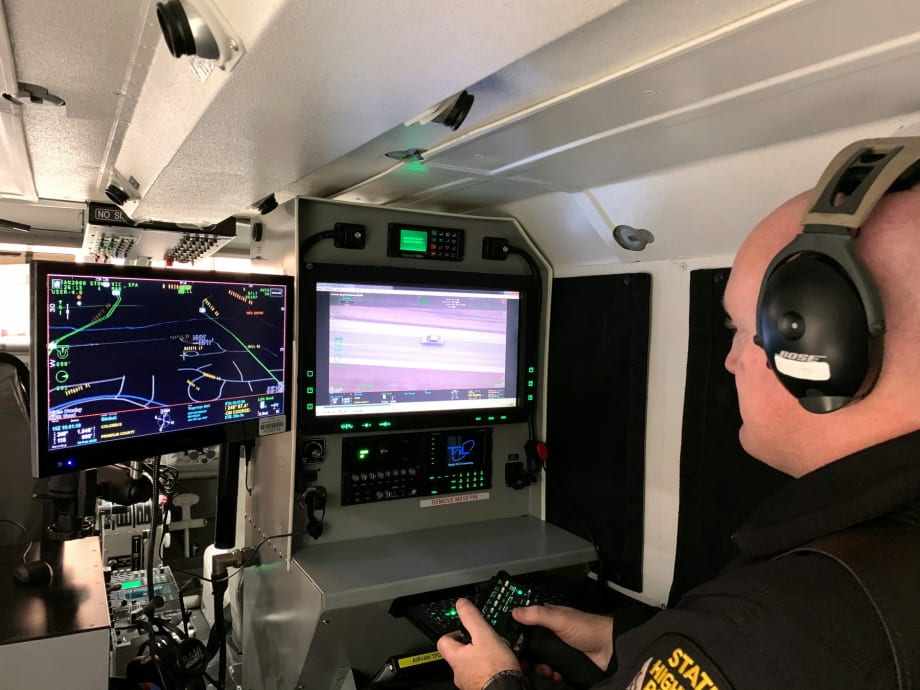
An Ohio State Highway Patrol tactical flight officer operates on of two vehicle speed measurement systems in use now.
Credit:
PHOTO: Ohio State Highway Patrol
9 min to read
Ohio State Highway Patrol Rolling Out Technology to Track Speeders and Dangerous Drivers from Above
The Ohio State Highway Patrol’s Aviation Section is working county by county to get the stamp of approval from local judges and prosecutors as it rolls out a new form of traffic enforcement from above. Since the 1960s, pilots have used stopwatches and known quarter-mile distances to catch speeders. Now they are transitioning to more advanced technology.
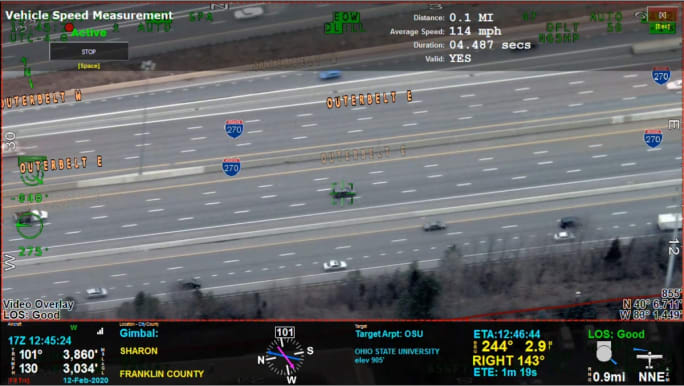
The aviation unit has now equipped two aircraft with Vehicle Speed Measurement devices (VSMs) that use GPS and cameras to track speeders and dangerous drivers. Currently the new VSMs are used when needed in five counties but the goal is to have the acceptance of 10 counties by the end of the year with the hopes of deploying anywhere statewide by the end of 2023.
Ad Loading...
The technology has been around for about five years explains Staff Lt. Justin Cromer, Aviation Section commander. He points out state police in Washington and Minnesota, plus some sheriff’s offices, are using similar technology.
“This technology is in all the new mapping systems, so it's available for anybody. I think probably we are maybe a bit more aggressive than most in using it and setting it up. We worked through the mapping system company to get the system to the point that it works for our needs,” he says. “We've done a substantial amount of testing to ensure that it's accurate before we employed it and now we are in the process of deploying the system throughout the state of Ohio.”
Cromer says the use of VSMs for speed enforcement will be rolled out one county at a time. In Ohio all speeding citations that are written go through a county-level court. The highway patrol demonstrates the system for judges and prosecutors in a county, and even takes them up for a demo flight if they are interested. Plus, the demo visit is a great time for them to ask questions.
“So far, every county that we've been in, no one's turned us down. Everyone has felt very confident in the way the system works and our ability to deploy it. Every county has given us the green light,” Cromer says.
The VSM system uses two components, a camera system and a mapping system. Cromer says the major players are FLIR and Wescam for cameras and Shotover Systems (formerly Churchill Navigation) and AeroComputers for mapping. Ohio State Highway Patrol is using the combination of Wescam and AeroComputers.
Ad Loading...
“As technology has evolved, basically the geo referencing of where the camera is looking and displaying that on the map has become very, very accurate,” says Cromer.
The state agency has been doing air speed enforcement since the 1960s using hashmarks on the roadway spaced one-quarter of a mile apart. A pilot flying above uses a stopwatch and times how long it takes a car to travel from one hashmark to the next and then calculates an average speed of the vehicle for enforcement purposes. Most of the Ohio aviation assets continue with that method while the VSMs are being rolled out.
“When we deployed this VSM we wanted to make it look as mirrored to current air speed operations as possible. So that's what we did. We declared that a quarter-mile distance was going to be the minimum distance that we were going to use on any of these checks,” Cromer explains. When deploying a VSM-equipped aircraft for a traffic enforcement detail, the system is checked against a known quarter-mile traffic enforcement location both before and after the operation.
Implementing VSMs is far easier than adding traditional airspeed zones to highways.
“In Ohio, for us to install an air speed zone into any area in the state the average cost is about $10,000 and the average timeframe is three to six months. That's depending on the time of the year and how the department of transportation is doing and their backlog,” he says.
Ad Loading...
The goal for the highway patrol is through enforcement to have an impact on traffic safety and reduce fatal crashes. The VSMs bring new capabilities to pursuing that goal.
“When the post commander looks at crash statistics in his or her area, they may not have an air speed zone where they need it. And rather than going through the process of submitting the paperwork, waiting on ODOT, and three to six months later we're finally able to start working it, this basically provides us with a portable air speed zone,” Cromer says. “If you want to think about it that way and the ability to deploy this at any given time, this is absolutely huge.”
He points out some of the highest crash areas in Ohio are construction zones, areas where it would be difficult to install the air speed zone markings. But, now with VSMs that will no longer be a challenge.
Operation
The automated video tracker (AVT) provides a gate that the operator can change in size. The operator matches the gate to the vehicle to be tracked and it locks on and tracks the vehicle.
“The latest iteration of the Wescam cameras that we have are very, very good with the AVT,” Cromer says as he explains older camera systems could often loose the track on a vehicle when it passed beneath an overpass. That is no longer an issue. “Ninety-nine times out of 100 that AVT will pick that vehicle up as soon as it comes out of that overpass whereas the older versions struggled with that quite a bit.”
Ad Loading...
Also, the stopwatch and hashmark method of noting vehicle speed cannot be done at night. The new VSM equipment can be used at night. Although the new VSMs can be used in the darkness, Cromer says currently they are only used at night for supporting evidence, such as noting reckless driving, and not for probable cause. He wants to make sure courts are good with the technology as it relates to daytime speeding enforcement first before it is used for such enforcement at night.
“We have tested it at night with the FLIR camera and we feel like that's going to make a big impact especially when we start talking about OVIs and things of that nature,” he says.
Getting Started
Cromer said the agency added the VSM equipment about three years ago and worked with it for eight months to a year to get comfortable with it before deployment. Testing was extensive and thorough.
“We’ve done well over 1,000 checks because when we called a lot of these other agencies, no one had really gone out and done a lot of testing to make sure the system works,” Cromer says. “We took an unmarked car, we put a radar in it, a GPS speed unit, and obviously the speedometer. So, we had three independent measurements of the speed of that vehicle.”
They first tested the accuracy on flat stretches of road and by flying the aircraft at different standoff distances, different altitudes, different orbits, and different configurations trying to get the system to fail or make errors. It did not. The testing next moved into more rural areas with hills and curves. Again, the system was accurate for enforcement use. In a few cases readings were just slightly off, but that actually is okay.
Ad Loading...
“Return of the speed on the vehicle was, in those cases, below what the actual speed of the vehicle was. So as long as the error is in the violator’s favor, we're happy with that and we proved that. We were very comfortable with it, and that's when we started then deploying it in the first county,” he says.
Currently, the new VSMs are installed only on one helicopter, one of the agency’s A-Star units, and one fixed wing aircraft, a GippsAero GA-8 Airvan. But, the stopwatch method has not yet shuffled off into retirement.
“The majority of what we still do in Ohio is still the traditional air speed methods. The traditional way is one pilot in a (Cessna) 182. For us, the new method is going to require a pilot, a TFO (tactical flight officer), and the ground crew,” he says.
He calls the VSM equipment the “perfect tool overhead” for risk mitigation if a traffic air speed check turns into a pursuit.
The OHSP Aviation Section deploys multiple aircraft, including a GippsAero GA-8 Airvan.
Credit:
PHOTO: Ohio State Highway Patrol
Aircraft
Aircraft currently in use by OSHP include:
Ad Loading...
Three A-Star helicopters
Eleven Cessna 182s
One Cessna Caravan
One GippsAero GA-8 Airvan
The GA-8 Airvan is a multipurpose aircraft and the newest in the fleet. It provided ample cabin space to install a TFO station with all the VSM equipment. At this point, the plan is to not equip the Cessna 182s with VSMs. However, VSMs will be installed into the aircraft that replace those Cessnas.
The agency is in the process now to build out quotes to upgrade the other two helicopters and the Cessna Caravan. Those two helicopters and the Caravan will get upgraded ISR (intelligence, surveillance, and reconnaissance) equipment including the VSM capabilities. The upgrades will also include downlink receive sites across the state for sending data to the ground. Cromer hopes those upgrades may be done by this time next year.
One of the main concerns early was data storage, so the highway patrol upgraded servers in advance of rolling out the VSMs. Video resolution is getting better, as Cromer points out, so that means increased data storage needs. He says an hour’s worth of video from newer camera systems can equate a full gigabyte whereas the technology of not too long ago meant that same length of video only tied up about 250 megabytes of storage.
The VSMs use GPS and camera systems to track vehicles during speed enforcement operations.
Credit:
PHOTO: Ohio State Highway Patrol
Enforcement
“We hang our hat on three main hooks. We talk about risk mitigation, liability reduction, and force multiplication. Aviation is critical in providing the division with those elements,” says Cromer.
Ad Loading...
Use of the new technology may also cut down on speeders trying to challenge citations in court.
“In the old system, it's a pilot’s word with a stopwatch. With the new system, we're shipping a video to the prosecutor and the prosecutor can show the defendant. They're watching themselves on the video. They're watching the system track, they're watching them pass vehicles, make unsafe lane changes, whatever,” he explains. To date, no defendants have gone into court to challenge citations linked to the VSMs.
When deployed, the aviation assets using VSMs for speed enforcement usually are working with three to four ground units at a time, but sometimes that may be as many as seven or eight. Even though the aircraft are from a state agency, that does not necessarily mean the units on the ground are state troopers. The ground units making the traffic stops can be state troopers, local police, deputy sheriffs, or often a mix.
“Seventy percent of the missions we fly are for other agencies. Only 30% of what we do is for us. Most of what we do is for other agencies because most other agencies in Ohio do not have aerial assets. They call us for support, and we're happy to help,” Cromer says.
The Aviation Section is based centrally in the state at the Ohio State University Airport. All camera assets currently are in that location. There are three remote bases of operation – one in Butler County near Cincinnati, one in Sandusky, and one in Akron.
Adept Armor has launched two new Level IV ballistic plates, the Emperor and the Archon Mark 2, which brings Adept Armor’s new Quatroid ceramic to the high-threat, performance-value center of the range at 5.2 pounds.
The Benchmade Bailout is a slim, lightweight carry knife with a deep-ride pocket clip and comes in a variety of blade steels and scales. Here is a detailed review of the Taiga Green Bailout, released earlier this year.
NLEOMF honored a Michigan deputy sheriff as the July 2026 Officer of the Month for rescuing a trapped driver from a burning vehicle following a Fourth of July crash.
Streamlight will showcase its latest lights, including the Portable Scene Light III and the LiteBox 1Million, at the 2026 National Safety Council (NSC) Safety Congress & Expo.
The National Law Enforcement Officers Memorial Fund (NLEOMF) named 15 officers of the Chico Police Department (California) as the Officers of the Month for June 2026 for their roles in responding to an active-shooter incident at a public library.
The Team Wendy Community App provides one location for warranty registration, size-fit tools, product updates, and community connection. For helmet owners, the new app creates a simpler path to the information and tools that matter most.