



Harris Corp.'s InTouch RPC-200 Smartphone
Like all other Android smartphones, the InTouch can also run apps, including Harris' BeOn push-to-talk app. Unlike other smartphones, the InTouch is designed to survive rough duty.
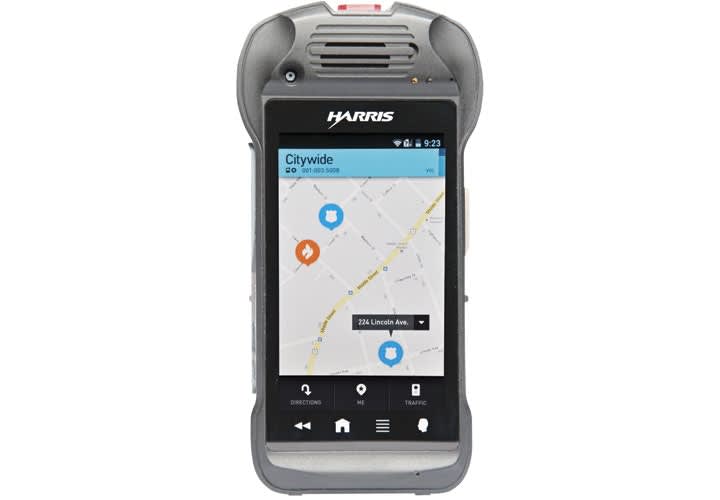
Photo courtesy of Harris Corp.
Attendees at this year's International Association of Chiefs of Police (IACP) show held last month in San Diego had the chance to catch a glimpse of the future of law enforcement communications. That future was on display in the Harris Corp. booth in the form of the InTouch RPC-200, a rugged Android smartphone that can access the Public Safety Broadband network.
Like all other Android smartphones, the InTouch can also run apps, including Harris' BeOn push-to-talk app. Unlike other smartphones, the InTouch is designed to survive rough duty. It can operate after 30 minutes of immersion in water, and it meets or exceeds MIL-STD 810G for impact, vibration, and temperature.
The most fragile element of any smartphone is the display, and the InTouch RP-200 features one of the toughest screens ever developed for a smartphone. Paul May, Harris Corp.'s manager of systems marketing for public safety and professional communications, says the glass in the InTouch is significantly thicker than the glass used in commercial smartphones.
So is the device itself, but not so much that the average user would really care. The InTouch is about 23 millimeters thick, while a commercial Android phone like the Samsung Galaxy SII is about 10 millimeters thick. The additional girth is what makes the InTouch so rugged. It also means Harris' public safety smartphone does not need any additional protection such as a cover. May points out that prudent owners of expensive, fragile, and extremely thin commercial smartphones generally make them much thicker by protecting them with covers such as an Otter Box. "If I took my Samsung Galaxy SII and put it in an Otter Box (cover), it would be 20 millimeters to 25 millimeters thick, so we don't think the InTouch is so thick at 23 millimeters that users will see it as too bulky," he says.
In addition to its tough exterior, the InTouch has a more powerful battery than a commercial smartphone. The goal, according to May, was to make sure the phone could be operated throughout a public safety shift without any worries about battery life.
May says Harris envisions the InTouch as a complement to a land-mobile public safety radio and not a replacement. "People ask me, 'Does it support mission critical voice?' The answer that I like to give is that it's capable of providing voice and other services that are critical for a mission. I see it as a tool for somebody who is trying to direct an incident command and needs to look at a wide variety of data—video, floor plans, etc.—to help with that incident response."
In many ways, the InTouch RPC-200 is a tool that the public safety market is not quite ready for, at least not yet. It's enabled for the Public Safety Broadband network (also called Public Safety LTE, First Net, and Band 14), which is just now being built and will be developed slowly over the next decade or so. May says Harris is well aware that this product is so innovative that it may be before its time, but the company expects demand to climb as the Public Safety Network is built out. "This device will operate on that private network and be able to provide a quality of service and other types of priority and preemption on that network that first responders can't get on a commercial network," he says.
Until the Public Safety Broadband Network is available, the InTouch RPC-200 is a rugged smartphone that offers first responders full use of commercial carrier networks for voice and data, as well as push-to-talk capabilities through Harris' proprietary BeOn app.
The InTouch RPC-200 is expected to ship next summer. May says it will take that long to get the device approved by commercial carriers. Pricing has not been set, but it’s expected to be between $1,000 and $2,000.
Related:
More Technology
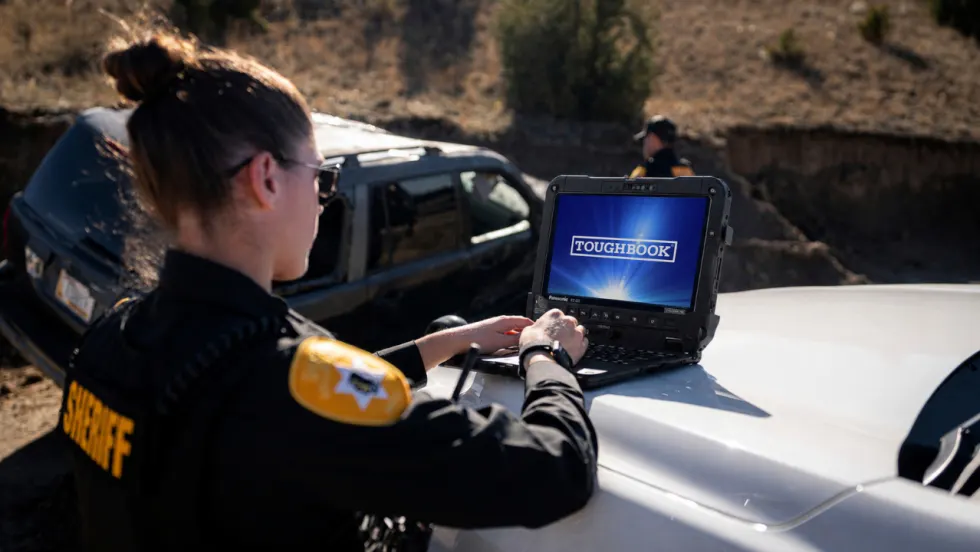
Panasonic Connect Launches the Toughbook 34 and Toughbook G3, Fully Rugged 2-in-1 Mobile Computers
Panasonic Connect has launched the Toughbook 34 and Toughbook G3 to facilitate in-vehicle dispatch, records management, and mobile command operations from any location.
Read More →
A police agency's guide to data-driven fleet management
Costs are rising and the public expects more transparency into how their tax dollars are spent. This e-book shows how police agencies can use fleet data to take control of fleet expenses while improving officer safety and demonstrating fiscal responsibility to the communities they serve.
Read More →
AI and analytics for law enforcement: Turning data into insights
Law enforcement agencies are managing more video, sensor data and digital evidence than ever before. Discover how AI and analytics can help turn that data into actionable insights that strengthen situational awareness, accelerate investigations and support more informed decisions.
Read More →
Vasco Electronics Adds Automatic Language Detection to Vasco Translator Q1
Vasco Electronics’ software update introduces hands-free language switching and expanded offline translation across 45 language pairs, empowering law enforcement, healthcare, and front-office enterprise teams
Read More →
North Miami Police Department Deploys Mark43
The North Miami Police Department has deployed Mark43 as part of its Five-Year Strategic Plan that represents its collective vision and goals for a more proactive police department, anchored by a core commitment to leveraging modern technology to enhance efficiency and public safety.
Read More →
Cellebrite Genesis for Enterprise Now Generally Available
Made available to the public sector in June, Cellebrite Genesis is serving a growing mix of national, regional, and local agencies worldwide, including some of the largest regional and metropolitan police departments. It is now available for enterprise organizations.
Read More →
2026 Vision FirstNet Users Summit to Host Emerging Leaders Training on Grassroots Advocacy for Public Safety
“Emerging Leaders Training: Understanding the Importance of Grassroots Advocacy for Public Safety," a session during the 2026 Vision FirstNet Users Summit, will offer a roadmap for unified advocacy at the federal level.
Read More →
Motorola Solutions Completes Acquisition of D-Fend Solutions
Motorola Solutions has acquired D-Fend Solutions, an industry leader in counter-drone technology. This deal provides public safety and enterprise customers with access to advanced counter-unmanned aerial systems.
Read More →
ZeroEyes, Advantech & Camden Police Partner to Bring AI Gun Detection Technology to Delaware School District
ZeroEyes has partnered with Advantech and the Camden Police Department to deploy ZeroEyes’ AI gun detection and intelligent situational awareness platform at Delaware’s Caesar Rodney School District (CRSD).
Read More →
Leonardo U.S. Cyber & Security Solutions Introduces SignalTrace, the Next Evolution in Electronic Signature Detection Technology
SignalTrace reflects years of product refinement and a clearer expression of the technology’s purpose of recognizing and correlating electronic signatures in publicly broadcast wireless signals to reveal patterns, relationships, and trends that might otherwise go undetected.
Read More →