



Just a Touch: Using Touch DNA Evidence
Amazing. This unknown suspect left behind enough DNA from just briefly touching the sides of the victim's underwear to provide a statistically significant partial DNA profile.

Peggy Hettrick was brutally murdered on Feb. 11, 1987. She was stabbed to death then sexually mutilated. The murder rocked the normally peaceful town of Fort Collins, Colo., and it went unsolved for more than a decade. Then in 1998 the Fort Collins Police Department obtained an arrest warrant in the case. Tim Masters, who was 15 at the time of the murder and who had lived about 100 feet from where Peggy's body was found, was convicted of the murder by a jury of his peers in 1999.
But the story doesn't end there. Masters was released from prison, where he had served almost nine years, last January. His release is credited to science.
New forensic DNA technology was used to test evidence from the case. The results raised sufficient doubts that a special prosecutor assigned to the case requested that the judge vacate the murder conviction.
Local newspapers reported that a technique called "touch DNA" was used to analyze the clothing Peggy Hettrick was wearing when her body was found. According to the media, trace amounts of DNA were found on her clothing, and these DNA results led to an alternate suspect, identified as one of Peggy's former boyfriends. At the time this article was written, no other arrests have been made in the case.
I want to make it clear that I have no inside information on this case. I have no idea who killed Peggy Hettrick. I only know what was released to the media.
My interest in this case lies in the development of new forensic technology. The "touch DNA" results created enough reasonable doubt that Masters' murder conviction was overturned.
This goes to show the power of the technology. A minute amount of cells left on the murder victim's clothing in 1987 was powerful enough to raise sufficient doubt in this case. It also has the potential to help detectives like myself close a lot of unsolved cases.
How It Works
Stories about "Touch DNA" are all over the media these days as it was involved in the Tim Masters case and other high-profile cases. It's also on the lips of a lot of police executives wanting their agencies to use the technology. This article will hopefully shed some light on this powerful forensic tool for law enforcement.
"Touch" or "trace" DNA is simply a term used to describe the collection and analysis of microscopic amounts of cellular material. The DNA is assumed to be from epithelial or skin cells. Unlike most other types of genetic material, including blood, saliva, and semen, this genetic material can't be seen with the naked eye.
There's also no presumptive test to indicate whether the cells are present or not. The cells slough off or are transferred from the individual and onto any item. That means the laboratory technician must somehow liberate these cells from the evidence.
Once the cells are removed, they undergo the exact same laboratory procedure as standard DNA testing; it's just that the quantity of DNA needed for analysis has gotten smaller.
If a DNA profile is developed, it's handled like any other profile, being entered into CODIS (Combined Offender DNA Index System) if appropriate and compared against the national DNA database. It is important to note that elimination standards from the victim and possibly the first responder may be needed for comparison purposes to the "touch DNA" sample profile before it is uploaded into the CODIS database.
1.5 Nanograms
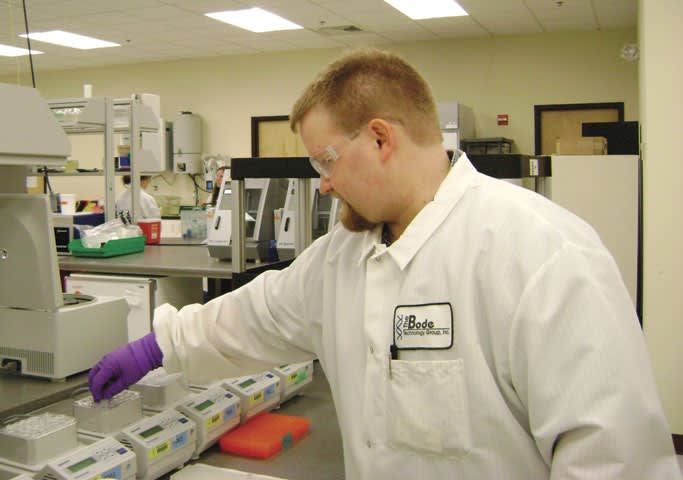
According to Angela Williamson, director of forensic casework at Bode Technology Group, the FBI first published a paper on touch DNA in 2001. However Bode, a leading private company offering forensic DNA work to law enforcement, has only been offering "touch DNA" for about three years.
Colorado Bureau of Investigation Laboratory Agent Mary Schleicher indicates that trace DNA technology has evolved from current practices. Advances in both technology and laboratory techniques have allowed results to be validated at lower and lower quantities of DNA. Williamson states that only about 200 to 300 individual cells are necessary for DNA analysis. This is only about 1.5 nanograms of DNA, or just over a billionth of a gram.
Bode Technology Group has validated four different methods for removing the cells from the evidence.
Bode uses either wet or dry swabs, a scraping technique, or a tape lift technique, depending on the nature of the evidence involved. The company's newest technique involves, believe it or not, Post-It notes. Bode has found that the adhesive on a Post-It note is perfect for collecting DNA from sensitive materials like facial tissue, where a normal tape lift would tear the evidence.
Bode is seeing a large increase in the number of "touch DNA" cases being submitted by law enforcement agencies from around the country. Angela Williamson believes this is because the technique has been used in a number of high-profile cases.
Because Bode is a private company, turnaround times are often much faster than overworked, but otherwise excellent, state labs. Bode charges between $995 and $1,095 per sample. You can contact Bode for further information.
[PAGEBREAK]
Practical Application
"Touch DNA" has expanded the types of items that can be considered physical evidence. Everything from gun and knife handles, to steering wheels, basically any physical object the suspect touched can be used to try to develop a DNA profile.
As a person crimes detective for the last 10 years, I've had a lot of experience with DNA. It's been amazing to see the technology and techniques grow and develop to the point where we can get DNA from swabbing a bicycle handlebar or from the inside brim of a baseball hat.
Just a few months ago, I received lab results from our state lab reference a sexual assault I'd been assigned to work. The victim reported that the unknown suspect used both of his hands to pull her underwear down. I spoke to the laboratory agent about the details of the case. The lab agreed to process the underwear for "touch DNA," concentrating on the parts of the underwear the suspect would have touched.
We got a hit. The swabs from the victim's underwear contained a partial DNA profile that presumably belongs to the suspect. Amazing. This unknown suspect left behind enough DNA from just briefly touching the sides of the victim's underwear to provide a statistically significant partial DNA profile.
Strengths and Weaknesses
Despite the amazing nature of Touch DNA technology, CBI Laboratory Agent Schleicher is quick to point out that agencies need to have realistic expectations and should understand that "touch DNA" has the same strengths and issues as other types of forensic DNA results.
First, "touch DNA," like standard DNA and fingerprints for that matter, doesn't tell the investigator when the DNA was left on the evidence. It could have been left an hour ago or a week ago. Of course the investigator may be able to narrow down the time range based on certain facts of the particular case.
An example is a suspect's baseball cap left behind at a murder scene. The lab swabs the inside and outside of the hat. A DNA profile from two individuals is developed. Even if there's more DNA from one contributor than the other, you still can't say who was wearing the hat at the time of the murder.
Also, "touch DNA" is so sensitive that it's possible to pick up background DNA. For example, if a shirt is made by hand, then someone has touched the shirt even before it's packaged and sold. It's possible "touch DNA" could liberate these skin cells from the evidence, even though this person has nothing to do with the investigation.
And of course, "touch DNA" doesn't tell the investigator how the DNA made its way onto an item. It doesn't provide the culpable mental state of the individual that committed the crime.
It's up to the lawyers to argue whether the "touch DNA" is the result of a casual contact, or from the suspect forcefully grabbing the victim's shirt. The bottom line is that good police work is necessary to piece together the events surrounding the commission of the crime.
Schleicher wants agencies to be aware of the power and limitations of the technology. Agencies need to clearly understand the questions they want answered. Why is this piece of evidence important? What will it tell me about the commission of the crime? Law enforcement agencies just need to be prepared for the answers, even if the answers aren't what they were expecting.
David Spraggs is a major crimes detective and a certified bomb tech for the Boulder (Colo.) Police Department. He is a member of the POLICE Advisory Board and a frequent contributor.
More Technology
What Qualifies a Laptop as Rugged or Fully Rugged?
Police officers face a wide range of working conditions that can damage or even destroy a regular consumer laptop. Learn what qualifies a computer as rugged or fully rugged and why those devices are vital for law enforcement.
Read More →
Panasonic Connect Launches the Toughbook 34 and Toughbook G3, Fully Rugged 2-in-1 Mobile Computers
Panasonic Connect has launched the Toughbook 34 and Toughbook G3 to facilitate in-vehicle dispatch, records management, and mobile command operations from any location.
Read More →
A police agency's guide to data-driven fleet management
Costs are rising and the public expects more transparency into how their tax dollars are spent. This e-book shows how police agencies can use fleet data to take control of fleet expenses while improving officer safety and demonstrating fiscal responsibility to the communities they serve.
Read More →

AI and analytics for law enforcement: Turning data into insights
Law enforcement agencies are managing more video, sensor data and digital evidence than ever before. Discover how AI and analytics can help turn that data into actionable insights that strengthen situational awareness, accelerate investigations and support more informed decisions.
Read More →
Vasco Electronics Adds Automatic Language Detection to Vasco Translator Q1
Vasco Electronics’ software update introduces hands-free language switching and expanded offline translation across 45 language pairs, empowering law enforcement, healthcare, and front-office enterprise teams
Read More →
North Miami Police Department Deploys Mark43
The North Miami Police Department has deployed Mark43 as part of its Five-Year Strategic Plan that represents its collective vision and goals for a more proactive police department, anchored by a core commitment to leveraging modern technology to enhance efficiency and public safety.
Read More →
Cellebrite Genesis for Enterprise Now Generally Available
Made available to the public sector in June, Cellebrite Genesis is serving a growing mix of national, regional, and local agencies worldwide, including some of the largest regional and metropolitan police departments. It is now available for enterprise organizations.
Read More →
2026 Vision FirstNet Users Summit to Host Emerging Leaders Training on Grassroots Advocacy for Public Safety
“Emerging Leaders Training: Understanding the Importance of Grassroots Advocacy for Public Safety," a session during the 2026 Vision FirstNet Users Summit, will offer a roadmap for unified advocacy at the federal level.
Read More →
Motorola Solutions Completes Acquisition of D-Fend Solutions
Motorola Solutions has acquired D-Fend Solutions, an industry leader in counter-drone technology. This deal provides public safety and enterprise customers with access to advanced counter-unmanned aerial systems.
Read More →
ZeroEyes, Advantech & Camden Police Partner to Bring AI Gun Detection Technology to Delaware School District
ZeroEyes has partnered with Advantech and the Camden Police Department to deploy ZeroEyes’ AI gun detection and intelligent situational awareness platform at Delaware’s Caesar Rodney School District (CRSD).
Read More →