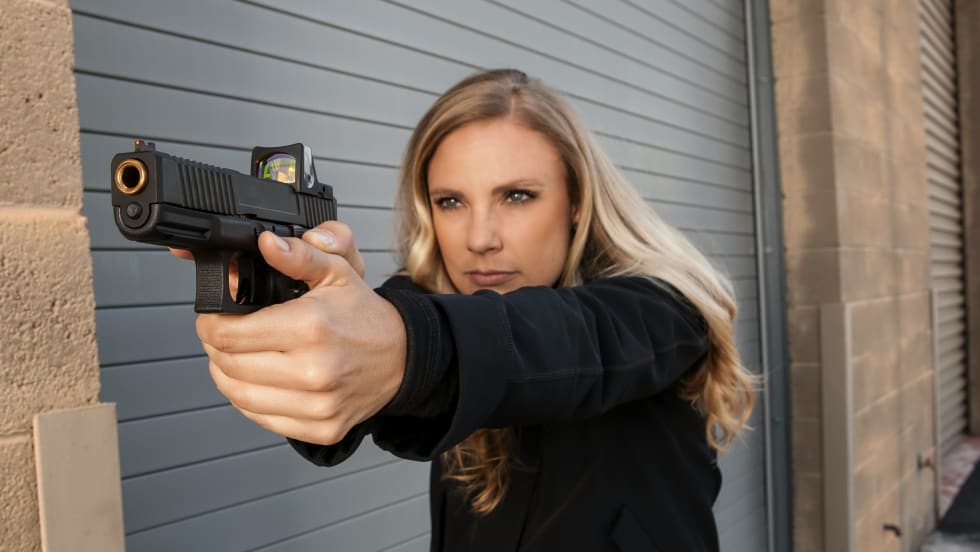

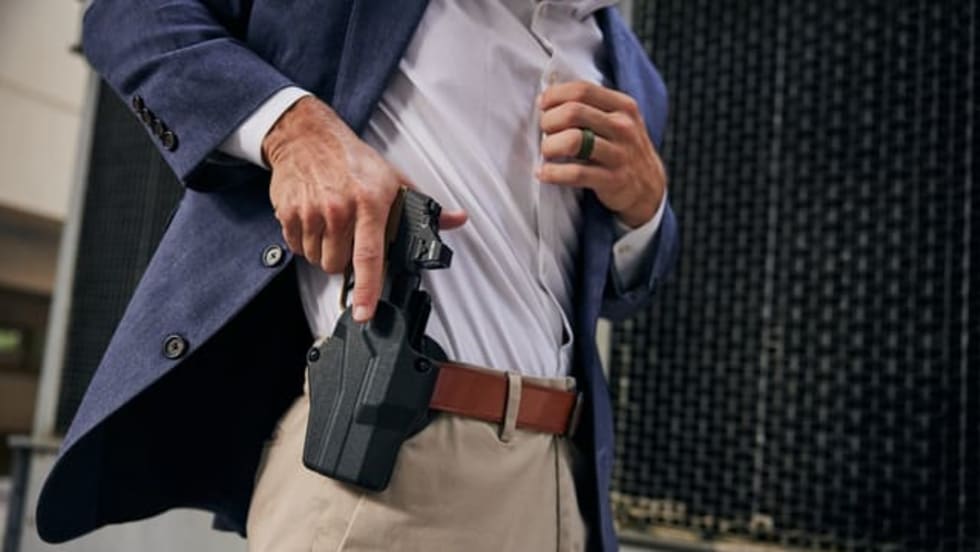
Photo: Michael Hughes
 |
Editor's note: View our S&W Shield photo gallery for extended coverage of this pistol.
Ever since their introduction in late 2005, Smith & Wesson's M&P pistols have garnered a growing share of the police market. M&Ps can now be seen in the holsters of a wide variety of American and international agencies,
To address this growing market S&W has offered the M&P in service, compact, long slide, and competition models. The last few years has seen the growth of unprecedented demand for subcompact pistols suitable for "deep cover" carry by undercover and off-duty police officers and licensed civilians. A number of handgun makers now offer semi-auto mini-pistols, and earlier this year S&W joined in this commercial fray with a new subcompact pistol, the M&P Shield.
19 Ounces
Is the Shield really a "sub-compact?" Well when you consider it is 6.1 inches long, 4.6 inches high, a mere 0.95 inches wide, and weighs only 19 ounces (unloaded), it’s pretty obvious that it fills the bill quite nicely.
The Shield is available in either 9mm or .40 S&W. While the latter is currently the most popular American police handgun cartridge, when fired from small pistols, recoil can be excessive much to the detriment of accuracy. For that reason I believe that the 9mm cartridge is the preferred round for pistols of this class. And thanks to advances in bullet technology and modern propellants, the 9mm's performance has become a much more attractive self-defense round.
Like its full-sized brethren the Shield features a Zytel polymer frame with steel rails embedded on either side of the frame that run from the front locking block to the rear sear housing block. These not only provide additional strength to the frame but reduce torque and frame flex and, combined with the polymer frame itself, minimize recoil pulse.
With a moderately extended grip tang and an optimum grip angle of 18 degrees, the Shield is a naturally pointing pistol. This design also helps with recoil control. Lastly, the trigger guard is enlarged to allow use by shooters wearing gloves.
Stainless Steel
The Shield's slide and barrel are stainless steel, and the slide rails are thicker than those on many other polymer pistols. A large extractor ensures that fired cases get out of the way reliably. The Shield comes with Lo-Mount sights that use the three-dot system to aid in rapid sight alignment and enhanced target acquisition. For those agencies desiring them, night sights are available as an option.
Sharply cut serrations allow smooth slide retraction even with wet hands or when wearing gloves. Another nice feature is that all edges of the slide, including the sights, have been beveled to prevent abrasion to the shooter's hands when drawing, loading, unloading, or clearing a malfunction. The rear of the barrel chamber has a half-moon cut, allowing the shooter to verify whether or not there is a cartridge in the chamber.
Breech locking is accomplished by the barrel hood moving up into and bearing on the front edge of the ejection port. Upon firing these two parts recoil together for a short distance before an angled lug on the bottom of the barrel cams it down, releasing the slide, which continues to the rear, extracting and ejecting the spent cartridge case. As the recoil spring pulls the slide forward, it strips the next round out of the magazine and chambers it. As the slide and barrel go into battery, the barrel hood once again moves up into the ejection port, locking the two units together.