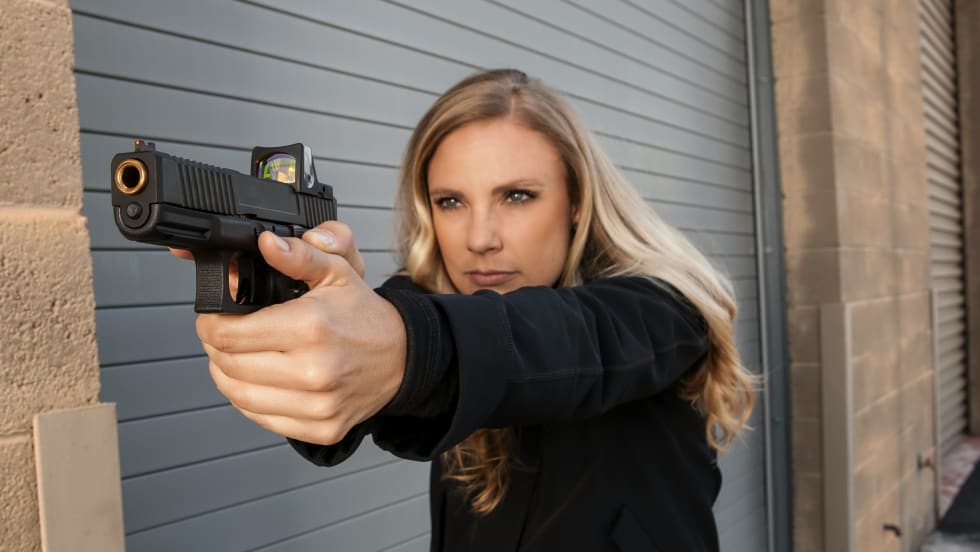

The Second Amendment says this: "A well-regulated militia, being necessary to the security of a free state, the right of the people to keep and bear arms, shall not be infringed." Does this mean that only members of a militia have a right to keep and bear arms, or do individuals also have this right? Does the Second Amendment apply only to the federal government, or also to states, counties, and cities?
Twice in two years, the U.S. Supreme Court decided cases that presented issues of the power of governments to limit the individual possession of firearms. The first of these cases arose in a federal jurisdiction (the District of Columbia); the second concerned ordinances adopted by a city. In both cases, the court held that the Second Amendment does not allow the blanket prohibitions against individual possession of handguns contained in the local laws.
District of Colombia V. Heller
Dick Heller, a DC special police officer, carried a handgun while on duty at a federal facility, but he was not authorized to possess the gun at home. He challenged a local ordinance that prohibited the unauthorized private possession of handguns anywhere-even in the home. He argued that he had a right under the Second Amendment to keep a handgun at his residence for protection.
Opposing Heller's lawsuit, DC officials argued that the Second Amendment was not designed to protect an individual's right to have a firearm but only to guarantee the right of government entities to maintain armed militias, such as the National Guard and state troopers. If this was the correct interpretation of the Second Amendment, the DC ordinance would not be unconstitutional.
The Supreme Court examined the history of the debate and adoption of the Second Amendment and concluded that the primary reason for its inclusion in the Constitution was to foster personal protection in the home. This meant, said the court, that the Amendment protected an individual right of gun ownership and possession. Insofar as the DC ban conflicted with this conclusion, it was ruled unconstitutional.
The District of Columbia, however, is a federal enclave. The Heller case therefore did not decide whether a constitutional amendment that applies to the federal government would also apply to the states. That ruling awaited the next case.
Mcdonald V. Chicago
Otis McDonald, a resident of Chicago, wanted to keep handguns in his home for self-defense. A Chicago ordinance provided that "no person shall possess any firearm unless such person is the holder of a valid registration certificate for such firearm." The catch was that another provision of the city code prohibited the registration of most handguns, effectively making private possession illegal.
The city claimed that these gun-control statutes were necessary to protect residents from injury and death. However, police statistics indicated that after enactment of these ordinances, the murder rate actually increased in Chicago, eventually becoming one of the highest murder rates in the country.
McDonald sued the City of Chicago, asking the federal court to declare the ordinances unconstitutional. Both the federal district court and the Seventh Circuit Court of Appeals dismissed the suit, ruling that the Heller decision applied only to federal jurisdictions and not to the states, and that the Second Amendment did not protect an individual right to keep and bear arms within the states. McDonald appealed, and the Supreme Court reversed the lower courts.