
Lately, the legal limits on gun possession by both police and private individuals have come under judicial scrutiny. Two matters in particular bear a closer look.
LEOSA Precludes State Prosecution
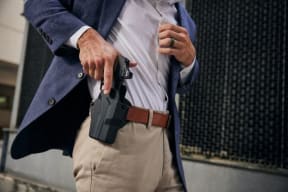
In 2004, Congress enacted the Law Enforcement Officers Safety Act, also known as House Resolution 218. As codified in Title 18 of the US Code, sections 926B (active-duty officers) and 926C (retired officers), provide that with some exceptions, law enforcement officers are entitled to carry their firearms off duty in every state, notwithstanding state statutes restricting the carrying of firearms by the general citizenry. (See the full discussion of the text of the law in Point of Law, POLICE Nov. 2004.) This law was recently applied in a highly publicized case to prevent police officers from being prosecuted under state law.
State v. Smith
In the summer of 2008, the City of Sturgis, S.D., hosted the 68th annual Sturgis Motorcycle Rally. The one-week event draws motorcycle clubs from throughout the country. Members of the Iron Pigs Club, made up of motorcycle-riding law enforcement officers and firefighters, were in town when several of their number, including two police officers from Seattle visited the Loud American Roadhouse tavern on August 8. A confrontation broke out between several Iron Pigs and some Hells Angels, resulting in non-fatal shootings.Following an investigation, it was determined that the Seattle officers had been carrying concealed handguns. South Dakota law prohibits carrying concealed firearms without a permit, and also prohibits possession of firearms in an establishment where alcohol is sold. The State's Attorney obtained grand jury indictments charging the officers with violating state law. (A wounded Hells Angel was also charged with aggravated assault.)
The officers asserted a bar to prosecution, arguing that the Supremacy Clause of the U.S. Constitution makes federal law paramount over conflicting state law, precluding state prosecution. South Dakota Circuit Judge Warren Johnson agreed and dismissed the charges. In his memorandum opinion the judge wrote, "While states retain the right to prohibit the possession of firearms on government property and to permit private persons and entities to prohibit the possession of firearms on their property, they cannot restrict qualified law enforcement officers in any other manner."
The decision in this case is not binding precedent for deciding other cases, either in South Dakota or in other states; however, it does illustrate the approach state courts may be expected to take if other prosecutors seek to charge officers with firearms violations in conflict with the federal law. The outcome in this case might also influence prosecutors' decisions when considering state-law charges that would be barred by the LEOSA.