
Optics Testing
Since the LRT had proven itself to be a fine shooting rifle with iron sights, I was curious to see what it would do with optics. Since this rifle has a flat top and a four-position forearm, optics that can be mounted on this rifle range from red dots, to ACOG-type sights, to telescopic sights, depending on your needs.
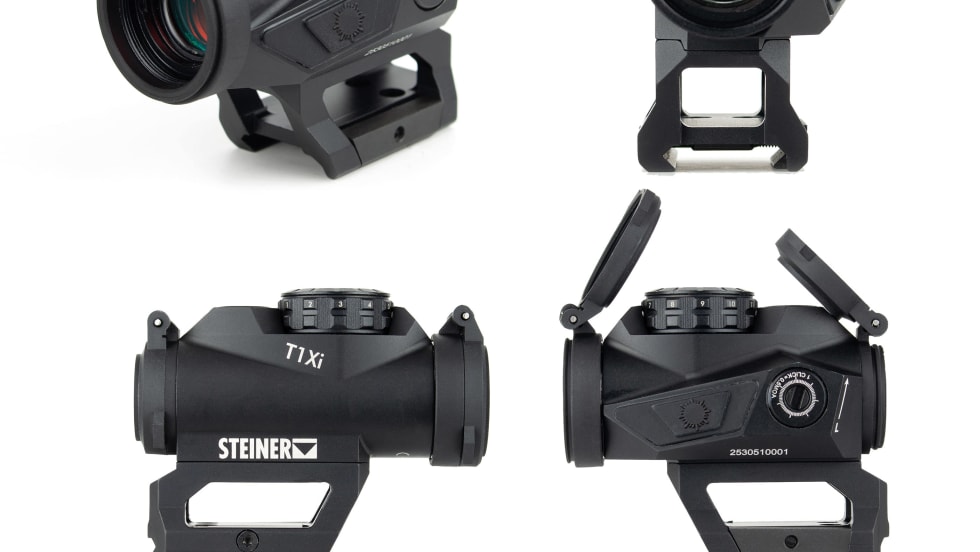
For optics on the LRT I chose to use a Trijicon ACOG, a Burris Tactical Speed Dot, a Meprolight Reflex, and TruGlo’s Infinity 6-24X44 with fine crosshairs for a telescopic sight. I selected this cross-section of scopes as a good representation of close-quarter optics to long-range precision optics.
To start, I wanted to see just how well the LRT-SASS shot. For this I mounted the TruGlo Infinity scope. Now some may grouse about this choice, but I have found that TruGlo’s optics are durable, clear, they hold zero, work well, and are affordably priced.
I bore sighted the rifle and rounded up a supply of premium ammunition from Black Hills, Hornady, Remington, Federal, and Winchester. This is a good mix of premium ammunition and represents most off-the-shelf ammo. Bullet weights were 168-grain and 175-grain boat tail hollow points, which are known for their match grade accuracy.
The LRT/TruGlo combination delivered consistent half minute-of-angle accuracy at 100 yards. The shooting was done using the Harris bipod from a bench and prone. I prefer not to use a bag rest to test a rifle’s accuracy because I am not aware of anyone who carries sand bags on a callout. I try to shoot the rifle as it would be used in the field.
After giving the LRT/TruGlo a thorough shooting at 100 yards, I wanted to shoot it at a longer range. The longest range I have to shoot at my local club is 200 yards, so that would have to suffice. And realistically, 200 yards in a police tactical situation is a very long shot. The LRT continued to perform superbly and was consistently shooting three-quarter to one MOA groups. This is about as good as I can make a rifle function, although I am sure there are many out there able to shoot one-hole groups at 200 yards.
To see how the LRT-SASS handles, I set up a number of clay pigeons on the backstop at 100 yards. The rifle quickly dispensed the dozen or so clay pigeons with one shot each, as quickly as the rifle recovered from recoil and was set on target. It had little muzzle rise and tracked quickly from clay pigeon to clay pigeon.
The LRT handled remarkably well. Thanks to its weight, follow-up shots were fast and accurate. There was little or no muzzle flash thanks to the proprietary Panther Arms muzzle brake/flash suppressor.
The LRT proved itself more than capable of performing as a full-fledged tactical rifle. Because of its size, I wanted to see if the LRT was capable of performing as a close-quarter battle carbine, albeit one on steroids. I know there will be those who feel an 11-pound rifle is not the ideal CQB weapon; but then again, an AR-15 can weigh just as much with all the stuff that gets strapped onto it.
To keep the weight down on the LRT, I avoided hanging a “ton” of gear on it. I opted not to use a vertical forearm. It just didn’t feel right on the LRT and it added extra weight.
One item the LRT requires to be a serious tool is a sling. It comes with a single quick-release sling point on the Vltor stock, but lacks on the forearm sling attachment. So I ordered a Midwest sling mount with quick-release sling stud from Brownells. It attaches to the rail of the forearm with a clamp just like a scope mount, and it’s very tough and secure.
To aid in carry and employment of the LRT, I attached a Spec Ops Universal Mamba. This three-point sling fit the quick-release studs on the LRT like a dream. It keeps the rifle slung directly on your chest and allows the user to quickly mount the rifle or transition to a sidearm as needed.