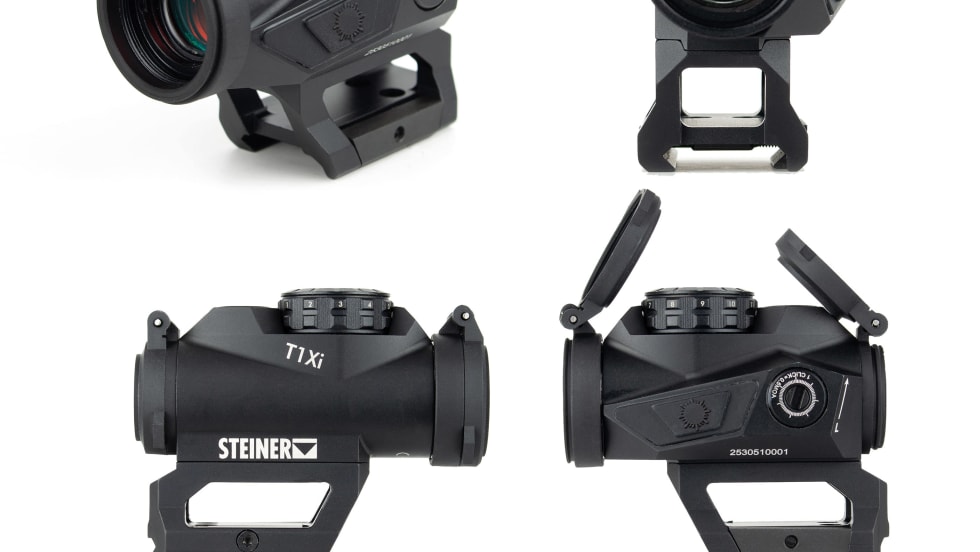

Range TimeI set up my targets at 25 yards to do my initial sight in with the EOTech and I was impressed with the tiny groups that the PLR-16 produced. Once I had the sights regulated, I moved the targets back to 50 yards and concentrated on adding pressure to the trigger until the shot broke.

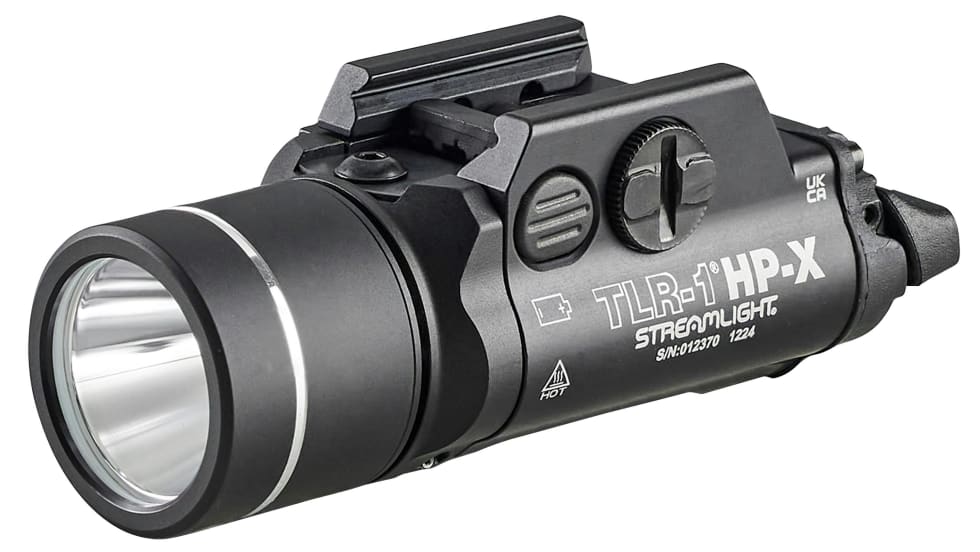
Detty mounted an Insight Technologies M6X light/laser combination on the handguard's Picatinny rail.
My Kel-Tec pistol has a long and heavy seven-pound pull, and I did my best to keep the inner dot of the larger circle of the EOTech on the one-inch pasters that I used for targets. I was amazed that all of my groups measured under 1.5 inches for a five-shot group with the best group clustering under an inch. Over the years I have tested many AR-15 carbines that couldn’t match that level of accuracy, and it is important to remember that this is a pistol, weighing less than half of what the carbines weigh and it only has a nine-inch barrel.
After adjusting the sling, I fired the PLR-16 in some rapid-fire exercises. Muzzle climb is noticeably more than that of a .223 carbine, and it did make me wish that I could install the verboten vertical foregrip. With some practice I was able to get the time between shots down without sacrificing hits. Compared to other AR-style pistols that I have fired this particular gun has much better handling characteristics thanks to its lack of protruding buffer tube. The pistol is only 18.5 inches long and well balanced.
I took the PLR-16 out for a session of night shooting to see just how effective the Insight M6X laser/light is. I had a shooting dummy set up at about 30 yards and fired about 10 shots, all from the hip, using only the laser dot as an aiming point. I fired as fast as I could center the dot on the chest and press the trigger. All 10 shots landed in a cluster about the size of my fist. I could clearly see the laser out to 100 yards, even when it was used in conjunction with the light. I think the combination of the EOTech and Insight M6X light/laser combination will effectively handle just about any tactical scenario.
Muzzle BlastOne thing that a shooter will have to accustom himself to is the PLR-16’s rather substantial muzzle blast. I never noticed it when I was using the EOTech to fire groups but, when I fired a few rounds from the hip, the large orange fireball became evident. Kel-Tec threads the muzzle of the pistol’s barrel with a standard thread pitch so that any aftermarket flash hider for an M-16 can be used on their gun, but it’s obvious that not all of the powder is getting a chance to burn in that nine-inch barrel.

Because of its mere nine-inch barrel length, the PLR-16 has significant muzzle blast, as this nighttime photo illustrates.
During my bench shooting, I noticed some unburned powder forward of my shooting position and that made me wonder just what the shooter is giving up by going to a nine-inch barrel rather than a 16-inch carbine barrel. When I chronographed the PLR-16, I took along an AR carbine for comparison. What I found is that the shorter barrel gives up about 16 percent in velocity. But that translates into a loss of 30 percent energy—not an insignificant number and something that should be factored into the equation if the Kel-Tec is being considered for duty use.
However, the PLR-16 produces far more energy than that of a typical duty sidearm. For example, my SIG 229 fires a .40 S&W, 165-grain Hydra-Shok bullet at 947 feet per second. That round produces 347 foot-pounds of energy. In contrast, the PLR-16 fires a Winchester 55-grain FMJ bullet from its nine-inch barrel at a velocity of 2,647 feet per second and produces 855 foot-pounds of energy. That’s 59-percent more horsepower for the PLR-16, compared to the .40 S&W SIG.
I finished my evaluation before ever cleaning the PLR-16, and I fired close to 1,000 rounds. I even fired some of the new Wolf 62-grain ammo and had no extraction problems with the steel-cased ammunition. In fact, I didn’t have any stoppages or malfunctions during the course of my testing. Disassembly of the pistol is easy and requires no special tools. One thing that I did notice was that, even after all of those rounds, the inside of the receiver was far from being dirty enough to induce a malfunction.

The PLR-16 disassembles easily without any special tools.
The PLR-16 is a compromise weapon: it can’t do everything that a full size carbine can do, but it sure can do a lot more than a typical police pistol can. When the confines of a building or vehicle inhibit an operator’s movement or when any environmental factors make using a carbine difficult or impossible, the Kel-Tec PLR-16 provides the user with more power, accuracy, and capacity than a duty sidearm can supply. My only real criticism of the pistol is the placement of the safety, and it may not be a problem for other more dexterous individuals. I am impressed with its accuracy and reliability and its extreme portability.
Mike Detty is an NRA-certified rifle, pistol, and shotgun instructor. A certified rangemaster and competition shooter, Detty served as an officer in the U.S. Marine Corps and holds a degree in criminal justice from the University of Arizona.