The lead story was the same on nine local television stations, four national networks and CNN: While conducting a "routine" vehicle stop, an officer was critically wounded and the suspects unknown. The five-year law enforcement veteran left behind two sons and a wife who was expecting their third child. We have all heard it and seen it, but are we learning from it?
While many police academies address officer safety issues in "scenario training," some are going one step further and establishing officer survival schools. Designed to provide additional street survival skills to officers in the field, they extensively use training scenarios based on deadly mistakes that too many officers make each year. From vehicle stops to burglary calls to where to write reports and take Code 7, officers get to rethink old habits and hone their decision-making skills.
One of the most dangerous issues facing officers today is the attitude that develops with perceived routine tasks. Seventy percent of on-duty officer murders occur during traditional calls and stops (traffic and pedestrian contacts, etc.). The key to surviving sudden and deadly attacks is the safe approach of every contact-no matter how repetitious it may seem.
Breaking Bad Habits
Officers fall into routines and become complacent; it takes only a second to fall into a dangerous situation, according to Joe Offutt, a retired sergeant with the Los Angeles Sheriff's Office (LASO) and current instructor of LASO's Officer Survival Course. Just like in the academy, officer survival school students are encouraged to think safety first. To promote this, the school gives patrol officers the following guidelines:
- Be Spontaneous-In some cities, people can set their clocks based on a police car passing by. One business owner commented he could always tell it was 3:30 p.m. because four patrol cars would drive past his store toward the station every day at that time.
While on patrol, vary your routes, and approach locations from different directions at various times. Try to be unpredictable; force yourself to alter your patterns. Try going down a street, and turning around and coming back. Take a lesson from executive protection specialists: Terrorists like a predictable target; they know when and where to set up.
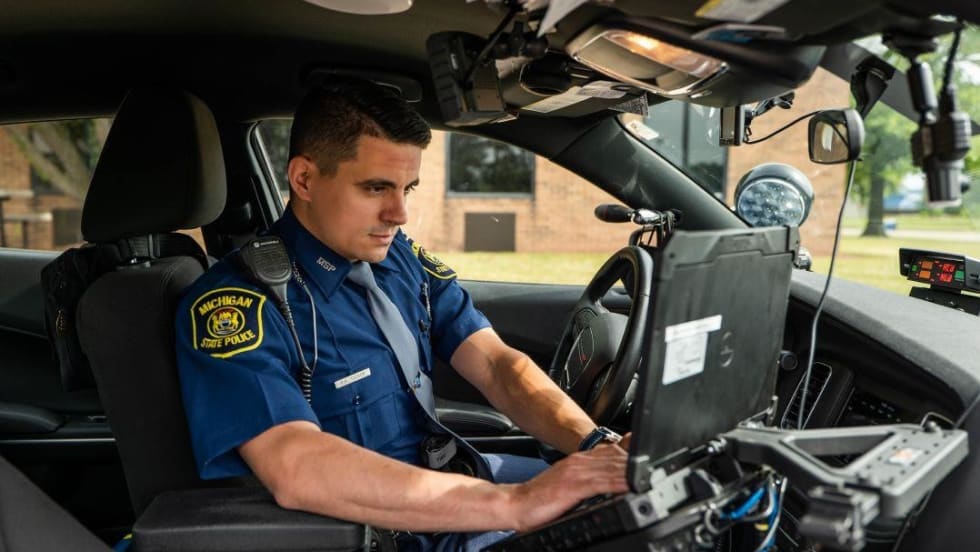
- Be Alert and Aware-We have all heard the horror stories about officers walking into crimes in progress, simply because they did not look inside before they entered. Offutt cites other cases where officers pulled up to stoplights reading the Mobil Display Terminal (MDT) and did not look at the cars next to them.
While on patrol, be aware of who and what is around you; avoid being distracted for very long. Drive with your passenger doors locked. And use the No. I (or inside lane) or far right lane while on patrol. This gives you an escape route to the side during an ambush situation. Driver training instructors often talk about space management and emphasize having an escape route while on a freeway, but this applies while on a street as well. In addition to avoiding an accident, this technique can help avoid an ambush.
At lights, stop so that you can see the front tires of the vehicle in front of you, also allowing maneuvering room in a crisis situation. Also, when weather dictates that you must leave your vehicle running at a call, always lock your doors.
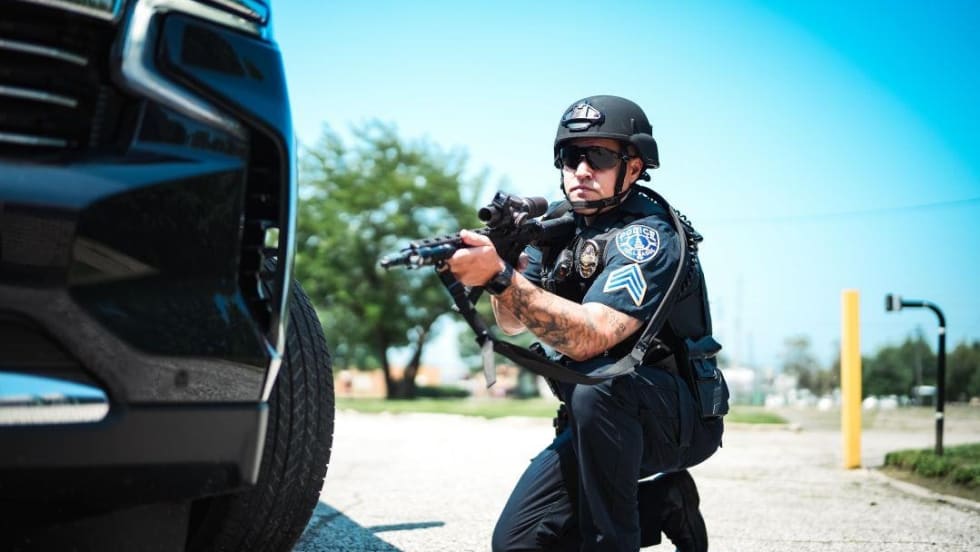
- Use Available Cover-Offutt cites a basic military rule of combat: Take cover, not just concealment. In 80 percent of life-threatening situations, officers fail to use the cover that's available, or they abandon it. Returning fire instead, officers fail 80 percent of the time to hit anything. Returning fire is often important, but officers must first find good cover if possible.
Cover is a solid object that will resist or prevent a bullet from penetrating it. Concealment is an object that simply may hide you from view-it may not be good cover. Bushes, boxes and motorcycles are not cover. For the officer driving a patrol car, the vehicle offers a fair amount of protection if parked correctly. Establish a safety corridor; park the vehicle offset to the left of the suspect's vehicle, with the wheels turned toward the street.
A few agencies have taken additional safety steps by installing armored doors and glass on vehicles. Vehicle door panels are reinforced with ARMET, an opaque, armored plated and bullet-resistant glass; windshields arc also replaced with bullet-resistant transparent glass.
Norm Smith, president of Protection Development International Corporation (PDIC) in Southern California, which makes armored vehicles, says that armor is becoming more cost effective for law enforcement agencies to purchase and has been well received by officers.
- Maintain Control-When confronted with multiple suspects, immediately call for backup. Many officers, for a variety of reasons, fail to call for a backup unit. In one recent incident, two reserve officers entered a known high-risk apartment complex and encountered four parolees wearing heavy overcoats. No backup was requested, and the officers left the safety of their vehicle to obtain identification from the suspects. Their sergeant arrived on- scene, just as the suspects started reaching inside their overcoats.
Don't fall victim to complacency, and don't let the suspects control the situation. Tactical communication, distinct commands and a good safety zone all aid in maintaining officer control. Use your vehicle as cover, and your spotlights to illuminate the scene. From cover, take control: direct the suspects to a search position that places them at a disadvantage. And call for backup.