
State restrictions vary. For example, Florida has a long list of places where license holders cannot carry firearms. Included are locations such as police stations, jails, courthouses, schools-including college and university facilities-nonfirearms sporting events, bars, airports and any place where carrying a firearm is prohibited by federal law. Even individuals who have a concealed firearms license may not carry a firearm to one of these restricted places.
Like many states, Georgia also prohibits firearms at public gatherings. The emphasis of such a law is on the gathering of people, not a specific place or location (State v.Burns). Law enforcement officers should be aware of persons near a gathering since the offense of carrying a firearm can occur in the parking lot or in close proximity to the gathering (Hubbard v. State).
Duty to Inform
Civilians generally have no legal duty to inform a law enforcement officer that they are legally carrying a concealed firearm. There is no offense in this, and with law abiding civilians, there is generally no danger to the officer. However, it may be a statutory duty for a civilian who is stopped, detained, questioned or addressed in person by a law enforcement officer, to immediately inform the officer that he or she is carrying a concealed handgun under a permit. In these cases, the officer may secure the firearm during the contact if he feels it is necessary for his own safety or that of others.
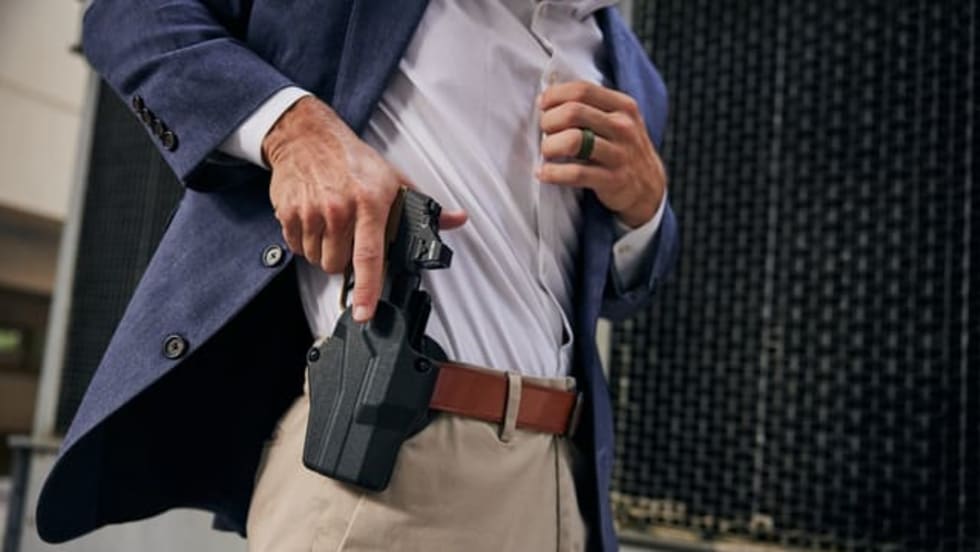
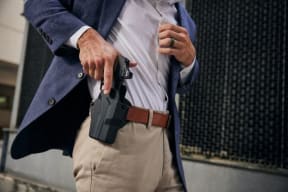
How do you know, in the absence of a search, commission of a crime or statutory duty to report, that a civilian is carrying a concealed firearm? You don't. Unless a civilian is careless and lets a firearm print against clothing or exposes it when clothing is pulled away, it won't be seen.
In Byford v. State, an officer saw the butt of a firearm protruding from the defendant's pocket and made a valid arrest. Likewise, an officer had the duty to arrest a suspect when the officer asked him for identification and saw a revolver in clear view when the suspect stepped from his automobile (AI/en \'. State).
Generally, a firearm is considered to be concealed if it cannot be seen by an ordinary, casual observer. It does not have to be absolutely invisible to other persons (Carpenter v. State). This applies to concealed, firearms carried on a person or in a motor vehicle.
For the offense of carrying a concealed firearm without a license or permit, an officer need not be concerned with any reason that a person gives for carrying the weapon. Feelings of a need for self-defense or duress, and the amount of force used against the person are not relevant in a charge of carrying a concealed firearm without a permit (State v. Hope). The person must prove that he or she has a license or permit (Washington v. State). Furthermore, a person's admission to a law enforcement officer that he has no permit to carry a concealed firearm is admissible into evidence (Johnson v. State).
It is an offense to fail to carry a permit or license along with a concealed firearm. You can charge a person with this offense in accordance with the specific requirements of your state statute. For example, in Com v. Sheridan, an officer found a gun while frisking the defendant. When asked, the defendant refused to to say if he had a license to carry the weapon. In that case, there was probable cause to charge the defendant.
Safety First
More states are allowing civilians to carry concealed firearms for self-protection, which means that more law enforcement officers will encounter legally-armed civilians. For the most part, these armed civilians will go unnoticed. You will probably only encounter such a person if you receive a complaint from someone who saw the firearm or a bulge in someone's clothing. In such cases, you should probably warn the carrying individual to be more careful in keeping the firearm concealed. If the civilian is in a location where such carry is not permitted, you are entitled to make an arrest.
An unlicensed person who carries a concealed firearm is a criminal. Take all the precautions necessary to ensure a safe arrest.
Donna Lea Hawley is the president of Paramount Training Center and a former attorney who teaches and writes about concealed weapons and other areas of law.