
Photo: Mark W. Clark
 |
Even in the good economic times of the last decade, it was a problem. Ammunition costs were outpacing police training budgets. No one's quite sure why the ammo became so precious. Some point to demand from the military; some say the Chinese drove up the price with their appetite for copper; still others believe the price of ammo went up just because the manufacturers had an opportunity to raise it.
Regardless of reason, the price of ammo skyrocketed and police training budgets were not ready for it. Former San Diego sergeant and rangemaster Dave Douglas remembers when the price of ammo zoomed 40 percent around 2003, shocking his training budget. Douglas retired from the San Diego PD before the real ammo shock. Now he serves as rangemaster for a tiny police department in central Colorado.
That Colorado agency has only six officers. So Douglas has now experienced the ammo crunch on one of the nation's largest agencies and one of the nation's smallest. He says cost per round is much greater at the small agency than it was in San Diego. "It's a few thousand rounds for small agencies. It's a few million for larger metro agencies," he explains.
The bottom line is that the cost of ammo has police agencies scrambling for ways to cut their firearms training budgets while still maintaining standards. Some are walking a very dangerous line where their solution to the problem has been to cut back on firearms training opportunities both for in-service personnel and for recruits. Others are looking for ways to achieve the same training goals without sending ammo down range.
Dry Fire
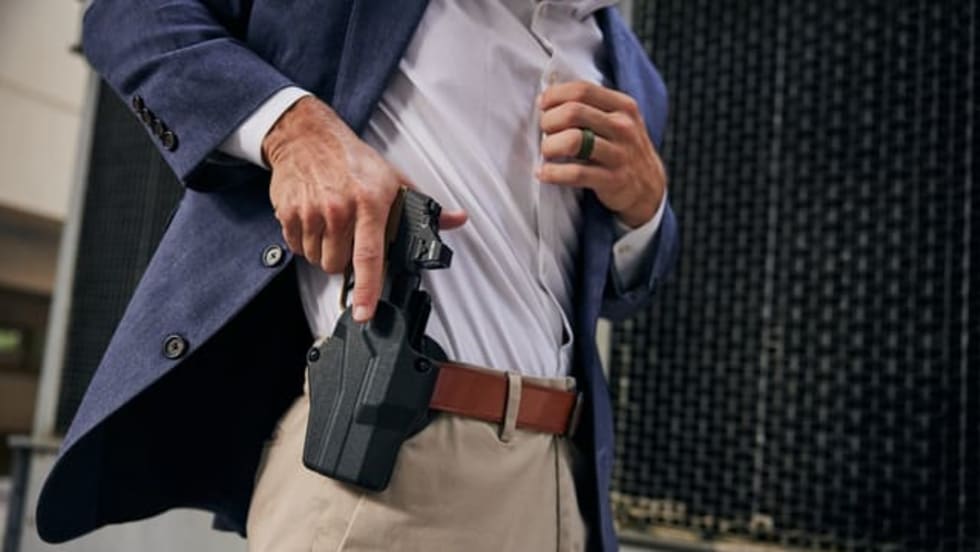
Noted handgun trainer, firearms author, and retired Montgomery County (Ohio) Sheriff's Office lieutenant Dave Spaulding says many agencies could save a lot of money on ammo by teaching recruits using dry fire. "Many essential skills such as reloads, clearing malfunctions, and drawing from the holster can be done dry fire," Spaulding argues.
Spaulding says it takes about three days and 500 rounds to make most recruits proficient enough to qualify with a handgun. But trainers could reduce the number of rounds down range substantially by teaching students with dry fire. "You need live ammo for trigger control, reset, and follow-up shots," he says. "Otherwise, you can use dry fire."
So if dry fire would accomplish the training goals much more cheaply why is it rarely used? "I think my gut feeling is that firearms instructors are concerned about the entertainment factor,” Spaulding says. “To have students standing there doing dry fire drills without anything going bang is not entertaining."
Many agencies may soon find themselves unable to provide such entertainment. Shrinking tax revenues, ballooning gas prices, and the rising cost of ammo have law enforcement firearms training programs stretched to the breaking point and looking for alternatives to costly training ammo.
Laser Guns
One alternative that many firearms trainers are beginning to champion is the idea of using lasers for essential skills training such as trigger control.
Back in 2009, research was conducted at the Federal Law Enforcement Training Center (FLETC) in Glynco, Ga. Instructors at FLETC worked with two groups of students who had little or no experience with handguns. Half of the students were trained with live ammo and the other half with guns fitted with lasers inserts. Both groups of students were then required to qualify with live ammo. The difference in performance between the two groups was statistically insignificant. FLETC duplicated these results using both local college students and U.S. Marshal Service recruits.
The FLETC study shows that much of a basic firearms training program can be accomplished without firing live ammo. And that's good news for the makers of laser training pistols and laser training devices.
One of the most popular laser systems for firearms training is the SIRT (Shot Indicating Resetting Trigger) Training Pistol sold by Next Level Training. The SIRT Training Pistol is designed to emulate the Glock 17/22 pistol in weight and ergonomics. It has an adjustable resetting trigger, and it has dual indicator lasers to help students learn how to prep the trigger and to see how trigger control affects each shot.
Bill Heutmaker of Next Level Training says the SIRT pistol is becoming more and more popular with law enforcement. "They are looking for viable products for maintaining muscle memory and teaching weapons manipulation without firing a bunch of ammo," he says.
SIRT Training Pistosl list for about $220 to $450. That may seem high for an emulated gun, but training officer Brian Buchanan of the Hamilton (Ohio) Police Department says SIRT guns offer a quick return on investment. "We are doing a lot of things that we would have done live fire using the SIRT pistols," he says. "We purchased them last year and that initial investment has already paid off."
The SIRT pistol cannot fire live ammo. So it can be used safely in places where a real handgun cannot be used. "I shoot Styrofoam cups in my office sometimes," Heutmaker says. "You don't have to have a target system to make it work."
While a range system is not required to use the SIRT. There are companies that are developing reactive targets for the training gun. Heutmaker says SIRT users will soon have access to a variety of target systems, including poppers and shoot-no-shoot simulations. Some of these targets will be sold on DVDs that users can show on their TVs, others for digital projectors, and others for inexpensive simulator systems. Heutmaker says prices for these targets and systems will likely range from $30 to more than $1,000.