
Limit the Mobility
Once you are behind the person, you want to limit his mobility. To do that, you have him widen his stance. The amount varies, because this part of the technique is also used to offset a disparity in height between a taller person and a shorter officer. Even if there is minimal height disparity, you want to have the suspect widen his stance because this adversely affects or limits his mobility.
To initiate movement from a widened stance (such as lunging forward or turning around preparatory to attack) the human body will instinctively move one or both legs toward its centerline. This movement creates more time for you to perceive resistance and react appropriately. In combative situations, fractions of a second can mean the difference between an advantage and a disadvantage.
Control the Hands
Of the personal weapons aggressors can use to hurt you, their hands should be your greatest concern. A suspect's hands can be used to strike, grab, choke, and manipulate weapons. Are you better off controlling one or both hands? Controlling only one hand leaves the other hand free to assault you or manipulate a weapon. Therefore, you should control both hands.
One way some officers attempt to do this is to have the person place her hands on a stationary object, such as a wall or the hood of a car. However, this does not control the hands, it merely isolates them. Worse, this gives her two more points of stability and balance from which to initiate an attack.
Another common method is to have the person place his hands in the small of his back. A variety of methods can be used to grab and hold both of the suspect's hands from this position. Although better than the first example, this method is not the optimal way to control the hands, for three very important reasons.
Don't Allow Waistband Access
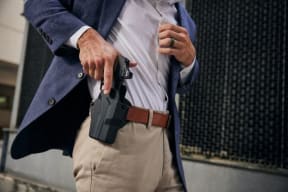
First, knowing what you know about where people are most likely to conceal weapons (I'll call them "hot zones"), I'm sure you'll agree the waistband (front and rear) is at or near the top of the list. This makes instructing someone to put his hands at the small of her back a risky proposition.
Considering human perception and reaction times, you are placing yourself at a tactical disadvantage by giving the person an opportunity to "comply" with your request by moving her hands toward her waistband, a primary "hot zone." If you told her to do it, you must allow that movement. How quickly can you distinguish between a person who is compliant, and one who is moving toward a "hot zone," intending to arm herself? How quickly can you react to the threat? Use a training gun or training knife, and work through some scenarios; you'll see what I mean.
Next, if you agree the rear waistband is one of the high-risk "hot zones," you should avoid obscuring that area with the person's hands. Although proponents of controlling the hands in this location claim they adequately search the rear waistband area, when I make observations in the field, I see just the opposite.
Thirdly, once you have a hold of the person's hands, you can use this connection to your advantage should you need to overcome resistant or combative behavior. How much control can you effect over the person with his hands behind his back at waist level? Some, but not as much as you might think. Advocates of this hand control position suggest disengaging from the person by shoving her forward.
As I mentioned before, you are innately wired for forward movement. Throughout our lives, we crawl, walk, run, and stumble forward. Our central nervous systems develop an orientation bias toward forward movement. We become adept at recovering our balance moving forward, but not backward. An aggressor's ability to recover her balance directly corresponds to her ability to re-initiate an attack. You can use this to your advantage, controlling an aggressor's balance by breaking her vertical plane in a backward direction, rather than forward. To do this most effectively, the subject's hands should not be at waist level.