
FREE e-Newsletter
Important News - Hot Topics
Get them Now!
Weapons
Bookmark and Share
SHARING TOOLS   | Email Print RSS

August 28, 2007

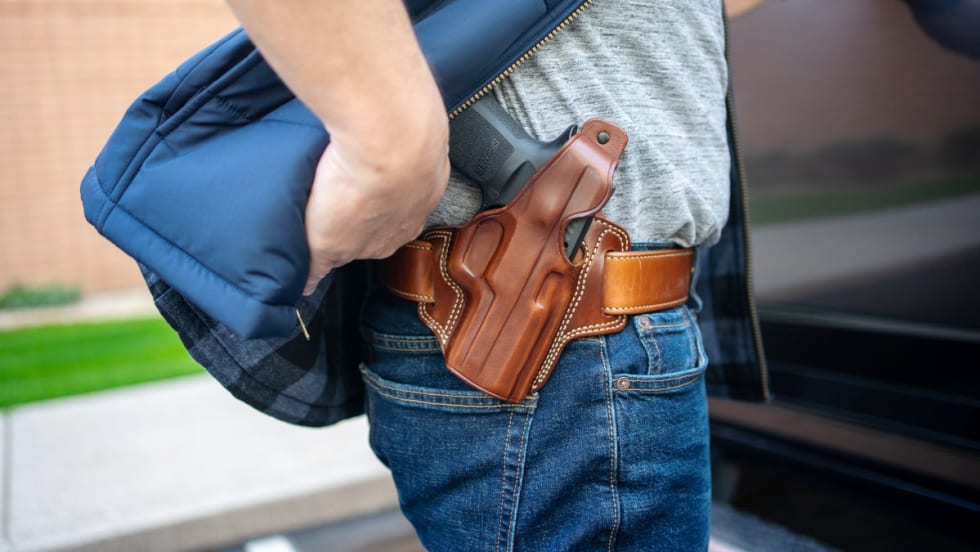
Are You Safer with a More Complicated Duty Weapon?

Easy-to-use pistols are best for law enforcement duty guns.

by Rob Pincus

There are probably two or three camps when it comes to what type of duty pistol is the safest for the average patrol officer. I am going to lump together the nuances of the manually operated safety and the de-cocker camps together for the purposes of this article. I am also going to lump the double-action only (DOA) and “safe action” camps together as well.

There are those that would have you believe that you are safer if your firearm is more complicated and there are those, I am one of them, who argue steadfastly against that assertion because the primary purpose of your firearm is self-defense or the defense of others. If your duty sidearm was designed or purchased with any other thought in mind, you were done a disservice

Regardless of what some may have you believe, you are in a lot more danger from the bad guys on the street who can and will do serious harm to you if you can’t defend yourself efficiently than you are from your own sidearm, especially if you are well trained in its use.

There are those who will argue that it doesn’t take any extra time for a proficient officer to engage a lethal threat with a firearm that has a manual safety (such as a 1911 design or a Beretta 92 carried with the safety engaged). While this may be true, it is certainly not true that most trained officers can return those firearms to their safe mode as quickly as they could return a firearm without such a device to its safe mode.

The reason should be obvious: double-action/single-action and single-action-only pistols are designed to be in their double action or on safe mode, respectively, when they are not actively being shot. To engage in any other activity with these guns in single action is potentially more dangerous because the firearm is in a condition where the trigger travel is short and the pressure needed to engage it is light.

So even if we take away the “from the holster” delay/distraction that these guns can and do suffer from, we run pretty squarely into a more complicated situation if after a shooting, or deciding not to take a shot, the officer needs to do anything else, including re-holstering quickly and safely to deal with the aftermath of a shooting incident.

The “safe-action” type striker-fired and double-action-only pistols do not suffer from either the extra physical action at deployment or the added cognitive and physical necessities after a shooting to be used effectively.

All other things being equal, less effort and time to conduct any given activity equals higher efficiency. When you are dealing with a critical incident that may involve the use of lethal force, you should strive to be as efficient as possible. Having tools that are fundamentally more efficient can help you achieve that goal.

Personally, I prefer any of the less complicated modern pistol designs such as the Glock, Smith & Wesson M&P, or Springfield XD over any other design for patrol officer and special reaction team use. Even the DAO firearms, which are just as simple to use, fall behind in the category of efficiency because of their heavy and unnecessarily long trigger pulls.

While these may not make a difference during typical close quarters defensive shooting, they do have an adverse affect on the officer’s ability to shoot at the extreme end of defensive precision and deter frequent realistic practice.

Safe handling of a firearm is a training issue, not an equipment one. A more complicated firearm is harder to train with and less efficient to use. So ultimately, it could end up putting you in much greater danger than a simpler design under the same circumstances.

Tags: Duty Pistols, Firearms Training, Glock, Smith & Wesson, Springfield Armory

View/Write Comments


Other Recent Blog Posts

Oral Interview Tips
Once you find some questions, practice them in front of someone and make sure to do it...
Foot Pursuits: A Runaway Policy?
What exactly was this "new bar" for performance? How was one to be evaluated against it?...
Officers Praise Safety Features and Ergonomics of Sleek New Ford Patrol Vehicle
Ford unveiled the vehicle at a private fleet event at the Las Vegas Motor Speedway. Law...
Beware of "Embellishment"
I was always told by my sainted Irish mother that if you tell the truth the first time you...
Tell Me Lies, Tell Me Sweet Little Lies
As you venture around your patrol area, strike up conversations. Don't have any particular...

Comments (16)

SIGN IN TO LEAVE A COMMENT

NOT A MEMBER YET?

Displaying 1 - 10 of 16
     

sledgehammer67 @ 8/29/2007 1:23 PM

Words well-spoken. Duty weapons demand two things--rerliability and simplicity. Both are absolutely critical, and not to be compromised on. While specialized weapons systems have their place in the world, many of the features manufacturers place on weapons are designed to sell weapons, not save lives. Much in the way that most fishing lures were designed to catch fishermen, not fish...The KISS principle works!


Oldcopper @ 8/29/2007 2:44 PM

Ah, so good to see nothing ever really changes. For those too young to remember, there once was a land where the wheelgun ruled. I carried a revolver for half of my police career, switched to a Beretta, now a GLOCK. When I draw my weapon I don't need 15 newfangled switches, knobs, or buttons to push. My safety is my trigger finger. Training, training, training. I am a pistol, shotgun, and patrol rifle instructor.


psc2857 @ 8/29/2007 9:26 PM

This discussion will soon be entering its 2nd century, and the author makes some interesting points, but only one that cannot be argued or denied: "Safe handling of a firearm is a training issue, not an equipment one."


CPD169 @ 9/1/2007 7:25 AM

I will have to differ with the author in regards to the 1911 and DA/SA Sig Sauer type pistols being somehow too "complicated" to re-engage the safety before reholstering, or when one knows they won't be firing their pistol. I've carried a 1911 in Condition 1 for 24 years and carried one on duty in uniform for half of that time. I've also carried Glocks. I know several officers who carry and swear by DA/SA Sig Sauers with the hammer drop feature. I've never known one who carried a 1911 or Sig DA/SA who had any difficulties in rendering their pistols safe to reholster. On the other hand, I've known and been present at more than one officer having an unintentional discharge with Glock pistols, especially right after switching to them from revolvers.

I think you'd be hard pressed to convince the FBI's Hostage Rescue Team, LAPD SWAT or the host of other LE units who issue the 1911 that they're "Too complicated' or "too slow." I also have no doubt that you'd be hard pressed to convince the IDPA and IPSC shooters of that as the 1911 is prolific in both of those high speed arenas. Granted no one is shooting at the participants but they're under stress nonetheless.

I will totally agree with the author about the Berreta, S&W, etc. type of DA/SA with the un-natural slide mounted hammer drop/safety. They should never be carried with the safety on. There have been documented cases of LEO's who've been killed trying to get the safeties off of those type of pistols over the years. I personally have no use for them.

Jusy my .02 worth.


R. W. Stalcup @ 9/19/2007 5:55 AM

I began my law enforcement career back in the dim recesses of the 1960s. In the agency where I was employeed autos were frowned on. Any wheel gun 38 caliber and above was okay as long as it was a Colt or Smith & Wesson. Over the years I have carried any number of Autos and wheel guns on and off duty. All will work if the user is properly trained. My favorites are the 1911 closely followed by Glock. Tho I have owned and carried a number of DA/SA's and shot well with all of them I never really liked the concept. Whatever you chose or is chosen for you train train and train some more. This will probably entail the fact you are going to have to purchase some of your training ammo. You may gripe about what it will cost you butw what is your life worth?


jbustamante @ 11/9/2007 11:25 AM

I've carried a Sig 220 DA/SA for a while. Now with the addition of a Tac Light there's way too much going on. On a night shoot qualification, I fired, deactivated the light and holstered a cocked 220. I am sending the pistol to be changed to a DAK trigger.

Good article!


deltaalpha @ 11/15/2007 1:28 PM

Believe that a company that uttilizes a quick release bar to a harden style holster with perhaps biometrics such as a two digit combo lock or perhaps thumb print scan like on the safe boxes will have a very good seller to law enforcement or other forms of security even

perhaps detention centers or Prisons. It makes sense and will deter theft of firearm in a take over situation.


Billy Kidd @ 12/7/2007 12:06 PM

I also have to disagree with the author as to the ability to quickly reholster a typical "cocked/locked" semi-auto. I train and teach, if you carry a semi-auto with a manual safety (specifically a 1911 type) then you only disengage the safety as you push towards the target and complete sight alignment prepatory to firing. I also recomend you re-engage the safety as you return to low ready, prior to re-holstering or scan/cover. You only have to see/have one deglegent discharge to believe in manual safties.


Kurt Taboga @ 1/4/2008 8:30 AM

Great information. I have been a police officer for over twenty-five years. We started with wheel guns, went to S&W semi-autos, and finally switched to Glocks. As a firearm instructor for the Department and local Police Academy, I've witnessed all types of problems with complicated weapons systems with all types of shooters. In the heat of combat, "simple" is often better. Training can fix most problems, but training time is usually limited. Most cops aren't "gun guys" like me, and won't train on their own time. Give them something they can use well without a lot of thought.


jamesgroody @ 1/24/2008 7:36 AM

in referance to CPD169 comment he said a mouthfull.... FBI hostage rescue, LAPD Swat, IDPA/IPIC shooters, etc. all of which are extremely highly trained in weapons tactics etc.

should carry the a"baddist weapon" they can hit with.

However... it has been my observation as a 20 year police firearms instructor, the "normal cop" (oxymoron), goes to the range only when they have to, prior to shooting want to know how many hours of over time or comp time to put on the slip, expect a meal, and complain that there should be extra trustees to pick up the brass... for these people the simpler the better.

If I could get them to reload their magazines on time, and carry enough bullets to complete the course of fire...that would be a big deal a a great day at the range!!!

please do not complicate the situation with a de-cocking lever, a "cocked and locked" carry

or a DA?SA weapon..

Next
Get Your FREE Trial Issue and Win a Gift! Subscribe Today!
Yes! Please rush me my FREE TRIAL ISSUE of POLICE magazine and FREE Officer Survival Guide with tips and tactics to help me safely get out of 10 different situations.

Just fill in the form to the right and click the button to receive your FREE Trial Issue.

If POLICE does not satisfy you, just write "cancel" on the invoice and send it back. You'll pay nothing, and the FREE issue is yours to keep. If you enjoy POLICE, pay only $25 for a full one-year subscription (12 issues in all). Enjoy a savings of over 60% off the cover price!

Offer valid in US only. Outside U.S., click here.
It's easy! Just fill in the form below and click the red button to receive your FREE Trial Issue.
First Name:
Last Name:
Rank:
Agency:
Address:
City:
State:
Zip Code:
We respect your privacy. Please let us know if the address provided is your home, as your RANK / AGENCY will not be included on the mailing label.
E-mail Address:

Enewsletter Subscription:
Police Magazine